
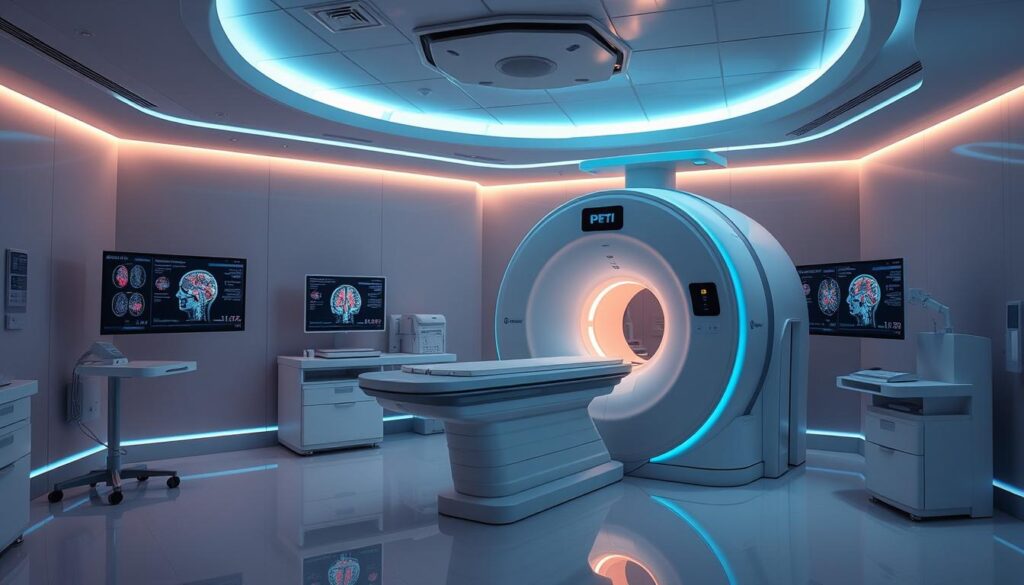
PET scans are a game-changer in medical imaging. They provide detailed insights into your body’s metabolic processes. This advanced technique uses radioactive tracers to create comprehensive pictures of your organs and tissues1.
These scans can spot diseases early on. They often detect issues before CT or MRI scans can1. Doctors use PET scans to investigate various health conditions2.
The procedure is straightforward. A small amount of radioactive tracer is injected into your vein. It then travels through your body, gathering in high-activity areas1.
A typical scan lasts about 30 minutes. It gives doctors vital information for diagnosis1.
Key Takeaways
- PET scans are advanced nuclear medicine imaging techniques
- They can detect diseases before traditional imaging methods
- Used for diagnosing cancer, heart, and brain conditions
- Involves using radioactive tracers for metabolic imaging
- Typically takes around 30 minutes to complete
What is a Positron Emission Tomography (PET) Scan?
Modern medical imaging has transformed how doctors understand complex health conditions. PET scans are a powerful diagnostic tool that surpasses traditional imaging techniques. They offer unique insights into the body’s inner workings.
PET scans provide a remarkable view of your body’s metabolic activity. They use special radioactive tracers to visualize organ and tissue function. This technology offers insights at the cellular level3.
Understanding PET Scan Technology
The technology behind PET scans is fascinating. Here’s how they work:
- A small amount of radioactive tracer is injected into your bloodstream3
- The tracer takes approximately one hour to be absorbed by your body3
- Special scanners detect gamma rays emitted by the tracer
- Detailed images of organ and tissue function are created
Key Applications of PET Scans
PET scans are incredibly versatile, supporting critical medical diagnostics:
| Medical Condition | PET Scan Application |
|---|---|
| Cancer | Assess cancer spread and monitor treatment response3 |
| Alzheimer’s diagnosis | Evaluate brain function and detect early neurological changes |
| Cardiac assessment | Evaluate blood flow and cardiac viability assessment3 |
“PET scans offer a unique glimpse into the body’s metabolic processes, providing physicians with unprecedented diagnostic insights.” – Medical Imaging Research Institute
The radiation exposure during a PET scan is minimal. It’s comparable to most CT scans and typically disappears within 2-10 hours3. This makes PET scans a safe and effective tool for understanding complex health issues.
Distinguishing PET Scans from Other Imaging Techniques
Unlike X-rays or CT scans that show structural details, PET scans reveal functional information. They detect areas of metabolic activity in the body. This makes them valuable for cancer detection, Alzheimer’s diagnosis, and cardiac assessment.
Your doctor might recommend a PET scan when other imaging techniques fall short. PET scans can provide a more complete clinical picture when needed.
Preparing for Your PET Scan
Careful preparation is crucial for accurate PET scan results. Your medical team will provide specific instructions for your health needs. Proper preparation minimizes radiation exposure and ensures high-quality imaging4.
What to Expect Before the Scan
You’ll need to follow important guidelines before your PET scan. The procedure involves dietary restrictions and preparation steps.
- Inform your healthcare provider about all medications
- Discuss any medical conditions or allergies
- Prepare for potential transportation arrangements
Dietary Restrictions and Guidelines
Fasting is crucial for an accurate PET scan. Patients should follow a specific diet before the examination.
- Consume a low carbohydrate diet 12 hours before the scan5
- Focus on high-protein foods like meat, eggs, and tofu4
- Avoid nicotine products and caffeine 24 hours before the appointment5
Special Considerations for Diabetic Patients
Diabetic patients require extra attention. Your medical team will guide you on managing insulin and blood glucose levels. The target blood glucose range is typically between 70mg/dL and 200mg/dL5.
| Dietary Recommendation | Timeframe |
|---|---|
| Low carbohydrate diet | 12 hours before scan |
| Water intake | At least 8 glasses |
| Stop liquid intake | 2 hours before scan |
Remember, careful preparation is key to obtaining the most accurate PET scan results.
Pro tip: Always follow your healthcare provider’s specific instructions, as individual requirements may vary.
During the PET Scan Process
PET scans offer vital insights into your body’s cellular activities. These advanced tools help doctors make accurate diagnoses. Knowing what to expect can ease your mind before the procedure.
Step-by-Step Scanning Procedure
Your PET scan journey begins with a radiotracer injection. This process involves several key steps for accurate imaging and patient comfort:
- Arrival and initial preparation
- Radiotracer injection through an IV line
- Resting period for tracer circulation
- Positioning on the scanning table
- Actual scanning process
Scan Duration and Expectations
A typical PET scan takes about 2 hours from start to finish6. The actual scanning lasts around 30 minutes. You’ll need to lie still on a narrow table during this time.
The process is usually painless, though you might feel slight discomfort. Your medical team will ensure you’re as comfortable as possible throughout the scan.
Patient Comfort Measures
Your comfort is a top priority during the scan. The medical staff may offer:
- Providing blankets for warmth
- Offering music or headphones
- Explaining each step of the process
- Allowing breaks if needed
“Your relaxation contributes to the scan’s accuracy and quality.”
Important Scanning Considerations
| Preparation | During Scan | After Scan |
|---|---|---|
| Limited carbohydrate diet | Remain motionless | Hydrate well |
| 6-hour fasting | Follow staff instructions | Rest and recover |
PET scans can spot cellular changes earlier than other imaging methods7. Your healthcare team will guide you through each step. They’ll ensure a smooth and informative diagnostic experience for you.
Understanding Your PET Scan Results
Decoding PET scan results can be daunting. But knowing the process helps you navigate your healthcare journey better. Radiologists analyze detailed metabolic activities in your scan images.
These experts look for areas of high chemical activity. Such areas might point to potential health issues8. Your doctor will examine metabolic changes and possible abnormalities.
PET scans excel in analyzing complex medical conditions. They help with cancer diagnosis, heart disease assessment, and brain disorder8. Doctors compare these results with other tests for a full health picture9.
Follow-up care is key in understanding your scan results. Your doctor will explain the findings and suggest next steps. You’ll have a chance to ask questions about your results.
Remember, PET scans offer valuable insights. However, more tests might be needed for a definite diagnosis8. Prepare for your follow-up by writing down your questions.
Be ready to discuss your medical history. Your active involvement ensures you grasp your health status fully. It also helps you understand potential treatment options better9.
FAQ
What exactly is a PET scan?
A PET scan is an advanced medical imaging test. It uses radioactive tracers to measure metabolic activity in your body. This test helps detect diseases early by showing how your cells work.
How do I prepare for a PET scan?
Fast for several hours before your PET scan, drinking only water. Wear comfy clothes and remove metal objects. Tell your doctor about medications, allergies, and medical conditions.
If you’re diabetic, you’ll get special instructions. Arrange transportation, as driving after the scan isn’t recommended.
What happens during the actual PET scan?
A radioactive tracer will be injected through an IV line. You’ll rest for 30-60 minutes to let the tracer circulate. Then, you’ll lie still on a table that moves through a scanner.
The scanning takes about 30 minutes. You can relax and even listen to music during this time.
Are PET scans safe? How much radiation will I be exposed to?
PET scans involve a small amount of radiation from the tracer. The exposure is typically low and safe for most patients. The benefits usually outweigh the minimal risks of radiation exposure.
What conditions can a PET scan detect?
PET scans can help detect various conditions. These include different types of cancer, heart disease, and brain disorders like Alzheimer’s. They’re great at finding active areas in your body that might indicate disease.
How quickly will I receive my PET scan results?
PET scan results are usually available within 24-48 hours. A radiologist will interpret the images, looking for highly active areas. You’ll then discuss the findings with your doctor.
Can I have a PET scan if I’m pregnant or breastfeeding?
If you’re pregnant or breastfeeding, tell your doctor right away. PET scans aren’t usually recommended during pregnancy due to potential risks. For breastfeeding moms, other imaging options might be discussed.
How is a PET scan different from other imaging tests like CT or MRI?
PET scans show metabolic activity, unlike CT or MRI scans that show structural details. They can spot cell-level changes before they’re visible on other tests. PET scans are often combined with CT or MRI for better diagnostics.
Source Links
- Positron emission tomography scan – Mayo Clinic – https://www.mayoclinic.org/tests-procedures/pet-scan/about/pac-20385078
- Positron Emission Tomography (PET) – https://www.hopkinsmedicine.org/health/treatment-tests-and-therapies/positron-emission-tomography-pet
- PET scan: MedlinePlus Medical Encyclopedia – https://medlineplus.gov/ency/article/003827.htm
- PET Scan: Procedure, Preparation & Diet – https://www.northshore.org/nuclear-medicine/diagnostic-tests/pet-scan-procedure/
- How to Prepare for Your PET/CT Scan – General Directions – https://www.brownhealth.org/centers-services/pet-ct/preparing-your-petct-exam/how-prepare-your-petct-scan-general-directions
- PET/CT Scan: How to Prepare, What to Expect & Safety Tips – https://radiology.ucsf.edu/patient-care/prepare/pet-ct
- PET Scan: What It Is, Types, Purpose, Procedure & Results – https://my.clevelandclinic.org/health/diagnostics/10123-pet-scan
- PET Scan: MedlinePlus Medical Test – https://medlineplus.gov/lab-tests/pet-scan/
- PET scan Information | Mount Sinai – https://www.mountsinai.org/health-library/tests/pet-scan

