
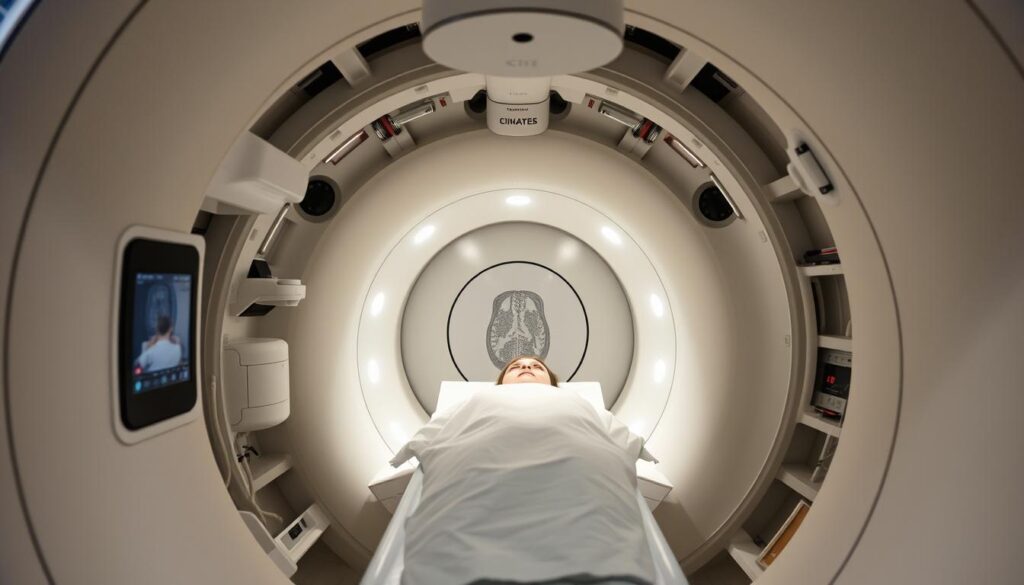
Medical imaging has transformed diagnostic medicine. Magnetic resonance imaging (MRI) leads non-invasive imaging technologies. It offers unparalleled insights into your body’s internal structures1.
MRI scans use magnetic fields and radio waves to create detailed body images. This method avoids harmful radiation exposure. It allows doctors to examine your organs and tissues clearly1.
MRI excels at capturing precise soft tissue images. It provides clear views of your spinal cord, nerves, and muscles. X-rays can’t match this level of detail1.
Doctors use MRI to diagnose complex conditions. These range from brain tumors to joint problems. The technology’s versatility makes it invaluable in modern medicine1.
Key Takeaways
- MRI uses magnetic fields and radio waves for non-invasive imaging
- No radiation exposure during the scan
- Provides detailed images of soft tissues and organs
- Used for diagnosing various medical conditions
- Safe and versatile medical imaging technique
Understanding Magnetic Resonance Imaging (MRI) Basics
Magnetic resonance imaging (MRI) is a powerful diagnostic tool. It lets doctors see inside your body with amazing detail. This advanced scanner provides clear images of soft tissues without harmful radiation2.
MRI uses strong magnetic fields and radio waves to create medical images. The machine aligns hydrogen atoms in your body. It then sends radio waves to disrupt this alignment.
As atoms return to their original position, they send signals. These signals are then processed into detailed images3.
How MRI Technology Generates Diagnostic Images
MRI can visualize anatomy in three distinct planes: axial, sagittal, and coronal3. It offers exceptional soft tissue contrast. There’s no exposure to ionizing radiation2.
MRI provides detailed views of internal structures2. This makes it a valuable tool for many medical diagnoses.
- Exceptional soft tissue contrast
- No ionizing radiation exposure2
- Detailed visualization of internal structures2
Types of MRI Machines
Different MRI machines serve various diagnostic purposes. Your doctor might recommend one of these types:
| MRI Type | Primary Application |
|---|---|
| Closed-Bore MRI | High-resolution imaging |
| Open MRI | Patient comfort for claustrophobic individuals |
| Functional MRI (fMRI) | Brain activity mapping3 |
Contrast-Enhanced MRI Techniques
Some MRI procedures use gadolinium, a contrast agent. It enhances image clarity. Contrast-enhanced MRI helps detect specific conditions by highlighting particular tissues or abnormalities2.
MRI technology continues to revolutionize medical diagnostics, offering unprecedented insights into human anatomy.
What to Expect During Your MRI Procedure
Knowing what happens during an MRI scan can help ease your nerves. Your journey starts with simple prep steps4.
- Remove all metal objects, including jewelry and watches
- Change into a comfortable medical gown
- Discuss any medical conditions with your technologist
You’ll lie on a table that slides into the imaging machine. The procedure is painless but noisy5. You’ll get earplugs or headphones to manage the loud tapping sounds5.
“Remaining still is crucial for obtaining clear, precise medical images,” says radiography experts.
MRI scans can last from 15 to 90 minutes. The duration depends on the area being examined5. Sometimes, you might get a contrast agent through an IV for clearer images4.
Pro tip: If you have claustrophobia, ask about open MRI options or sedation5.
After the scan, you can usually resume normal activities right away. Results typically come in one to two weeks5.
Conclusion
MRI is a game-changing diagnostic tool. It reveals intricate body details without invasive procedures using advanced magnetic resonance techniques. New methods can now spot up to 89% of previously unseen microscopic abnormalities6.
MRI technology keeps improving. New reconstruction techniques boost image quality significantly. These methods work fast, delivering detailed images in seconds7.
These advances mean more precise diagnoses. They have the potential to transform your healthcare experience. Future MRI tech promises even more breakthroughs.
Researchers are exploring new problem-solving techniques. These include better coil sensitivity estimation and motion correction. Such developments will make medical imaging more accurate and efficient7.
MRI offers a safe, radiation-free way to explore your body. It’s a valuable tool for various medical fields. Discuss with your doctor to understand how MRI can help you.
FAQ
What exactly is an MRI?
An MRI is a safe medical imaging technique. It uses a magnetic field and radio waves to create detailed body images. This method doesn’t use radiation, making it safer for examining soft tissues.
How does an MRI machine work?
MRI machines use strong magnets to align hydrogen atoms in your body. Radio waves then disrupt this alignment. As atoms realign, they emit signals that create detailed images.
Most MRI machines use magnets with a strength between 1.5 to 3 teslas. A computer processes these signals to produce high-quality images.
Are there different types of MRI machines?
Yes, several types of MRI machines exist. Traditional closed-bore MRIs offer the highest image quality but can feel confining. Open MRI scanners provide more space for claustrophobic patients.
Specialized machines like functional MRI (fMRI) focus on brain activity. Cardiac MRI machines are designed for heart imaging.
What is a contrast agent, and why is it used?
Contrast agents are injectable substances that enhance image clarity during an MRI. They highlight specific tissues, blood vessels, or abnormalities. This makes it easier to detect tumors, inflammation, or vascular disorders.
While generally safe, your doctor will consider your medical history before using contrast agents.
What should I expect during an MRI procedure?
During an MRI, you’ll remove metal objects and change into a gown. You’ll lie on a table that slides into the MRI machine. The procedure is painless but noisy, so earplugs or headphones are provided.
You’ll need to remain still for clear images. Scan duration varies from 15 minutes to over an hour.
Is an MRI safe?
MRI is considered very safe and non-invasive. It doesn’t use ionizing radiation, making it a low-risk imaging technique. However, you’ll be screened for metal implants or devices beforehand.
Always inform your doctor about any medical devices or conditions before the scan.
Can I have an MRI if I’m claustrophobic?
If you’re claustrophobic, you have options. Open MRI machines provide more space and can reduce anxiety. Some facilities offer wide-bore MRI machines for additional comfort.
Your doctor might also recommend mild sedation to help you relax during the procedure.
How quickly can I return to normal activities after an MRI?
You can usually resume normal activities right after an MRI scan. If you received sedation, you’ll need someone to drive you home. In this case, rest for the remainder of the day.
Your doctor will provide specific post-procedure instructions based on your situation.
Source Links
- MRI (Magnetic Resonance Imaging): What It Is, Types & Results – https://my.clevelandclinic.org/health/diagnostics/4876-magnetic-resonance-imaging-mri
- Magnetic Resonance Imaging (MRI) – https://www.hopkinsmedicine.org/health/treatment-tests-and-therapies/magnetic-resonance-imaging-mri
- MRI Basics – https://case.edu/med/neurology/NR/MRI Basics.htm
- MRI – Mayo Clinic – https://www.mayoclinic.org/tests-procedures/mri/about/pac-20384768
- MRI scan – How it’s performed – https://www.nhs.uk/conditions/mri-scan/what-happens/
- Conclusion – https://mayoclinic.elsevierpure.com/en/publications/conclusion
- Conclusion – https://bigwww.epfl.ch/guerquin/thesis/thesis010.html

