
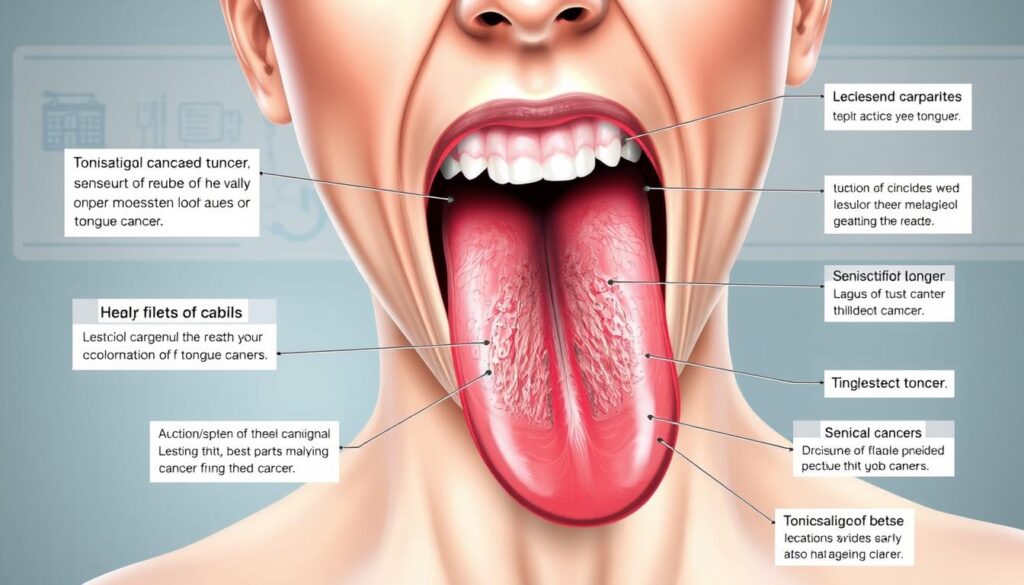
Tongue cancer is a serious head and neck cancer that can greatly affect your health. It’s a type of oral cancer that starts on the tongue’s surface. Early detection and treatment are crucial for better outcomes.
In the U.S., about 18,040 people are diagnosed with tongue cancer yearly. Sadly, around 2,940 may not survive. Knowing the risks and warning signs can help you protect your health.
Certain habits can increase your chances of getting tongue cancer. Smokers are five times more likely to develop it than non-smokers. Combining smoking and drinking can raise the risk up to 30 times.
Key Takeaways
- Tongue cancer represents a small but significant portion of cancer diagnoses
- Early detection dramatically improves treatment outcomes
- Lifestyle choices significantly impact cancer risk
- Regular medical screenings are essential for high-risk individuals
- Understanding symptoms can lead to faster diagnosis
Understanding Tongue Cancer and Its Types
Tongue cancer affects thousands yearly. Knowing its forms and causes helps spot risks early. Quick medical attention is crucial.
Tongue cancer has two main types. Squamous cell carcinoma (SCC) is the most common. It starts in the thin cells lining the tongue’s surface1.
Oral Tongue Cancer vs. Oropharyngeal Cancer
Tongue cancer appears in two areas:
- Oral Tongue Cancer: Affects the front two-thirds of the tongue, typically more visible and easier to detect
- Oropharyngeal Tongue Cancer: Occurs at the base of the tongue, often more challenging to diagnose early2
Key Statistics and Prevalence
Tongue cancer facts to know:
- Men are more likely to develop tongue cancer due to higher rates of tobacco and alcohol consumption1
- Individuals over 45 years old have an elevated risk1
- Approximately 18,040 new cases are expected annually in the United States1
Risk Factors and Causes
Key factors that raise tongue cancer risk:
- Tobacco use dramatically increases cancer risk2
- Human papillomavirus (HPV) infection can significantly elevate potential risks2
- Excessive alcohol consumption
- Weakened immune system
- Poor oral hygiene1
“Prevention is always better than cure. Understanding your risk factors can be the first step toward protecting your health.”
Quit smoking and get regular dental check-ups to lower tongue cancer risk. Talk to your doctor about glossectomy prevention.
Create a personal plan to manage your risk factors. Your health is worth the effort.
Early Warning Signs and Symptoms
Spotting early signs of lingual neoplasm is vital for quick treatment. Your knowledge could be crucial in managing this serious condition3. Look out for these key symptoms:
- Persistent sores or lumps on the tongue that don’t heal
- Unexpected bleeding in the mouth
- Difficulty moving or using your tongue
- Unusual red or white patches on the tongue
Oral cancer is typically diagnosed at age 63. About 20% of cases occur in patients under 554. Speech therapists often spot early warning signs during check-ups3.
“Early detection is your best defense against tongue cancer progression”
Seek medical help right away if you notice these symptoms:
- Persistent throat pain
- Unexplained weight loss
- Numbness in the mouth or tongue
- Difficulty swallowing or chewing
- Swollen lymph nodes in the neck
Squamous cell carcinoma is the most common type of tongue cancer3. See a doctor if any symptoms last over two weeks4.
Remember, your quick action can significantly improve treatment outcomes for a lingual neoplasm.
Treatment Options and Management
Understanding your tongue cancer treatment options is vital. Your medical team will create a personalized approach based on your cancer’s characteristics5.
Surgical Interventions
Surgery is often the main treatment for tongue cancer. Your doctors might recommend different procedures based on the tumor’s size and location.
- Partial glossectomy for smaller tumors
- Complete tumor removal
- Lymph node dissection if cancer has spread5
Radiation and Chemotherapy Protocols
Radiation therapy is crucial in treating tongue cancer. It uses high-energy beams to destroy cancer cells while sparing healthy tissue5.
Chemotherapy often works with radiation for advanced cases. Together, they create a powerful treatment strategy6.
“Customized treatment plans are essential for effectively managing tongue cancer and minimizing potential side effects.” – Cancer Research Experts
Innovative Therapeutic Approaches
Modern medicine keeps improving treatment options. Immunotherapy shows promise for managing recurrent or metastatic tongue cancer6.
Clinical trials offer access to cutting-edge treatments. These may provide new hope for patients6.
Rehabilitation is key to your treatment journey. Specialists can help with speech, chewing, and swallowing challenges after surgery5.
| Treatment Option | Primary Use |
|---|---|
| Surgery | Tumor removal |
| Radiation Therapy | Targeting cancer cells |
| Chemotherapy | Systemic cancer treatment |
| Immunotherapy | Advanced/Recurrent cases |
Conclusion
Oral cancer awareness and prevention are crucial. Globally, 400,000 new cases occur annually, with two-thirds in South and Southeast Asia7. Early detection and lifestyle changes are key in managing head and neck cancer risks8.
Your health choices can greatly affect oral cancer outcomes. The five-year survival rate is 40%, but rises to 80% with early detection7. Quitting tobacco, eating fruits and vegetables, and regular dental check-ups reduce your risk9.
Ongoing research offers hope through new prevention and treatment methods. Studies show that lifestyle choices are vital in preventing oral cancer. Stay informed and practice self-exams to lower your risk8.
Your health is in your control. Screen regularly, know the risks, and maintain a healthy lifestyle. These steps are your best defense against oral cancer.
FAQ
What is tongue cancer?
Tongue cancer is abnormal cell growth on the tongue. It can occur in the oral tongue or the base. Most tongue cancers are squamous cell carcinomas that form in the tongue’s surface cells.
What are the primary risk factors for tongue cancer?
Main risk factors include tobacco use, heavy drinking, and HPV infection. Other factors are male gender, age over 45, and weak immune system. Smoking increases risk by five times.
Combining smoking and alcohol can raise risk 30 times compared to others.
What are the early signs of tongue cancer?
Early signs include a persistent sore or lump on the tongue. Pain or bleeding in the mouth and difficulty moving the tongue are also signs.
Red or white patches, sore throat, numbness, and swallowing problems may occur. Voice changes can happen too. See a doctor if symptoms last over two weeks.
How is tongue cancer diagnosed?
Diagnosis involves a physical exam, imaging tests, and a biopsy. Doctors examine the tongue, throat, and neck. They use special tools to view and sample suspicious areas.
What treatment options are available for tongue cancer?
Treatment depends on the cancer’s stage and location. Options include surgery, radiation therapy, chemotherapy, and immunotherapy. Early-stage cancers may need surgery or radiation alone.
Advanced cases often require a mix of treatments.
Can tongue cancer be prevented?
Prevention strategies include avoiding tobacco and excessive drinking. Good oral hygiene, HPV vaccination, and regular dental check-ups help. Early detection through self-exams and screenings can improve outcomes.
What is the survival rate for tongue cancer?
The five-year survival rate varies by cancer stage and location. It ranges from 40.8% for distant spread to 84.5% for localized disease.
HPV-positive oropharyngeal cancers generally have better outcomes than HPV-negative cases.
How does HPV relate to tongue cancer?
HPV causes about 70% of oropharyngeal cancers, including base of tongue cancers. HPV-positive tongue cancers often have better outcomes. They also respond differently to treatment than HPV-negative cancers.
What are the potential side effects of tongue cancer treatment?
Side effects can include speech and swallowing problems. These may require therapy and rehab. Pain, fatigue, and taste changes are common.
Dry mouth and impacts on eating and speaking can occur.
Are there ongoing research efforts for tongue cancer?
Yes, research focuses on improving treatments and understanding cancer progression. Scientists are developing targeted therapies and exploring immunotherapy approaches. Clinical trials offer hope for more effective treatments.
Source Links
- Tongue cancer – Symptoms and causes – https://www.mayoclinic.org/diseases-conditions/tongue-cancer/symptoms-causes/syc-20378428
- What is tongue cancer? – https://www.cancerresearchuk.org/about-cancer/mouth-cancer/stages-types-grades/tongue-cancer/about
- Tongue cancer: Symptoms, pictures, and outlook – https://www.medicalnewstoday.com/articles/322519
- Mouth cancer – Symptoms and causes – https://www.mayoclinic.org/diseases-conditions/mouth-cancer/symptoms-causes/syc-20350997
- Tongue Cancer – https://www.mskcc.org/cancer-care/types/mouth/types-mouth/tongue
- Oral Cavity (Mouth) Cancer Treatment Options, by Stage – https://www.cancer.org/cancer/types/oral-cavity-and-oropharyngeal-cancer/treating/by-stage.html
- Oral Cancer at a Glance – http://waocp.com/journal/index.php/apjcb/article/view/1221
- Causes of oral cancer – an appraisal of controversies – British Dental Journal – https://www.nature.com/articles/sj.bdj.2009.1009
- Oral Cancer and Precancer: A Narrative Review on the Relevance of Early Diagnosis – https://www.mdpi.com/1660-4601/17/24/9160

