
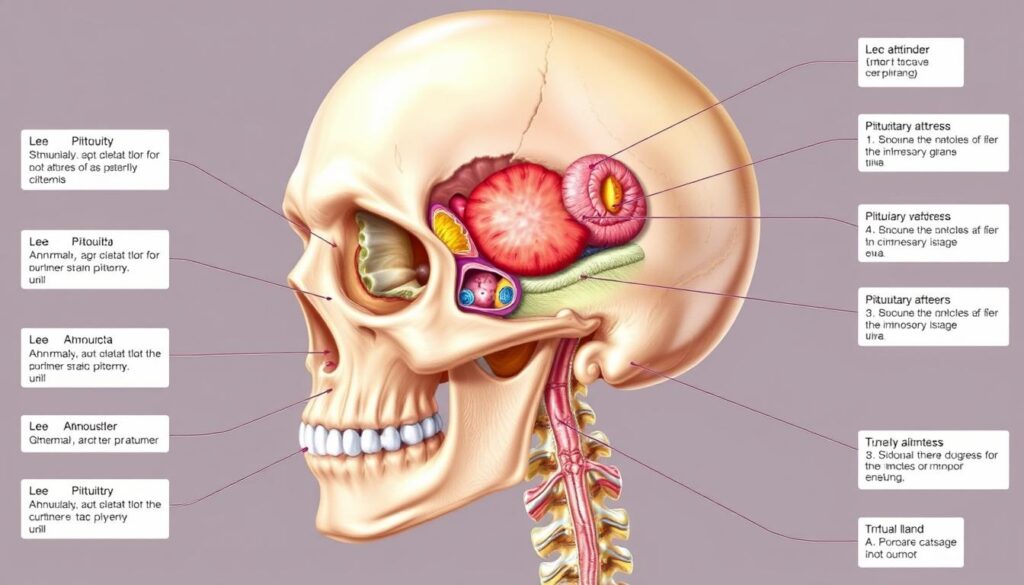
Pituitary tumors grow in a small but vital gland at your brain’s base. These growths, usually harmless, can still mess up your hormones and health1. Knowing about them helps catch and treat them early.
Your genes play a big role in these tumors. Some risky gene changes come from your parents2. But most happen during your life.
Certain genes like AIP, GNAS, and USP8 often change in pituitary adenomas2. Surprisingly, your lifestyle or surroundings don’t cause these tumors2.
These tumors come in different types. Some make hormones, while others don’t do much3. Prolactinomas are the most common kind, making up 40% of all cases3.
Key Takeaways
- Pituitary tumors are mostly benign growths in the brain’s pituitary gland
- Genetic mutations can increase the risk of developing pituitary tumors
- Most pituitary tumors do not result from environmental factors
- Hormonal imbalances can be a significant consequence of these tumors
- Early detection is crucial for effective management
What Are Pituitary Tumors and Their Impact on Health
The pituitary gland is a tiny but powerful part of your brain. It’s often called the “master gland” because it controls many body functions through hormones4.
About 1 in 4 people may have small pituitary tumors without knowing it5. These tumors can upset your body’s hormone balance and affect your health.
Understanding Pituitary Adenomas
Pituitary adenomas come in different types. Most are benign and grow slowly, but they can change your hormone production4.
There are two main types:
- Functioning adenomas that produce excess hormones6
- Nonfunctioning adenomas that do not produce significant hormones5
Types of Hormone-Producing Tumors
Different pituitary tumors can trigger various hormone-related conditions:
- Prolactinomas: Affect about 4 in 10 pituitary tumors, causing menstrual irregularities and sexual dysfunction6
- Growth hormone tumors: Can lead to acromegaly or gigantism5
- ACTH-producing tumors: May cause Cushing’s disease5
“Understanding your pituitary gland is key to recognizing potential hormonal disorders.”
Impact on Hormone Production
Pituitary tumors can cause hormone overproduction or underproduction. This can lead to various endocrine disorders, affecting your metabolism and growth4.
Most pituitary tumors are treatable with proper medical care. Your doctor can help you manage pituitary gland issues and tumors5.
Common Symptoms and Warning Signs of Pituitary Tumors
Pituitary tumors can show a range of symptoms that often go unnoticed. Recognizing these signs is vital for early detection and treatment7. Most pituitary tumors are benign, with 99% being noncancerous7.
Your body may signal a potential pituitary tumor in various ways. Common symptoms include:
- Persistent headaches
- Unexpected vision problems
- Hormonal imbalance symptoms
- Unexplained weight changes
Different pituitary tumors cause unique symptoms based on hormone production. Here’s a breakdown:
| Tumor Type | Specific Symptoms |
|---|---|
| Prolactinomas | Lack of menstrual periods, unexpected milk production |
| ACTH-secreting tumors | Cushing’s syndrome with rapid weight gain, hypertension |
| Growth hormone tumors | Abnormal hand/foot growth, facial changes |
“Early detection is key to managing pituitary tumors effectively”
Hormonal imbalance symptoms can vary from person to person. Look out for mood changes, fatigue, and irregular menstrual cycles. Cushing’s syndrome shows distinct signs like muscle weakness and easy bruising7.
Not all pituitary tumors cause noticeable symptoms. Some are found by chance during routine medical imaging8. If you have ongoing symptoms, see a doctor for proper diagnosis and treatment8.
Diagnosis and Treatment Options for Pituitary Tumors
Diagnosing and managing pituitary tumors requires a thorough approach. Advanced medical techniques and custom treatment plans are essential. These methods aim to identify and address these complex growths effectively9.
Grasping the diagnostic process is key for effective tumor management. Doctors use various advanced methods to detect pituitary tumors. These approaches involve comprehensive medical testing for accurate evaluation.
Medical Testing and Imaging Techniques
Your diagnostic journey typically includes several assessment methods:
- MRI with gadolinium for detailed tumor visualization10
- CT scan to examine tumor characteristics
- Hormone level tests to assess endocrine function
- Visual field exam to evaluate potential neurological impacts10
Surgical Treatment Approaches
Two main surgical approaches are available when needed:
- Transsphenoidal surgery: Recommended for small functional adenomas9
- Craniotomy for more complex tumor removals
Early intervention provides the best chance for controlling pituitary tumors and their potential side effects9.
Radiation Therapy Options
Radiation techniques offer alternative treatment strategies:
- External beam radiation
- Stereotactic radiosurgery
- Gamma knife treatment for precision targeting9
Medication Management Strategies
Medicines play a crucial role in managing pituitary tumors:
- Dopamine agonists for prolactinomas
- Somatostatin analogs for hormone regulation
- Hormone replacement therapy when necessary9
Your medical team will create a tailored treatment plan. It will consider your specific tumor features and overall health needs10.
Conclusion
Pituitary tumor management is vital for your health. These rare tumors affect about 1 in 1000 people11. They can greatly impact your life quality and make up 10% to 25% of intracranial neoplasms12.
Your treatment journey is unique. Doctors know different adenomas need specific approaches. Prolactin-secreting and non-functioning adenomas are most common11. New techniques in surgery, radiation, and medicine have boosted patient outcomes.
Regular check-ups help track tumor growth and possible issues. Only 6.8% of pituitary adenomas are malignant11. Still, early detection is crucial. New research explores innovative treatments to improve life quality.
A full treatment plan helps manage pituitary tumors effectively. Ongoing research and personalized care can help you tackle this challenge. Your medical team is your best resource for understanding and treating these tumors.
FAQ
What exactly is a pituitary tumor?
A pituitary tumor is an unusual growth in the pituitary gland. This small, pea-sized organ sits at your brain’s base. Most tumors are benign and called pituitary adenomas.
These growths can disrupt hormone production. They may cause either overproduction or underproduction of certain hormones.
Are all pituitary tumors the same?
Pituitary tumors come in different types. They can be functioning (hormone-producing) or nonfunctioning (non-hormone-producing). Size also matters: macroadenomas are larger than 1 cm, while microadenomas are smaller.
Common types include prolactinomas, growth hormone-secreting tumors, and ACTH-producing tumors.
What symptoms might indicate a pituitary tumor?
Symptoms vary widely but often include headaches and vision problems. You might experience irregular menstrual cycles, erectile dysfunction, or unexplained weight changes.
Other signs include fatigue, mood swings, and increased sweating. Some tumors cause no noticeable symptoms and are found accidentally.
How are pituitary tumors diagnosed?
Diagnosis involves various medical tests. These include blood and urine tests to check hormone levels. Imaging techniques like MRI and CT scans help visualize the tumor.
Doctors may perform a visual field exam to assess vision impact. In some cases, a biopsy confirms the diagnosis.
What treatment options are available?
Treatment depends on the tumor’s characteristics. Options include surgery, radiation therapy, and medication. Surgical removal is often the primary approach, especially for smaller tumors.
Medications can help manage hormone production. Some cases might need a combination of treatments or a “wait-and-see” approach.
Can pituitary tumors be dangerous?
Most pituitary tumors are benign but can significantly impact your health. They can disrupt hormone production and pressure surrounding brain structures.
Some tumors cause serious conditions like Cushing’s disease or acromegaly. Early diagnosis and treatment are crucial for managing these tumors effectively.
Will I need hormone replacement therapy?
You might need hormone replacement therapy depending on how the tumor affects your pituitary gland. This is common if the tumor or treatment reduces hormone production.
Your endocrinologist will run tests to determine if you need hormone replacement. They’ll also decide what type of replacement you might need.
How common are pituitary tumors?
Pituitary tumors are relatively uncommon but not rare. They make up about 10-15% of brain tumors. Many people have small pituitary tumors that never cause symptoms.
These tumors are often found during imaging for other reasons. Most are benign and can be successfully treated with current medical technologies.
Source Links
- Pituitary Tumors – https://www.ninds.nih.gov/health-information/disorders/pituitary-tumors
- What Causes Pituitary Tumors? – https://www.cancer.org/cancer/types/pituitary-tumors/causes-risks-prevention/what-causes.html
- Pituitary Adenomas: Definition, Symptoms & Treatment – https://my.clevelandclinic.org/health/diseases/15328-pituitary-adenomas
- Pituitary tumors – Symptoms and causes – https://www.mayoclinic.org/diseases-conditions/pituitary-tumors/symptoms-causes/syc-20350548
- Pituitary Tumors – https://www.hopkinsmedicine.org/health/conditions-and-diseases/pituitary-tumors
- What is a Pituitary Tumor? – https://www.cancer.org/cancer/types/pituitary-tumors/about/what-is-pituitary-tumor.html
- Pituitary Tumor | University of Michigan Health – https://www.uofmhealth.org/conditions-treatments/brain-neurological-conditions/pituitary-tumor
- Pituitary Tumors | Symptoms & Surgical Treatment | MedStar Health – https://www.medstarhealth.org/services/pituitary-tumors
- Pituitary Gland and Pituitary Tumors – https://www.aans.org/patients/conditions-treatments/pituitary-gland-and-pituitary-tumors/
- Pituitary Tumors Treatment – https://www.cancer.gov/types/pituitary/patient/pituitary-treatment-pdq
- Pituitary tumors and the risk of other malignancies: is the relationship coincidental or causal? – https://pmc.ncbi.nlm.nih.gov/articles/PMC10259320/
- Pituitary Tumors Treatment (PDQ®) – https://www.cancer.gov/types/pituitary/hp/pituitary-treatment-pdq

