
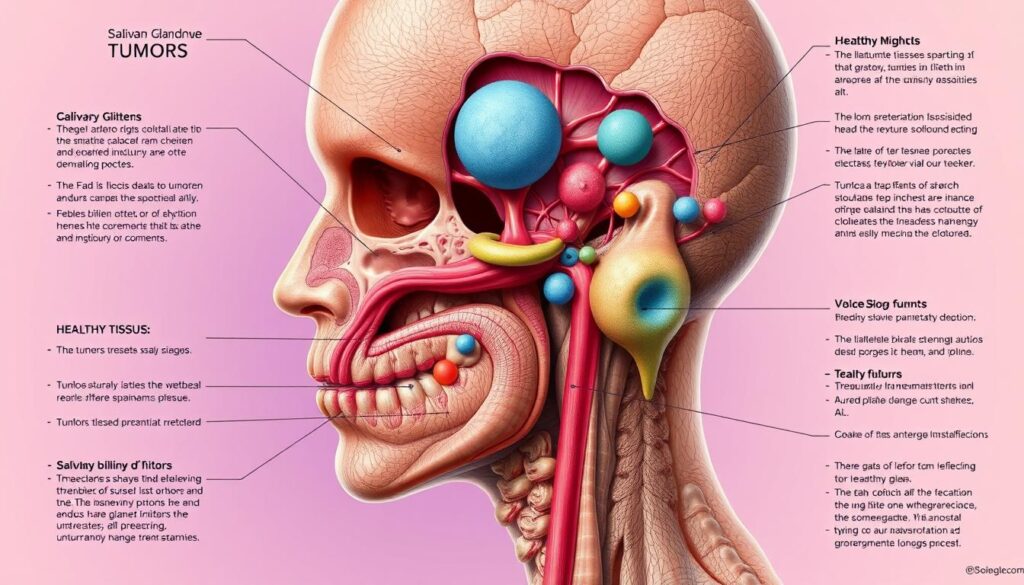
Salivary gland tumors are complex growths in saliva-producing structures. They can appear in your mouth and neck area. Most develop in the parotid glands, making early detection crucial1.
Your body has over 1,000 tiny salivary glands2. Parotid gland tumors make up 85% of all cases1. These tumors are usually benign, slow-growing, and painless1.
Submandibular and sublingual gland tumors are less common. About 75-80% of these tumors are non-cancerous1. Knowing their signs can help you spot potential issues early.
Key Takeaways
- Salivary gland tumors primarily occur in parotid glands
- Most salivary gland tumors are benign
- Over 1,000 microscopic salivary glands exist in the human body
- Early detection is crucial for effective treatment
- Different types of salivary gland tumors require specialized care
What Are Salivary Gland Tumors and Their Types
Salivary gland tumors are growths in glands that make saliva. They can pop up in different spots. Knowing about these tumors helps catch them early.
Doctors look at these growths closely. They check where they are and how they look. This helps them figure out the best way to treat them.
Benign Salivary Gland Tumors
Benign tumors don’t spread to other parts of the body. They’re not cancer. Pleomorphic Adenoma is the most common benign tumor.
It has a mix of different cells. Warthin’s Tumor is another common benign growth. It’s often found in older patients.
- Pleomorphic Adenoma: Slow-growing and typically harmless
- Warthin’s Tumor: More common in men over 40
- Oncocytoma: Rare benign tumor with specialized cells
Malignant Salivary Gland Tumors
Malignant tumors are more serious. They can spread to other body parts. Mucoepidermoid Carcinoma is the most common type of salivary gland cancer3.
Adenoid Cystic Carcinoma is another important malignant tumor. It needs careful medical care4.
| Tumor Type | Characteristics | Frequency |
|---|---|---|
| Mucoepidermoid Carcinoma | Most common salivary gland cancer | High |
| Adenoid Cystic Carcinoma | Slow-growing but potentially aggressive | Moderate |
| Acinic Cell Carcinoma | Tends to develop in younger patients | Low |
Common Locations of Salivary Gland Tumors
Salivary gland tumors can grow in different places. The parotid gland is where they show up most often. Submandibular and sublingual glands are next in line.
“Understanding the nuanced nature of salivary gland tumors is key to effective diagnosis and treatment.”
Signs, Symptoms, and Risk Factors
Early detection of salivary gland tumors is crucial. Watch for subtle changes that might go unnoticed. A painless lump near your jaw, neck, or mouth is often the first warning sign5.
Key symptoms to watch for include:
- Facial Muscle Weakness that impacts your facial expressions
- Persistent Salivary Gland Pain in the affected area
- Swallowing Difficulties when eating or drinking
- Numbness around the facial region
- Trouble opening your mouth widely
Risk factors are important in developing salivary gland tumors. Older age increases your chances of developing these tumors6. Specific occupational and environmental exposures also contribute to potential risks.
*Early detection is key to successful treatment and management of salivary gland conditions.*
Several significant risk factors include:
- Radiation exposure to the head and neck
- Workplace exposure to specific substances
- Smoking tobacco
- Viral infections like HPV and Epstein-Barr
If you have persistent symptoms or multiple risk factors, seek medical help. A healthcare professional can provide a thorough evaluation7.
Conclusion
Diagnosing salivary gland tumors requires a thorough medical evaluation. Specialized medical research shows these tumors can vary greatly in their features8. Over half of all salivary gland tumors are benign, offering some comfort to patients8.
Your tumor prognosis depends on factors like location and type. Most tumors form in the parotid glands, making up about 80% of cases8. Treatment usually involves surgery, with survival rates varying by tumor characteristics.
Early detection is key for successful salivary gland cancer treatment. These tumors are rare, accounting for only 1% of head and neck tumors9. Knowing your risk factors and seeking prompt medical care can improve outcomes.
Regular check-ups and advanced diagnostic methods help spot potential issues early. This can boost your chances of successful treatment. Staying informed and working with doctors helps you manage salivary gland tumors confidently.
Research is advancing our understanding of these tumors. New studies explore factors like serum levels of zinc, copper, and ferritin8. These findings may lead to better diagnostic and treatment strategies in the future.
FAQ
What are salivary gland tumors?
Salivary gland tumors are uncommon growths in saliva-producing glands. They can be benign or malignant. Most occur in the parotid gland.
About 80% of these tumors are non-cancerous. They can develop in major or minor salivary glands throughout the mouth and throat.
What are the different types of salivary gland tumors?
Salivary gland tumors fall into two main groups. Benign tumors include pleomorphic adenoma, Warthin’s tumor, and oncocytoma.
Malignant tumors include mucoepidermoid carcinoma, adenoid cystic carcinoma, and acinic cell carcinoma. These are graded from 1 to 3, with higher grades being more aggressive.
What are the common symptoms of salivary gland tumors?
Common signs include a painless lump near the jaw, neck, or mouth. Facial muscle weakness, numbness, and pain near a salivary gland may occur.
Other symptoms are difficulty opening the mouth widely and trouble swallowing. If these persist, consult a doctor for evaluation.
What are the risk factors for salivary gland tumors?
Risk factors include older age, radiation exposure, and smoking tobacco. Certain viral infections like Epstein-Barr virus, HIV, and HPV can increase risk.
Workplace exposure to substances in rubber manufacturing and nickel processing also raises risk. However, having risk factors doesn’t guarantee tumor development.
How are salivary gland tumors typically treated?
Surgery is the main treatment for salivary gland tumors. Benign tumors are usually removed surgically.
Malignant tumors may need additional radiation therapy. The specific approach depends on tumor type, grade, location, and patient health.
Where do salivary gland tumors most commonly occur?
The parotid gland is the most frequent site for these tumors. It accounts for most cases.
Tumors can also develop in the submandibular and sublingual glands. Minor salivary glands in the lips, cheeks, and throat can be affected too.
What is the prognosis for salivary gland tumors?
Prognosis varies based on tumor type, grade, and location. Benign tumors generally have an excellent outlook.
Malignant tumors require more intensive treatment. Early detection and intervention can greatly improve outcomes. Seek medical attention promptly if you notice concerning symptoms.
Source Links
- Salivary Gland Tumors – Ear, Nose, and Throat Disorders – Merck Manual Professional Edition – https://www.merckmanuals.com/professional/ear-nose-and-throat-disorders/tumors-of-the-head-and-neck/salivary-gland-tumors
- Facts About Salivary Gland Cancer – https://www.fredhutch.org/en/diseases/salivary-gland-cancer/facts-resources.html
- What Is Salivary Gland Cancer? | Types of Salivary Gland Cancer – https://www.cancer.org/cancer/types/salivary-gland-cancer/about/what-is-salivary-gland-cancer.html
- Types of salivary gland cancer – https://www.cancerresearchuk.org/about-cancer/salivary-gland-cancer/types
- Saliva & Salivary Gland Disorders – https://www.nidcr.nih.gov/health-info/saliva-salivary-gland-disorders
- What Are the Risk Factors for Salivary Gland Cancer? – https://www.cancer.org/cancer/types/salivary-gland-cancer/causes-risks-prevention/risk-factors.html
- Salivary Gland Cancer – https://www.hopkinsmedicine.org/health/conditions-and-diseases/salivary-gland-cancer
- Salivary Gland Cancer | CancerIndex – http://www.cancerindex.org/salivary_gland_cancer
- Diseases of the salivary glands in infants and adolescents – Head & Face Medicine – https://head-face-med.biomedcentral.com/articles/10.1186/1746-160X-6-1

