
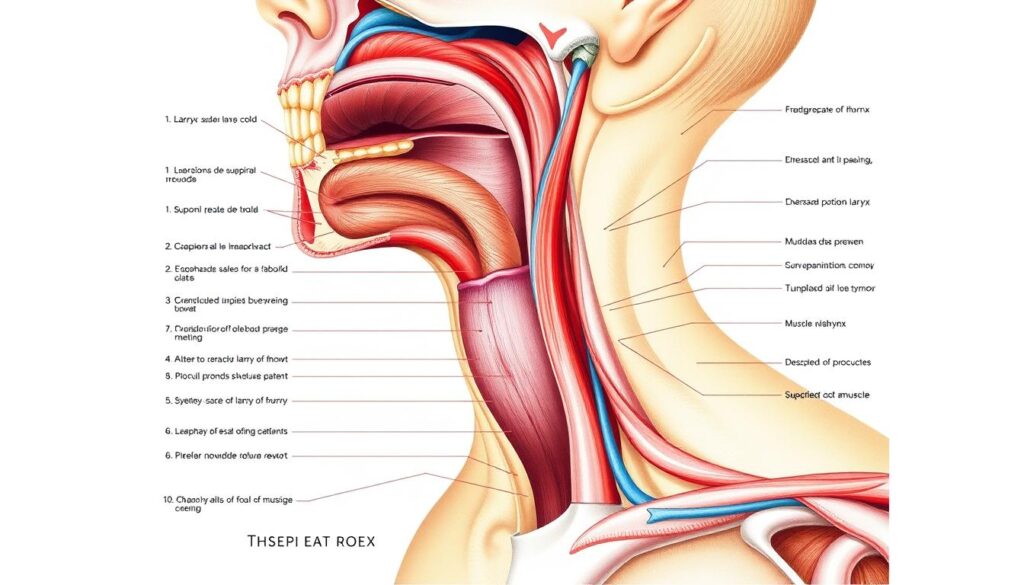
Your throat is a complex part of the respiratory system. It’s crucial for breathing, speaking, and swallowing. The throat’s anatomy is a network of structures that support vital body functions1.
The pharynx is the main tube in your throat. It’s a muscular structure about 12-14 cm long. The pharynx connects your nasal and oral cavities to the voice box and esophagus1.
This positioning allows for smooth passage of air, food, and liquids. It supports key functions in both digestive and respiratory systems1.
Your throat’s muscles enable complex actions like swallowing and speaking. Six specialized muscles are divided into two groups. These muscles push food through your digestive tract and help you communicate1.
Arteries and nerves ensure each muscle works precisely. This network allows for coordinated function of all throat components.
Key Takeaways
- The throat is a multifunctional system supporting breathing, speaking, and swallowing
- Pharynx is a 12-14 cm muscular tube with complex anatomical structures
- Throat anatomy involves multiple interconnected systems
- Six specialized muscles enable critical physiological functions
- Understanding throat anatomy helps recognize potential health issues
Essential Components of Throat Anatomy
Your throat is a complex system of structures. It supports breathing, speaking, and swallowing. This vital area showcases your body’s intricate design.
The Pharynx: A Crucial Passageway
The pharynx is a muscular tube for air and food. It links your nasal and oral cavities to the larynx and esophagus2. This structure has three distinct regions:
- Nasopharynx
- Oropharynx
- Laryngopharynx
Understanding the Larynx and Vocal Mechanics
Your larynx, or voice box, is a biological marvel. It houses the vocal cords and produces speech. The subglottic space below the vocal cords is your upper airway’s narrowest part3.
The Protective Epiglottis in Action
The epiglottis is a small but mighty flap of tissue. It stops food from entering your lungs when you swallow. This component ensures food and drink go down the right path.
| Throat Component | Primary Function |
|---|---|
| Pharynx | Air and food passageway |
| Larynx | Speech production |
| Vocal Cords | Sound generation |
| Epiglottis | Preventing food entry into lungs |
Your throat is not just a simple tube, but a sophisticated system designed for multiple critical functions.
The throat has important lymphatic tissues like tonsils and adenoids. These structures help fight infections3. They play a key role in your body’s defense, especially during childhood2.
How Your Throat’s Structure Supports Vital Functions
Your throat is a remarkable system playing a crucial role in many bodily functions. It supports speech, swallowing, and breathing with amazing precision4.
The throat contains several key structures working together seamlessly:
- Larynx coordinates breathing and speech production
- Vocal cords generate sound for communication
- Epiglottis prevents food from entering lungs
- Pharynx acts as a critical passageway5
Your swallowing mechanism involves an impressive network of muscles. About 25 muscle pairs in the mouth, pharynx, and larynx work together.
These muscles move food safely through your digestive system5.
| Throat Component | Primary Function |
|---|---|
| Larynx | Speech and Breathing Coordination |
| Pharynx | Food and Air Passage |
| Epiglottis | Preventing Aspiration |
The throat is not just a passageway, but a complex system ensuring your survival and communication.
Your throat’s intricate design is truly amazing. Its structures work together to support vital breathing and talking functions4.
Conclusion
Your throat anatomy is a marvel of biological engineering. It plays a crucial role in your respiratory system and overall health. The throat’s complex network supports vital functions like breathing, speaking, and swallowing6.
The throat’s design includes multiple components working together for optimal performance. From intricate pharyngeal nerve networks to delicate cartilage structures, each part serves a specific purpose7. Understanding these details helps you recognize potential health concerns.
Knowing your throat anatomy helps you tune into your body’s signals. This knowledge provides a foundation for proactive medical care. It also increases self-awareness of your respiratory system.
Your throat is a dynamic, responsive system that adapts and protects you. Understanding its incredible design can change how you view your body. An ENT specialist can help you appreciate the precision of these interconnected systems.
FAQ
What are the main functions of the throat?
Your throat supports breathing, swallowing, and speech production. It connects your mouth and nose to respiratory and digestive systems. This complex passageway allows air, food, and liquids to move while protecting your lungs.
What is the pharynx, and what does it do?
The pharynx is a muscular tube connecting your nose and mouth to the larynx and esophagus. It directs air and food to the right channels. This ensures smooth breathing and swallowing processes.
How do vocal cords produce speech?
Vocal cords in the larynx vibrate when air passes through them, creating sound waves. These waves generate speech. The cords’ tension and position determine your voice’s pitch and quality.
What is the role of the epiglottis?
The epiglottis is a protective flap that keeps food and liquids out of your lungs. It closes over the trachea when you eat or drink. This directs substances into the esophagus and keeps your airway clear.
How do tonsils and adenoids contribute to health?
Tonsils and adenoids are made of lymph tissue and boost your immune system. They trap and destroy harmful bacteria and viruses. These tissues protect you from infections entering through your mouth and nose.
What makes the throat such a complex anatomical structure?
Your throat is a sophisticated system with many interconnected parts. It includes the pharynx, larynx, vocal cords, epiglottis, blood vessels, and nerves. These structures work together to support vital functions.
What is the subglottic space?
The subglottic space is the narrowest part of your upper airway. It’s located just below the vocal cords. This space regulates airflow during breathing and is important for medical professionals.
When should I consult an ENT specialist about throat issues?
See an ENT specialist if you have ongoing throat pain or trouble swallowing. Changes in voice quality, chronic infections, or unusual symptoms need attention. Seek help if these issues disrupt your breathing or speaking.
Source Links
- Pharynx – https://www.kenhub.com/en/library/anatomy/the-pharynx
- The Throat – ENT Clinic Sydney – https://ent-surgery.com.au/the-throat/
- Anatomy and Physiology of the Nose and Throat – https://www.urmc.rochester.edu/Encyclopedia/content.aspx?ContentTypeID=90&ContentID=P02027
- Anatomy of the Throat and Neck | Dr. Larian – https://www.hyperparathyroidmd.com/anatomy-of-the-throat-and-neck/
- The Anatomy of the Pharynx – https://www.verywellhealth.com/pharynx-anatomy-4802318
- Overview, Gross Anatomy, Microscopic Anatomy – https://emedicine.medscape.com/article/1899345-overview
- Anatomy, Head and Neck: Larynx – StatPearls – https://www.ncbi.nlm.nih.gov/books/NBK538202/

