
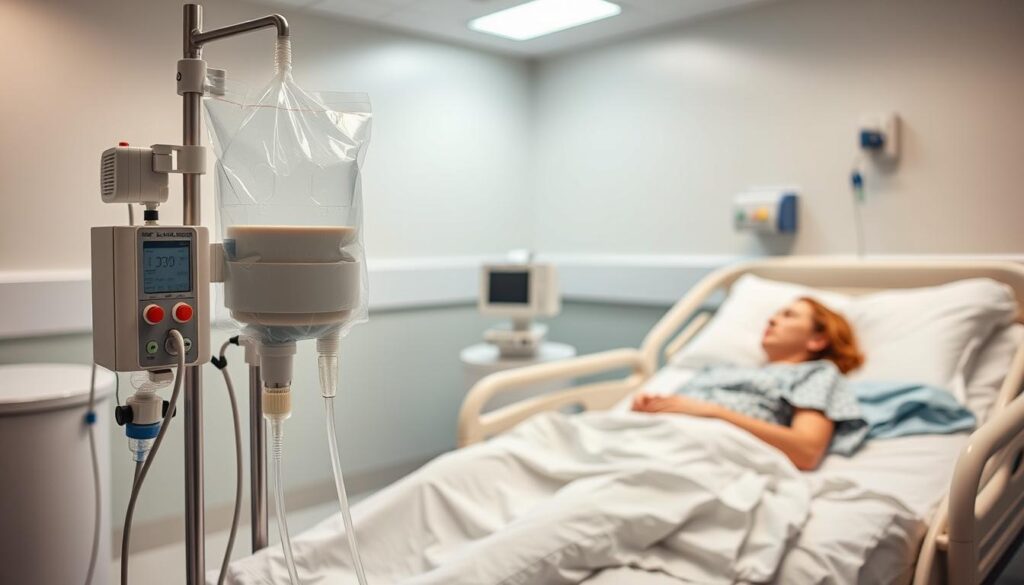
Peritoneal dialysis is a powerful treatment for renal failure. It lets you filter your blood at home, giving you flexibility and independence12.
This method uses your body’s peritoneum membrane to clean your blood. It removes waste and extra fluid when your kidneys can’t do the job1.
Unlike hemodialysis, peritoneal dialysis offers a personalized approach to kidney disease management. Your journey might start months or years after your initial diagnosis1.
The process involves placing a special catheter in your abdomen. This lets you perform dialysis exchanges efficiently at home1.
Key Takeaways
- Peritoneal dialysis is a flexible home-based kidney disease treatment
- Treatment can be performed independently with proper training
- Reduces frequent medical facility visits
- Less physically stressful compared to traditional dialysis
- Allows for more personalized healthcare management
What is Peritoneal Dialysis and How It Works
Peritoneal dialysis is a unique kidney treatment. It uses your body’s natural filtering system to help patients with kidney failure. Your peritoneal cavity becomes a vital pathway for cleansing your blood.
Your body’s internal filtering mechanism is remarkable. The peritoneum, a thin membrane in your abdomen, acts as a sophisticated filter. It allows dialysis solution to remove waste and excess fluid from your blood3.
The Role of the Peritoneum in Dialysis
Your peritoneal cavity is crucial in the dialysis process. The membrane enables a unique fluid exchange method. This helps clean your blood when kidneys can’t function properly4.
During treatment, special dialysis solution flows through a catheter. The catheter is surgically placed in your peritoneal cavity.
Understanding Dialysis Solution and Fluid Exchange
- Dialysis solution contains essential components that help remove waste
- Fluid exchange occurs through three primary steps:
- Draining old solution
- Filling with fresh dialysis solution
- Allowing solution to dwell and absorb waste5
Key Components: Catheter and Transfer Set
A soft, flexible catheter is inserted into your peritoneal cavity. It helps with fluid exchanges. The transfer set connects this catheter to dialysis solution bags.
This setup enables smooth and controlled waste removal3.
Your body becomes a powerful filtration system, working in harmony with medical technology to manage kidney health.
Two main methods of peritoneal dialysis exist. These are Continuous Ambulatory Peritoneal Dialysis (CAPD) and Continuous Cycling Peritoneal Dialysis (CCPD).
CAPD involves manual exchanges during the day, typically 3-4 times. Each exchange takes about 30-40 minutes4. CCPD uses a machine at night to perform exchanges while you sleep3.
Types of Peritoneal Dialysis Treatment Options
Peritoneal dialysis offers two main treatment approaches. Each option has unique benefits for your lifestyle and medical needs6.
Continuous Ambulatory Peritoneal Dialysis (CAPD)
CAPD is a manual dialysis procedure you control. You’ll do 3-5 exchanges daily, each taking about 30-40 minutes67.
- Manual exchanges performed during daytime hours
- Solution typically remains in your abdomen for 4-6 hours
- Allows for flexible treatment scheduling
Automated Peritoneal Dialysis (APD)
APD uses a machine called a cycler for your dialysis needs. It performs exchanges automatically while you sleep67.
- Machine-assisted exchanges during nighttime
- 3-5 exchanges performed while you rest
- Potential for fewer infection risks
“Your dialysis treatment should fit your life, not control it.” – Dialysis Specialist
Both CAPD and APD can be done at home, work, or while traveling. This flexibility helps you manage your health without disrupting your lifestyle8.
Choosing between CAPD and APD depends on your preferences and medical needs. Talk to your doctor to find the best dialysis option for you7.
Preparing for and Managing Your Peritoneal Dialysis
Peritoneal dialysis requires careful planning and understanding. Your success hinges on proper training, equipment management, and diligent care practices. Mastering these elements will help you navigate your treatment journey effectively.
Catheter Placement Surgery and Recovery
Peritoneal dialysis starts with catheter placement, a minor surgery lasting under an hour9. Your healthcare team suggests placing the catheter at least two weeks before starting dialysis9.
Most patients can return to normal activities within three to four days after surgery9. This recovery period allows your body to heal and adapt to the catheter.
Essential Training for Dialysis Management
Peritoneal Dialysis Training is vital for successful home treatment. Your medical team will guide you through comprehensive education covering key aspects.
- Sterile technique and infection prevention
- Solution preparation and exchange procedures
- Equipment handling and maintenance
Daily Care and Maintenance Procedures
Effective Catheter Care involves meticulous attention to hygiene and technique. Here are key guidelines to follow:
- Create a clean, draft-free work area10
- Practice strict hand hygiene
- Use recommended supplies like masks and hand sanitizer10
- Check solution bags for strength and expiration10
“Sterility is your best defense against potential complications in peritoneal dialysis.”
Your Dialysis Access management requires ongoing vigilance. Always discard contaminated supplies and start with fresh, sterile equipment10. Regular check-ups with your healthcare provider ensure optimal treatment and catheter function.
Digital welcome kits and patient management tools can support your dialysis journey10. With proper training and dedication, you can effectively manage your treatment. This approach helps maintain your quality of life during peritoneal dialysis.
Conclusion
Peritoneal dialysis transforms kidney replacement therapy. It offers a flexible lifestyle that adapts to your medical needs. Less than 10% of end-stage renal disease patients choose this treatment11.
Your dialysis lifestyle needs commitment and understanding. Studies show peritoneal dialysis can offer better outcomes in the first two years12. Work closely with healthcare professionals to manage your kidney health effectively13.
Success depends on thorough training, consistent monitoring, and personalized medical guidance. Research shows that patient education is crucial for optimal treatment outcomes. Your journey is unique, so team up with your doctors.
Peritoneal dialysis is more than just treatment. It’s a way to maintain your quality of life while managing kidney disease. Take an active role in your health journey.
Stay informed and positive throughout your treatment. Embrace this opportunity to improve your daily life and health management13.
FAQ
What is peritoneal dialysis?
Peritoneal dialysis treats kidney failure using your abdomen’s lining to filter blood. It’s a home-based alternative to hemodialysis. A catheter in your abdomen exchanges dialysis solution to remove wastes and extra fluid.
How does peritoneal dialysis work?
The process fills your peritoneal cavity with a special dialysis solution. This solution contains water, salt, and additives that absorb waste and excess fluid. After several hours, the fluid is drained, removing toxins and maintaining balance.
What are the types of peritoneal dialysis?
There are two main types: Continuous Ambulatory Peritoneal Dialysis (CAPD) and Automated Peritoneal Dialysis (APD). CAPD involves manual exchanges during the day. APD uses a machine for automatic exchanges while you sleep.
Can I perform peritoneal dialysis at home?
Yes, peritoneal dialysis can be done at home, work, or while traveling. You’ll receive training from dialysis nurses to manage exchanges independently. This offers flexibility in your treatment schedule.
How long does catheter placement and training take?
Catheter placement surgery happens at least 3 weeks before starting treatment. Recovery takes 10-20 days. Training on exchanges and equipment management lasts 1-2 weeks.
What are the key challenges of peritoneal dialysis?
The main challenges include maintaining strict hygiene and preventing infections. You’ll need to practice careful hand washing and wear a mask during exchanges. Keeping a clean environment is crucial.
Is peritoneal dialysis right for everyone?
Not necessarily. The choice depends on your lifestyle, medical needs, and personal preference. Your healthcare provider will help determine the most suitable treatment for you.
How often do dialysis exchanges need to be performed?
With CAPD, you’ll typically perform 3-5 exchanges daily, each taking 30-40 minutes. APD uses a machine for exchanges while you sleep.
What should I do to prevent complications?
Focus on daily catheter exit site care. Use antibacterial soap or antiseptic for cleaning. Apply antibiotic cream and change dressings regularly. Manage related health issues like constipation.
Does peritoneal dialysis cure kidney disease?
No, peritoneal dialysis doesn’t cure kidney disease. It replaces many functions of failing kidneys by filtering waste and excess fluid. This helps manage the condition and maintain a better quality of life.
Source Links
- Patient education: Peritoneal dialysis (Beyond the Basics) – https://www.uptodate.com/contents/peritoneal-dialysis-beyond-the-basics/print
- Understanding Peritoneal Dialysis: A Comprehensive Guide – Nephrology Associates of Greater Houston kidney treatment – https://nephrologyhouston.com/understanding-peritoneal-dialysis-a-comprehensive-guide/
- Dialysis – peritoneal Information | Mount Sinai – https://www.mountsinai.org/health-library/surgery/dialysis-peritoneal
- Peritoneal dialysis – https://www.kidneyfund.org/treatments/dialysis/peritoneal-dialysis
- How peritoneal dialysis (PD) works – https://www.pdempowers.com/patient/how-peritoneal-dialysis-pd-works
- Peritoneal Dialysis – NIDDK – https://www.niddk.nih.gov/health-information/kidney-disease/kidney-failure/peritoneal-dialysis
- Peritoneal dialysis – Mayo Clinic – https://www.mayoclinic.org/tests-procedures/peritoneal-dialysis/about/pac-20384725
- Types of Dialysis | Hemodialysis and Peritoneal Dialysis | Kidney Disease – https://www.umms.org/ummc/health-services/kidney/dialysis/types
- Preparing for peritoneal dialysis catheter surgery – http://www.davita.com/treatment-services/peritoneal-dialysis/preparing-for-peritoneal-dialysis-catheter-surgery
- Preparing and performing PD treatments – https://pdempowers.com/preparing-for-and-doing-your-pd-treatment
- Frontiers | Urgent-Start Peritoneal Dialysis as a Bridge to Definitive Chronic Renal Replacement Therapy: Short- and Long-Term Outcomes – https://www.frontiersin.org/journals/physiology/articles/10.3389/fphys.2018.01830/full
- Peritoneal dialysis – https://en.wikipedia.org/wiki/Peritoneal_dialysis
- Epidemiology of peritoneal dialysis outcomes – https://pmc.ncbi.nlm.nih.gov/articles/PMC9483482/

