
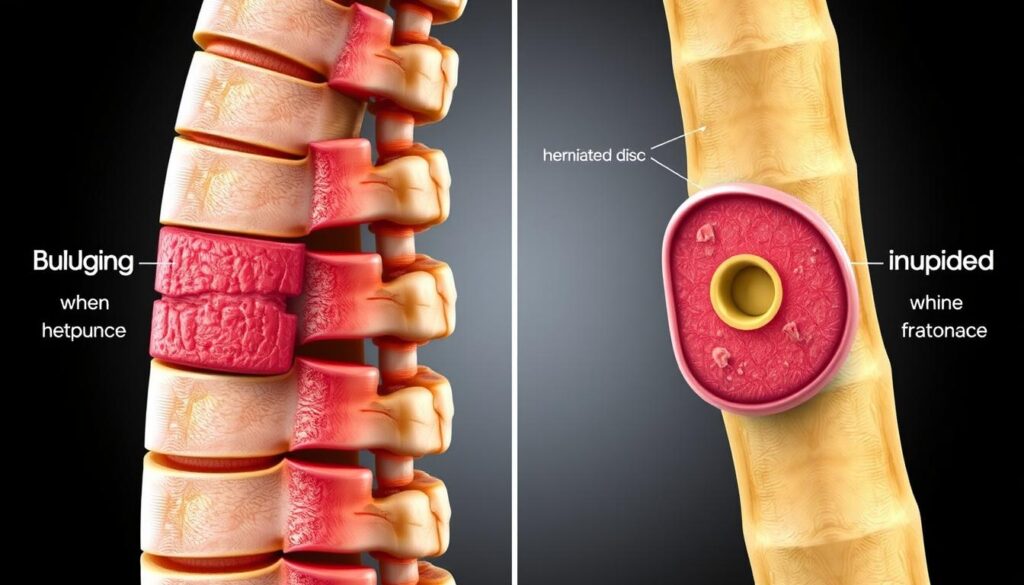
Spinal disc injuries can be tricky to understand. Knowing the difference between bulging and herniated disks is crucial. These conditions affect the cushions between your vertebrae and can cause back pain1.
A bulging disk sticks out beyond its normal space. It usually affects 25% to 50% of the disk’s edge1. A herniated disk has a crack in its tough outer layer. This allows the soft inner material to push through1.
Herniated disks often cause more pain. The inner material can irritate nearby nerves more intensely1. Some people don’t even know they have a disk problem. It’s often discovered through MRI scans1.
Symptoms can vary widely among individuals. It’s important to see a doctor for an accurate diagnosis. They can help determine the best treatment for your specific condition.
Key Takeaways
- Bulging disks affect 25-50% of the disk circumference
- Herniated disks involve a crack in the outer disk layer
- Not all disk issues cause noticeable symptoms
- Professional medical imaging can detect hidden disk problems
- Herniated disks typically cause more intense nerve irritation
Understanding Spinal Disk Anatomy and Function
Your spine is a complex structure that relies on intervertebral discs for flexibility and support. These discs play a vital role in body movement and protection.
Structure of Healthy Spinal Disks
Spinal disks have two main parts. The inner core, called the nucleus pulposus, is a gel-like substance that absorbs shock.
The outer layer, the annulus fibrosus, surrounds the core. It’s made of tough fibrous rings that give the disk its strength.
- Nucleus pulposus: 80% water, provides elasticity
- Annulus fibrosus: 7-15 layers of protective fibers
- Crucial for spine conditions and nerve compression
Location and Distribution in the Spine
Intervertebral discs are found throughout the spine. They span three main regions: cervical, thoracic, and lumbar.
Each region supports your body’s movement and protects important neural pathways. These areas have unique roles in spinal function.
| Spinal Region | Number of Vertebrae | Primary Function |
|---|---|---|
| Cervical | 7 | Neck mobility and support |
| Thoracic | 12 | Upper and mid-back stability |
| Lumbar | 5 | Lower back movement and load-bearing |
“Understanding your spine’s anatomy is the first step in maintaining its health and preventing potential conditions.”
These disks cushion vertebrae and allow smooth movement. They protect the spinal cord from daily stress and impact2.
Their unique design helps your spine flex and rotate. It also absorbs shock during various activities.
Bulging Disk vs. Herniated Disk: Clinical Differences
Bulging and herniated disks affect the spinal canal differently. These conditions have unique traits that impact nerve compression and back pain. Recognizing the differences can help identify potential spinal health issues.
Bulging disks occur when the outer layer slightly protrudes into the spinal canal. These disks remain largely intact and often don’t cause major symptoms3. Herniated disks, however, involve a complete breach of the disk’s protective wall.
In herniated disks, inner gel-like material leaks out4. This can lead to more significant nerve root compression and pain.
- Bulging disks: Minimal nerve irritation
- Herniated disks: Significant nerve root compression
- Potential symptoms: Sciatica, numbness, weakness
Symptom severity depends on the disk’s location and nerve involvement. Lumbar disk issues often cause lower back and leg pain. Cervical disk problems might trigger neck and arm discomfort4.
Risk factors for disc degeneration include:
- Excess body weight
- Physical labor
- Genetic predisposition
- Smoking
- Sedentary lifestyle
“Early recognition and proper management can prevent long-term spinal complications.”
Treatment approaches vary based on the specific condition. Conservative methods like physical therapy and medications are often tried first. Spinal injections may also be used3.
In severe cases, nerve pressure can become critical. Surgical options such as discectomy might be recommended for these situations3. Learn more about these disk conditions to better understand your spinal health.
Conclusion
Managing disc issues requires a holistic approach to spine health. Bulging and herniated discs need different treatment strategies. Recovery often starts with conservative techniques that address pain and promote healing5. Non-surgical options like physical therapy can effectively manage symptoms for most patients6.
Disc treatments range from gentle to complex surgical interventions. Many find relief through targeted exercises and pain management. Surgery is considered when conservative methods don’t provide enough improvement5. Spine surgeons carefully evaluate each case to determine the best action6.
Your spine health depends on proactive management and lifestyle choices. Regular exercise and proper posture can reduce the risk of disc problems6. Understanding the differences between disc issues helps you make informed decisions about your treatment.
FAQ
What is the main difference between a bulging disk and a herniated disk?
A bulging disk protrudes outward with an intact outer layer. It affects 25-50% of the disk’s circumference. A herniated disk has a cracked outer layer, allowing inner cartilage to break through. This typically causes more severe nerve irritation and pain.
Can bulging or herniated disks be asymptomatic?
Yes, both conditions can be asymptomatic. They may only be found through imaging tests like MRI or CT scans. Not all disk abnormalities cause noticeable pain or symptoms.
What are the common symptoms of a herniated disk?
Symptoms depend on the disk’s location. They can include pain, numbness, and weakness in the affected area. Cervical herniation may cause neck and arm pain.
Thoracic herniation can lead to mid-back and chest pain. Lumbar herniation often results in lower back and leg pain.
What are the primary risk factors for disk problems?
Key risk factors include age, genetics, physical job demands, obesity, and smoking. As you age, your spinal disks become less flexible. This makes them more prone to injury.
How are bulging and herniated disks typically treated?
Treatment ranges from physical therapy to surgical interventions in severe cases. Most patients improve with non-surgical treatments within 4-6 weeks. If symptoms persist, options like discectomy or spinal fusion may be considered.
How can I prevent disk problems?
Maintain good spine health by practicing proper posture and exercising regularly. Keep a healthy weight, avoid smoking, and use proper lifting techniques. These strategies can help prevent disk degeneration and reduce spinal issues.
How do spinal disks function in the body?
Spinal disks cushion vertebrae, providing shock absorption and allowing spinal movement. They have a tough outer layer and a soft inner core. The inner core is 80% water and helps maintain flexibility.
Are herniated disks more serious than bulging disks?
Generally, yes. Herniated disks are more severe because the inner disc material can irritate surrounding nerves. This can cause more intense and persistent symptoms compared to bulging disks.
Source Links
- Bulging disk vs. herniated disk: What’s the difference? – https://www.mayoclinic.org/diseases-conditions/herniated-disk/expert-answers/bulging-disk/faq-20058428
- Herniated lumbar Disc, herniated disc, ruptured lumbar disc, bulging disc, back surgery, | Mayfield Brain & Spine – https://mayfieldclinic.com/pe-hldisc.htm
- Difference Between a Bulging Disc and a Herniated Disc | Blog – https://fayazneurosurgery.com/what-is-the-difference-between-a-bulging-disc-and-a-herniated-disc/
- Bulging Disc vs Herniated Disc: Key Differences Explained – https://longislandbrainandspine.com/herniated-disc-vs-bulging-disc-whats-the-difference/
- Herniated Vs. Bulging Disc: What’s The Difference? | New Jersey | Comprehensive Spine Care – https://compspinecare.com/blogs/herniated-vs-bulging-disc-whats-the-difference/
- Bulging Disc vs. Herniated Disc – https://www.texasspinecenter.com/articles/bulging-disc-vs-herniated-disc/

