
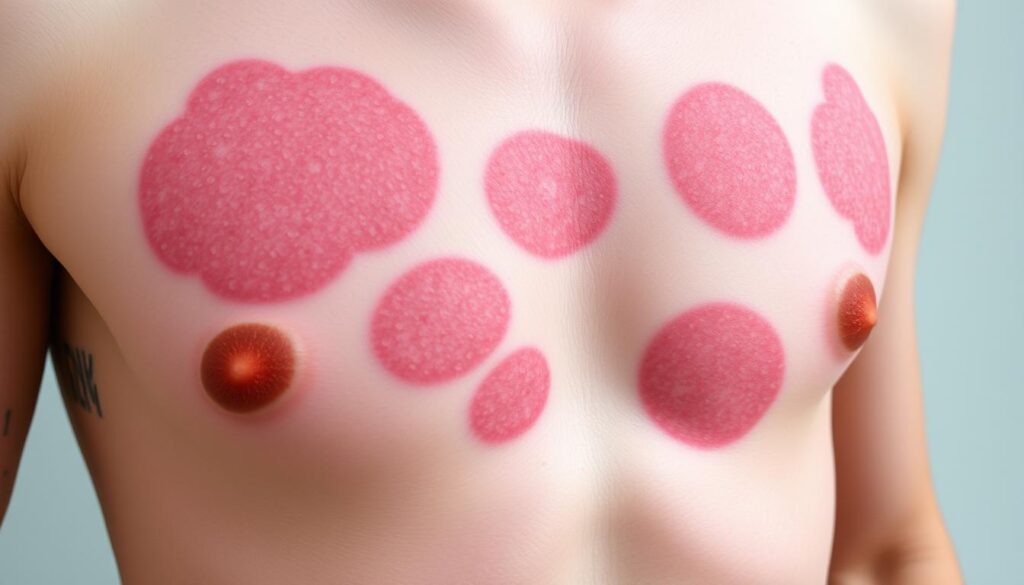
Pityriasis rosea is a temporary skin rash with a unique appearance. It’s a self-limiting disease that creates a distinctive pattern across your body. Though it causes mild discomfort, it rarely poses serious health risks12.
This skin condition mainly affects young people aged 10 to 35. Women are 50% more likely to develop it than men2. It often starts with a large oval patch called the herald patch.
The rash then spreads across the body in a characteristic pattern1. Most cases last between 6 to 8 weeks, sometimes extending to 3 months13. While the exact cause is unknown, viral infections might play a role.
Key Takeaways
- Pityriasis rosea is a common, temporary skin rash
- Most cases resolve within 6-8 weeks without intervention
- The condition primarily affects young adults
- Women are more likely to develop the rash
- The rash is typically harmless and non-contagious
Understanding Pityriasis Rosea and Its Origins
Pityriasis rosea is a peculiar skin condition that baffles many. Its exact cause remains unknown, but researchers have made interesting discoveries4. This rash typically affects people aged 10 to 35, making it common among younger individuals4.
What Triggers the Christmas Tree Rash
The Christmas tree pattern rash develops in a fascinating way. Certain factors can increase your chances of getting this skin condition:
- Potential viral infections
- Family history of the condition4
- Specific medications like terbinafine and isotretinoin4
The Herald Patch Development
Pityriasis rosea usually starts with the herald patch. This large, oval lesion appears on your chest, back, or abdomen4. The scaly patch measures 1 to 4 inches across and signals the condition’s onset5.
“The herald patch is like a preview of the skin’s upcoming transformation.” – Dermatology Insights
Smaller lesions develop across your body within 1-2 weeks. They often create a Christmas tree pattern on your back. These scaly patches may spread to your chest, arms, legs, and sometimes neck and face5.
Fortunately, this rash typically clears up within 10 weeks4. While uncomfortable, it’s generally not serious and can be managed with proper care5.
Common Symptoms and Diagnosis
Pityriasis rosea has distinct symptoms. It starts with a herald patch, a large scaly mark6. Smaller spots then spread on the chest and back7.
The rash can cause mild to severe itching. Up to 25% of patients experience this discomfort7. Scaly patches may irritate the skin.
- The rash appears 5 to 15 days after the herald patch6
- Most cases occur during winter months7
- Teenagers and young adults aged 10-35 are most commonly affected7
Doctors diagnose pityriasis rosea through physical exams. They check the skin condition carefully. Sometimes, extra tests are needed.
- Skin biopsy to examine tissue samples
- Blood tests to rule out other potential infections
- Skin scraping to check for fungal infections
It’s important to consult a healthcare professional if your rash persists for more than 3 months or causes significant discomfort6.
The rash looks different on various skin tones. It’s pink or red on pale skin. On darker skin, it’s purple, brown, or gray7.
Skin color changes usually fade within a few months8. This is good news for those dealing with the condition.
Conclusion
Pityriasis rosea usually clears up on its own. However, knowing your treatment options can help manage symptoms. It mainly affects people aged 15-30, with a 0.5-2% occurrence rate9. Your doctor may suggest ways to ease discomfort.
Treatments focus on reducing discomfort through various medications. Clinical research supports using corticosteroid creams, calamine lotion, and oral antihistamines. Ultraviolet light treatment in the first week can also help10.
For most people, the rash goes away within 1-3 months. Your doctor might watch you closely if symptoms persist. This applies to high-risk groups like children, pregnant women, and those with weak immune systems9.
The exact cause is unclear. However, viral reactivations like human herpesvirus-6 and -7 have been linked to it10. Each case of pityriasis rosea is different. Talk to your dermatologist for personalized treatment options.
With proper care and patience, you can manage this temporary skin condition. Your doctor can help you find the best ways to relieve your symptoms.
FAQ
What is Pityriasis Rosea?
Pityriasis Rosea is a skin condition with a distinctive rash. It usually affects people aged 10 to 35. The rash starts with a large oval spot called the herald patch.
Smaller spots follow, forming a pattern like drooping pine-tree branches. The condition typically clears up on its own within 1 to 3 months.
What causes Pityriasis Rosea?
The exact cause isn’t known, but viral infections may trigger it. Some patients have cold-like symptoms before the rash appears. It’s not contagious, but family history might increase your risk.
What are the typical symptoms of Pityriasis Rosea?
Symptoms start with the herald patch, a large, scaly oval lesion. Smaller, scaly spots then spread across the body. Itching may occur, worsening with heat or exercise.
Some people experience headache, fatigue, fever, or sore throat before the rash appears.
How is Pityriasis Rosea diagnosed?
Diagnosis is mainly based on the rash’s appearance and a physical exam. Additional tests may be done in some cases. These can include skin scraping, skin biopsy, and blood tests.
What treatment options are available for Pityriasis Rosea?
Treatment focuses on symptom relief as the condition usually clears up on its own. Options include corticosteroid creams, calamine lotion, and oral antihistamines.
For severe cases, oral prednisone may be prescribed. Some doctors might suggest acyclovir or ultraviolet light treatment.
How long does Pityriasis Rosea last?
The rash typically resolves within 1 to 3 months without specific treatment. It’s self-limiting, meaning it will go away on its own.
Consult a doctor if the rash lasts more than three months or worsens. Also seek help if it occurs during pregnancy.
Can Pityriasis Rosea recur?
Pityriasis Rosea rarely happens more than once. If you’ve had it, you likely won’t get it again. However, if similar symptoms return, consult a doctor to confirm the diagnosis.
How does Pityriasis Rosea appear on different skin tones?
The rash’s appearance varies with skin tone. On pale skin, it may look pink or red. On darker skin, it can be purple, brown, or gray.
People with brown or Black skin might also experience temporary changes in skin color.
Source Links
- Pityriasis rosea: Signs and symptoms – https://www.aad.org/public/diseases/a-z/pityriasis-rosea-symptoms
- What Is Pityriasis Rosea? – https://www.webmd.com/skin-problems-and-treatments/whats-pityriasis-rosea
- Pityriasis rosea – https://www.healthdirect.gov.au/pityriasis-rosea
- Pityriasis rosea: Take steps to ease this skin condition-Pityriasis rosea – Symptoms & causes – Mayo Clinic – https://www.mayoclinic.org/diseases-conditions/pityriasis-rosea/symptoms-causes/syc-20376405
- Pityriasis Rosea – https://www.hopkinsmedicine.org/health/conditions-and-diseases/pityriasis-rosea
- Pityriasis rosea – https://www.nhs.uk/conditions/pityriasis-rosea/
- Pityriasis rosea – DermNet – https://dermnetnz.org/topics/pityriasis-rosea
- Pityriasis rosea: Take steps to ease this skin condition-Pityriasis rosea – Diagnosis & treatment – Mayo Clinic – https://www.mayoclinic.org/diseases-conditions/pityriasis-rosea/diagnosis-treatment/drc-20376410
- Pityriasis Rosea: An Update on Etiopathogenesis and Management of Difficult Aspects – https://pmc.ncbi.nlm.nih.gov/articles/PMC4966395/
- Pityriasis Rosea: Diagnosis and Treatment – https://www.aafp.org/pubs/afp/issues/2018/0101/p38.html

