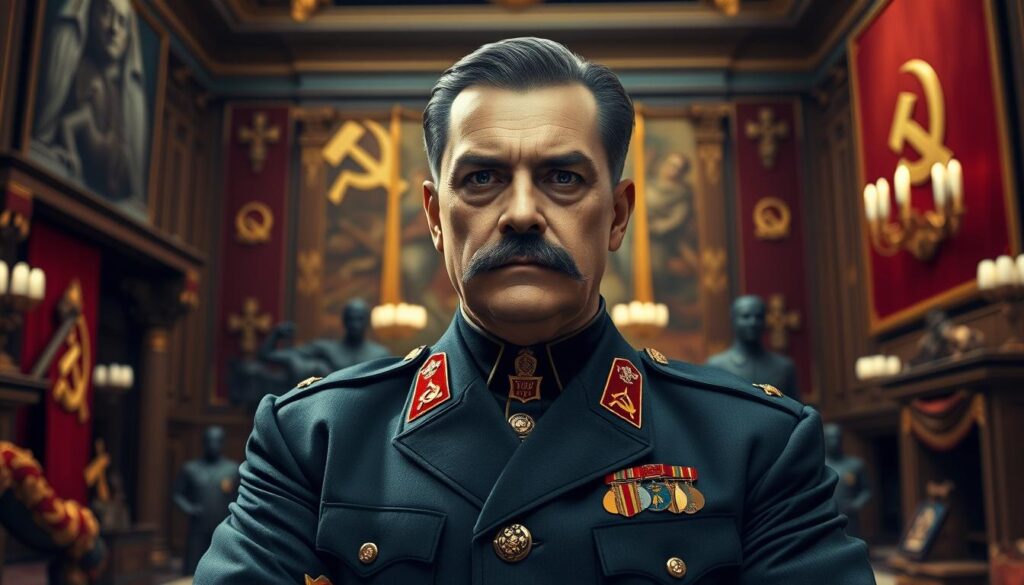
Joseph Stalin was born on December 18, 1878, in Gori, Georgia, which was part of the Russian Empire1. His real name was Ioseb Besarionis dze Jughashvili. His parents were Besarion Jughashvili and Ekaterine Geladze1. His early life and involvement in the Russian Social Democratic Labour Party shaped his worldview.
Stalin’s experiences in his youth were key to understanding his later life. He was involved in socialist activities within the Russian Social Democratic Labour Party1. His life and legacy are fascinating, giving insights into Soviet politics and the Russian revolution’s impact.
Key Takeaways
- Joseph Stalin was born on December 18, 1878, in Gori, Georgia, Russian Empire1.
- Stalin’s birth name was Ioseb Besarionis dze Jughashvili, and his parents were Besarion Jughashvili and Ekaterine Geladze1.
- He was involved in socialist activities within the Russian Social Democratic Labour Party1.
- Stalin played a significant role in the Russian revolution and Soviet politics as a Soviet leader.
- His legacy continues to be felt, with his impact on the Russian revolution and Soviet politics remaining a topic of interest and study.
Early Life and Rise to Power
Joseph Stalin’s life story is a remarkable journey from a tough childhood to becoming the USSR dictator. Born on December 18, 1878, in Gori, Georgia, Stalin faced many challenges early on2.
Childhood and Education
Stalin grew up in poverty and faced many changes. His father, a shoemaker, had trouble making ends meet, causing them to move often2. At ten, Stalin started at the Gori Church School. He did well despite health issues like smallpox and a permanent injury to his left arm2.
Political Beginnings
Stalin was drawn to revolutionary ideas and joined the Communist Party. He became a dedicated Bolshevik. His early work included organizing strikes and facing arrests and exiles, which helped him develop leadership and strategy skills2.
Bolshevik Revolution
In 1917, Stalin became a key player in the Russian Revolution. He played a big role in the Bolshevik takeover and the Civil War, working closely with Vladimir Lenin2. After Lenin’s death in 1924, Stalin removed rivals like Leon Trotsky. By the late 1920s, he had become the top leader of the Soviet Union3.
| Event | Year | Source |
|---|---|---|
| Birth of Stalin | 1878 | 2 |
| Enrollment in Gori Church School | 1888 | 2 |
| Joining Communist Party | 1901 | 2 |
| Becoming USSR dictator | Late 1920s | 3 |
Leadership and Policies
Joseph Stalin turned the Soviet Union into a strong industrial power. This change came at a high human cost. It shaped the nation for many years.
Economic Policies and Collectivization
Stalin’s Five-Year Plans aimed to make the Soviet Union a major industrial power4. He made farms into large state-controlled farms. This move was met with resistance from peasants and led to famine, causing millions of deaths5.
Role in World War II
Stalin was key in World War II, facing tough battles against Nazi Germany. Despite losing around 11 million Red Army soldiers5, Stalin’s leadership was vital in defeating Hitler. His strategic moves and resilience were key in winning the war and shaping the post-war world4.
Propaganda and Control
To keep power, Stalin used propaganda and built a cult of personality. The regime controlled media to show his image and ideas. It also used the Great Purge of the 1930s to silence dissent4. This control kept Stalin in power, spreading fear and obedience among the people.
| Policy | Impact | Source |
|---|---|---|
| Five-Year Plans | Industrial Growth | 4 |
| Collectivization | Famine and Deaths | 5 |
| Great Purge | Political Repression | 4 |
| Role in WWII | Defeat of Nazi Germany | 45, |
Legacy and Historical Impact
Joseph Stalin, as an USSR dictator, greatly influenced the Soviet Union. His actions and policies are widely debated today. They continue to shape our understanding of history.
Evaluation of Stalin’s Regime
Stalin made the Soviet Union a major industrial power by 19376. His aggressive planning boosted the economy but caused great suffering. Hundreds of thousands were killed or imprisoned during the Great Purge7.
Some see Stalinism as key to the USSR’s growth. Others strongly criticize the human rights abuses and the lives lost under his rule.
Influence on Later Communist Leaders
Stalin’s ways and policies affected many communist leaders. His system of control lasted even after he died, but his personal dictatorship did not6. Those who came after him tried to balance growth with stability and control.
Public Perception and Modern Interpretations
Views on Stalin have changed, mainly in Russia. In 2019, 70% of Russians saw Stalin positively8. Younger people are less sure or unaware of his harsh policies8.
Places like Moscow’s GULAG History Museum and media help us understand Stalin today. They show both his Cold War role and the dark side of his rule87.
FAQ
Who was Joseph Stalin?
A: Joseph Stalin was a key Soviet leader from the mid-1920s until his death in 1953. He was a major figure in the Russian Revolution. He made the Soviet Union a world power through Stalinism.
What were Stalin’s early life and education like?
Stalin was born in Georgia. He started with religious studies at a seminary. He then joined the Communist Party and got involved in politics.
How did Stalin rise to power within the Communist Party?
Stalin climbed the ranks by organizing strikes and joining the Bolshevik Revolution. His bond with Lenin and outsmarting rivals like Trotsky helped him become the top leader of the Soviet Union.
What were Stalin’s major economic policies?
Stalin launched Five-Year Plans for fast industrial growth. He also pushed for agricultural collectivization. This led to huge human losses and famines.
What was Stalin’s role in World War II?
At first, Stalin faced challenges in World War II. But he led the Soviet Union to victory over Nazi Germany. His leadership was critical to the war’s outcome.
How did Stalin maintain control over the Soviet population?
Stalin used propaganda and a cult of personality to keep power. He also had a system of political repression and terror. These methods controlled the population and eliminated opposition.
What is Stalin’s legacy and historical impact?
Stalin’s legacy is debated. He modernized the Soviet Union but at a high human cost. His influence is seen in Communist leaders and the Cold War.
How is Stalin perceived in modern times?
Views on Stalin have changed over time. Some see him as a leader who modernized the Soviet Union. Others criticize his oppressive regime. Today, Stalinism is a topic of ongoing debate.
Source Links
- https://en.wikipedia.org/wiki/Joseph_Stalin – Joseph Stalin
- https://en.wikipedia.org/wiki/Early_life_of_Joseph_Stalin – Early life of Joseph Stalin
- https://www.history.com/topics/european-history/joseph-stalin – Joseph Stalin: Death, Quotes & Facts | HISTORY
- https://www.britannica.com/topic/Stalinism – Stalinism | Definition, Facts, & Legacy | Britannica
- https://alphahistory.com/coldwar/joseph-stalin/ – Joseph Stalin
- https://www.britannica.com/biography/Joseph-Stalin/Legacy – Joseph Stalin – Soviet Leader, Dictator, Purges | Britannica
- https://fiveable.me/key-terms/world-history-since-1400/joseph-stalin – Joseph Stalin – (World History – 1400 to Present) – Vocab, Definition, Explanations | Fiveable
- https://lossi36.com/2020/03/30/remembering-reality-the-challenge-of-keeping-stalins-painful-legacy-alive/ – Remembering Reality: The Challenge of Keeping Stalin’s Painful Legacy Alive