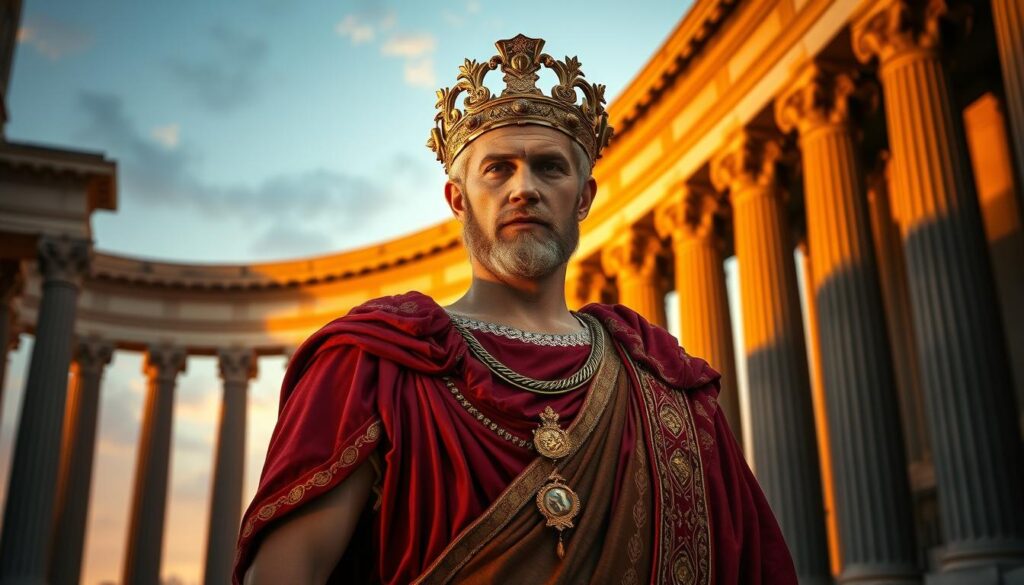
Nero was the last emperor of the Julio-Claudian dynasty. His reign was marked by significant events, including the Great Fire of Rome. This fire lasted for six days and seven nights, damaging or destroying 10 out of Rome’s 14 districts1.
As a Roman emperor, Nero’s legacy is complex. Some see him as a tyrant, while others view him as a visionary leader. The Roman Empire, under Nero’s rule, experienced significant cultural and architectural development. Nero himself was a patron of the arts2.
Imagine being a citizen of Rome during Nero’s reign. You would have seen the city transform and felt the impact of his decisions. The fire that began in the shops at the Circus Maximus on July 18, AD 64, raged for nine days. It burned two-thirds of Rome, including the Palatine Hill2.
As a Roman emperor, Nero’s actions had far-reaching consequences. They shaped the course of history and left a lasting legacy in the Roman Empire.
Nero reigned as emperor from 54 AD to 68 AD1. His reign was marked by significant events that would shape the Roman Empire’s future. His legacy continues to fascinate people today, with many wondering what drove his decisions and how his reign impacted the Roman Empire. As we explore Nero’s life and reign, we’ll uncover the complexities of his character and the lasting impact of his rule.
Key Takeaways
- Nero was the last emperor of the Julio-Claudian dynasty, ruling from 54 AD to 68 AD1.
- The Great Fire of Rome, which occurred during Nero’s reign, lasted for six days and seven nights, damaging or destroying 10 out of Rome’s 14 districts1.
- Nero’s legacy is complex, with some viewing him as a tyrant and others as a visionary leader, and his impact on the Roman Empire and the Julio-Claudian dynasty continues to be felt.
- Nero’s reign was marked by significant cultural and architectural development, with Nero himself being a patron of the arts2.
- The fire that began in the shops at the Circus Maximus on the night of July 18, AD 64, raged for nine days, burning two-thirds of Rome, including the Palatine Hill2.
Overview of Nero
Nero was born Lucius Domitius Ahenobarbus on December 15, 37 CE, in Antium, Italy3. He became emperor at just sixteen years old after Emperor Claudius died under unclear circumstances4. His early life was shaped by his mother, Agrippina the Younger, in the powerful Julio-Claudian dynasty3.
Historical Significance
Agrippina the Younger played a big role in Nero’s rise to power. She made sure he was adopted by Emperor Claudius, making him the fifth Roman emperor35. His rule, from AD 54 to AD 684, ended the Julio-Claudian dynasty. It was a time of big changes in Roman politics and society4.
Key Contributions
In the early years of his rule, Nero made changes to help Roman citizens. He lowered taxes, gave the Senate more freedom, and stopped capital punishment3. He also started many public works projects and supported arts like poetry and theatre4.
Controversies Surrounding Nero
Nero’s rule is often remembered for the Great Fire of Rome in AD 6435. The fire destroyed a lot of the city. Even though Nero wasn’t in Rome, people thought he started it to build his Golden House5.
After the fire, Nero blamed Christians for it, starting the first big persecution of Christians3. His love for luxury and arts also got him criticized by the Roman elite4.
| Event | Year | Details |
|---|---|---|
| Ascension to Emperor | AD 54 | Became emperor at age 16 after Emperor Claudius’ death4 |
| Great Fire of Rome | AD 64 | Destruction of Rome; Nero blamed Christians35 |
| Nero’s Reforms | Throughout reign | Reduced taxes, granted Senate autonomy, abolished capital punishment3 |
| Death of Nero | AD 68 | Committed suicide, ending Julio-Claudian dynasty4 |
The Legacy of Nero
Nero’s reign left a lasting impact on Rome. It shaped its buildings and culture.
Impact on Roman Architecture
After the Great Fire of 64 AD, Nero started a big rebuilding project. His Domus Aurea was a highlight of Neronian architecture. It had gardens, frescoes, and a huge bronze statue of himself6.
- Innovative use of concrete and vaults
- Integration of natural elements into urban design
- Advanced water management systems
Influence on Art and Culture
Nero loved to be seen as an artist. He performed in chariot races and played the lyre. This was new for an emperor and caused a lot of talk7.
He also took part in the ancient Olympic games. This showed how Rome and Greece shared art and culture.
Nero in Modern Literature
Nero’s story has been told in many ways in historical novels and popular culture. He’s often seen as a bad ruler or misunderstood. His story has been told in books and movies, showing how people’s views have changed over time.
| Work | Author/Creator | Year |
|---|---|---|
| Nero | J.F. Mallory | 2006 |
| Quo Vadis | Henryk Sienkiewicz | 1896 |
| Rome: Rise and Fall of an Empire | CITOWRCH | 2008 |
Lessons from Nero’s Reign
Nero’s time as emperor teaches us about leadership, public image, and governance. His rule offers lessons that are relevant today.
Leadership Styles
Nero became emperor at 17, with help from advisors like Seneca and Burrus8. This shows the value of experienced guidance in leadership. But, Nero later became more autocratic, making decisions alone9.
This change led to unstable governance10. Today, finding the right balance between advisor input and personal authority is key.
The Role of Public Perception
Nero knew how important his image was and used propaganda to control public opinion8. He performed in public and built grand projects to win people over9. But, the Great Fire of Rome damaged his reputation8.
Blaming Christians for the fire made things worse10. This shows how media and public relations can shape how we see leaders.
Lessons in Governance
Nero’s rule was complex, with both good and bad policies. He supported the arts and improved the status of slaves, and built public works9. But, his later decisions, like favoring some regions with tax breaks, were not good10.
His rule shows the importance of balancing personal power with institutional checks. This lesson is important today.
FAQ
Who was Emperor Nero?
Emperor Nero was the last of the Julio-Claudian dynasty. He ruled the Roman Empire from 54 to 68 AD. His actions and character have greatly influenced Roman history.
What were Nero’s key contributions to Roman governance?
Nero started his rule by cutting taxes and giving the Senate more power. He also supported the arts and built many public projects. These actions made him popular at first.
How did Agrippina the Younger influence Nero’s rise to power?
Agrippina the Younger was key in Nero becoming Emperor. She married Emperor Claudius and helped Nero get to the throne. Her actions shaped his early years and policies.
What is the Great Fire of Rome, and what was Nero’s involvement?
The Great Fire of Rome happened in 64 AD and destroyed much of the city. Some say Nero started it, but others doubt this. The fire hurt his reputation and caused big problems for him.
How has Nero been portrayed in modern literature and popular culture?
Nero has been a big topic in books, movies, and TV. He’s shown as a bad ruler and a supporter of the arts. This shows how complex his image is.
What is Nero software, and what are its primary functions?
Nero software is a package from Nero AG. It helps with burning CDs and DVDs, editing videos, backing up data, and managing media. It’s useful for many digital tasks.
How can I download Nero software for my computer?
You can get Nero software from the Nero website. They have versions for Windows and Mac. You can try it for free before buying.
Is there a free version of Nero burning ROM available?
Nero Burning ROM usually needs to be bought. But, Nero has a free trial. To use all its features, you need to buy it.
What features are included in the Nero multimedia suite?
The Nero suite has tools for burning CDs and DVDs, editing videos, backing up data, and encoding media. It’s a complete package for digital content.
Can Nero video editing software be used on both Windows and Mac platforms?
Yes, Nero’s video editing tools work on both Windows and Mac. This makes it easy to edit videos on different devices.
Source Links
- https://www.pbs.org/empires/romans/empire/nero.html – The Roman Empire: in the First Century. The Roman Empire. Emperors. Nero
- https://penelope.uchicago.edu/encyclopaedia_romana/gladiators/nero.html – Nero as the Antichrist
- https://www.britannica.com/biography/Nero-Roman-emperor – Nero | Biography, Claudius, Rome, Burning, Fate, Accomplishments, & Facts | Britannica
- https://en.wikipedia.org/wiki/Nero – Nero
- https://www.newyorker.com/magazine/2021/06/14/how-nasty-was-nero-really – How Nasty Was Nero, Really?
- https://www.history.com/topics/ancient-rome/nero – Nero ‑ Olympics, Accomplishments & Fate | HISTORY
- https://medium.com/@tinywonder/the-life-and-legacy-of-emperor-nero-from-power-to-infamy-b63a03472061 – The Life and Legacy of Emperor Nero: From Power to Infamy
- https://fbccov.org/the-emperor-nero-and-the-word-of-god/ – The Emperor Nero and the Word of God – First Baptist Church Covington, Louisiana
- https://medium.com/@bari200304007/the-complex-legacy-of-nero-unraveling-the-truth-of-romes-notorious-emperor-6cecbdcf4c7d – The Complex Legacy of Nero: Unraveling the Truth of Rome’s Notorious Emperor
- https://projects.swan.ac.uk/ancient-world/?p=642 – Nero and History: A Clash of Interest