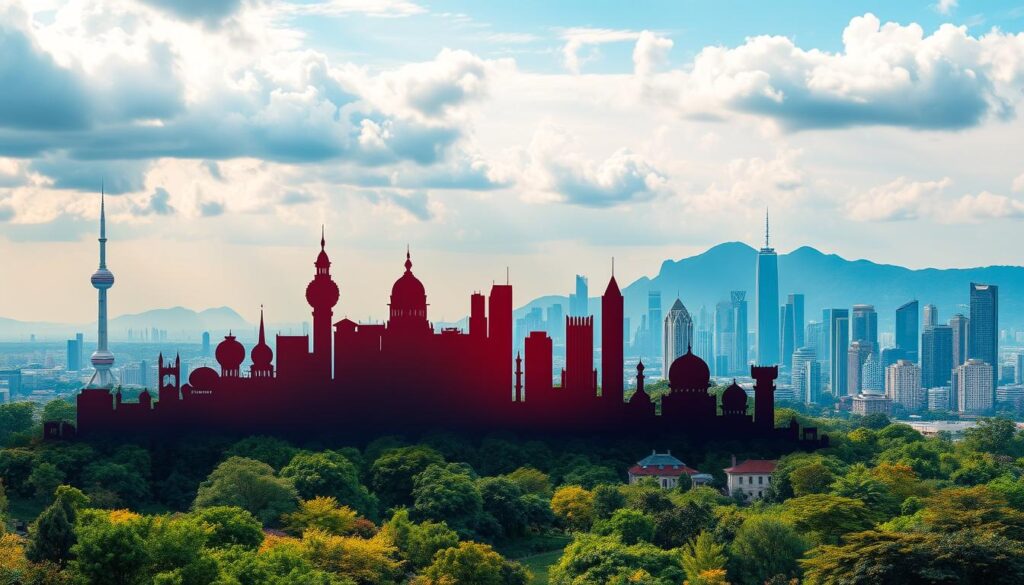
The world of international politics is changing fast. Emerging powers are leading this change. They have a big impact on global politics and diplomacy1. Countries like Brazil, India, and Indonesia are making their mark on the world.
These nations are changing how we see international relations. They are challenging the old ways of the Western world order. Their rise is making the world a more diverse place.
Emerging powers are making a big difference in the world. They are working together on economic and diplomatic fronts. Their influence is being seen in many areas, including international relations2.
Their growing role in global affairs is a big change. It’s affecting how we see the future of politics and the economy. This shift is important for everyone around the world.
Key Takeaways
- Emerging powers are redefining international relations and challenging the traditional Western-dominated world order.
- The rise of emerging economies, such as Brazil, India, and Indonesia, is being felt in emerging markets.
- The increasing presence of emerging powers in global governance is a significant shift in global dynamics.
- Emerging powers are shaping the world order in meaningful ways, from economic cooperation to diplomatic relations.
- The impact of emerging powers is being felt across various industries, including international relations2.
- The collective impact of emerging powers is having a significant effect on the global economy and international politics1.
Understanding Emerging Powers and Their Characteristics
Emerging powers are countries that are quickly becoming more important on the world stage. These nations are moving from being developing economies to being major players in global affairs3. Their growth is often because of economic expansion, large populations, and access to important resources4.
Definition of Emerging Powers
Emerging powers are countries or groups that can greatly influence global events. They show strong economic growth, growing political power, and expanding military strength3. Examples include the BRICS nations—Brazil, Russia, India, China, and South Africa—as well as countries like Saudi Arabia and Turkey5.
Historical Context
The idea of emerging powers became important in the early 21st century. This was due to the rise of large markets and changes in the economy4. The BRIC group was formed to represent these powers, later becoming BRICS with the addition of South Africa3. These nations have played big roles in global governance, taking part in international talks and efforts to reform5.
Key Characteristics
- Rapid economic growth
- Increasing political influence
- Expanding military capabilities
- Large populations and strategic geographic locations
- Abundant natural resources
These traits help emerging powers use their strengths in international groups and bilateral relations. They shape global policies and economic agreements35.
| Country | Region | Key Strength |
|---|---|---|
| Brazil | South America | Natural Resources |
| Russia | Europe/Asia | Military Strength |
| India | Asia | Population |
| China | Asia | Economic Growth |
| South Africa | Africa | Strategic Location |
| Saudi Arabia | Middle East | Energy Resources |
| Turkey | Middle East/Europe | Diplomatic Influence |
The Influence of Emerging Powers on Global Governance
Emerging powers are changing how the world is governed. They challenge old rules and create new alliances. These countries, known as growth economies, are becoming new world leaders.
Case Studies: BRICS and ASEAN
The BRICS group, made up of Brazil, Russia, India, China, and South Africa, is a strong force in global affairs6. ASEAN, the Association of Southeast Asian Nations, is key to regional peace and economic growth7. These groups show how emerging powers can change the world’s politics and economy.
Economic Collaboration and Trade Agreements
Emerging powers are leading in economic partnerships and trade deals. China’s fast-growing trade shows its big impact on global markets6. India’s steady growth makes it a future economic leader6. These countries are building networks to boost their economic power worldwide.
Environmental and Climate Initiatives
Emerging powers are leading on environmental issues. They are key in fighting climate change, with their emissions set to be half of global totals by 20306. They invest in green energy and work together to fight climate change.
| Group | Member Countries | Key Contributions |
|---|---|---|
| BRICS | Brazil, Russia, India, China, South Africa | Economic collaboration, alternative financial systems, global trade influence |
| ASEAN | 10 Southeast Asian Nations | Regional stability, economic integration, diplomatic initiatives |
Challenges and Opportunities Presented by Emerging Powers
The rise of growth economies and new world leaders is changing the world. These nations are becoming more important. They bring challenges and opportunities that change how countries work together and make rules.
Balancing Power Dynamics
China and India are changing how power is spread out. This makes the world more complex, with many countries having influence8. Old powers must form new alliances and change their ways to keep things balanced9.
Socioeconomic Development Challenges
Growth economies face big problems like income gaps, fast city growth, and protecting the environment10. Solving these issues is key to keeping their economies stable and growing over time.
Opportunities for Multilateral Cooperation
Even with challenges, there are chances for working together. New powers are leading in tech and green projects, showing new ways to partner. This teamwork can make global rules fairer and more effective8.
FAQ
What are emerging powers and how do they differ from developed nations?
Emerging powers are countries growing into influential global players. They differ from developed nations by showing fast economic growth and increasing political and military strength. Countries like Brazil, India, and Indonesia are changing the world order, bringing new dynamics to international relations.
How have emerging economies evolved to become key players on the global stage?
Emerging economies have grown through steady economic growth and smart investments. They use their natural resources and strategic locations to their advantage. China and India have made big strides in technology and manufacturing, competing with established economies. This has helped them gain more influence in global institutions and form strong alliances.
What are the key characteristics that define emerging markets?
Emerging markets are known for fast economic growth and a growing middle class. They attract more foreign investment and expand their industrial and service sectors. With large populations, natural resources, and strategic locations, they play a big role in global trade and finance.
In what ways are organizations like BRICS and ASEAN shaping global governance?
Groups like BRICS and ASEAN are changing global governance by promoting economic cooperation. They create trade agreements that challenge Western dominance. These efforts lead to more collective decision-making, stability, and solutions to common challenges, reshaping the world order.
How are emerging powers influencing environmental and climate initiatives?
Emerging powers are leading in environmental and climate efforts. They invest in green technologies, sign climate agreements, and lead in conservation. For example, China leads in renewable energy, and India focuses on reducing carbon emissions. Their efforts are key to solving global environmental problems.
What challenges do emerging economies face in their path to becoming global leaders?
Emerging economies face challenges like income inequality and environmental damage. They also deal with political instability, infrastructure needs, and joining the global economy. Overcoming these hurdles is vital for their continued growth and global influence.
What opportunities do emerging markets offer for international cooperation?
Emerging markets offer chances for cooperation in tech, sustainable development, and global health. Their growing consumer markets and investment opportunities attract partnerships. These partnerships can drive economic growth and strengthen diplomatic ties.
How can established powers engage constructively with emerging nations?
Established powers can work well with emerging nations by supporting inclusive frameworks and capacity-building. They should also promote fair trade and respect. Building partnerships based on mutual respect can lead to a more balanced and prosperous world.
Source Links
- Emerging Powers and the Future of American Statecraft – https://carnegieendowment.org/research/2024/04/emerging-powers-and-the-future-of-american-statecraft
- The Emerging Powers and the Emerging World Order: Back to the Future? – https://link.springer.com/chapter/10.1007/978-1-137-56178-7_1
- Emerging power – https://en.wikipedia.org/wiki/Emerging_power
- No title found – https://www.oxfordbibliographies.com/abstract/document/obo-9780199743292/obo-9780199743292-0187.xml
- What does it mean to be an emerging power? – https://moderndiplomacy.eu/2015/05/03/what-does-it-mean-to-be-an-emerging-power/
- Microsoft Word – papier LT10.doc – https://agritrop.cirad.fr/549192/1/document_549192.pdf
- Emerging Powers in Global Governance: Lessons from the Heiligendamm Process – https://www.cigionline.org/publications/emerging-powers-global-governance-lessons-heiligendamm-process/
- Emerging Powers and the Challenge to US Hegemony: Strategies and Responses – https://moderndiplomacy.eu/2023/04/06/emerging-powers-and-the-challenge-to-us-hegemony-strategies-and-responses/
- The New Geopolitics: Emerging Powers and the Challenges of a Multipolar World – https://carnegieendowment.org/events/2010/11/the-new-geopolitics-emerging-powers-and-the-challenges-of-a-multipolar-world
- PDF – https://agents.cirad.fr/pjjimg/tancrede.voituriez@cirad.fr/papier_LT10.pdf