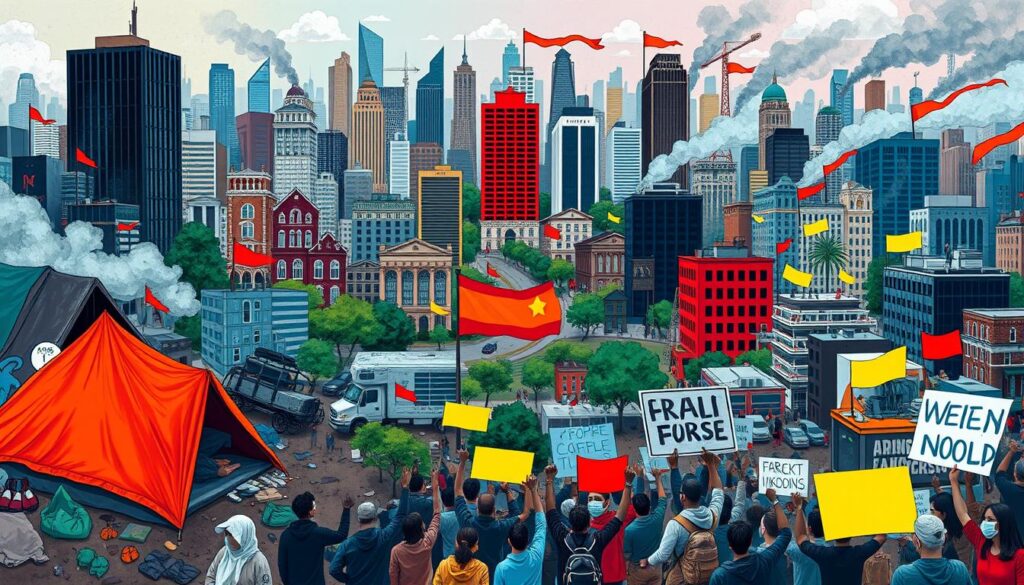
Social issues, societal problems, and community challenges are all connected. They affect people and communities all over the world. The United Nations says climate change, wars, and military conflicts are big problems today. Other issues include water contamination, human rights violations, and global health problems.
In the United States, student debt totals $1.75 trillion. On average, each borrower owes almost $29,000. This shows how serious the student debt crisis is1. These issues are complex and need a detailed plan to solve them.
Economic inequality, racial and ethnic discrimination, and climate change are all linked. In the US, about 1 in 10 adults have medical debt. Three million people owe more than $10,000, showing the high cost of healthcare1. The gap between the rich and the poor is growing, with the top 1.0% seeing a big increase in wages. The bottom 90% have only seen a small growth1.
Societal problems and community challenges need our attention and action. We must work towards a fair and equal society.
Key Takeaways
- Social issues are complex and multifaceted, requiring a detailed plan to solve them.
- Economic inequality, racial and ethnic discrimination, and climate change are all pressing concerns.
- The gap between the rich and the poor is growing, with the top 1.0% seeing a significant increase in wages1.
- About 1 in 10 adults in the US have medical debt, with 3 million owing more than $10,0001.
- Societal problems and community challenges need our attention and action to create a fair society.
- Climate change-related events are becoming more common, with severe winter storms in Texas causing energy failures and 246 deaths1.
Economic Inequality and Its Impacts
Economic inequality is a big issue in current affairs. It affects many parts of society. The gap between the rich and the poor keeps growing. This has led to many public debates and raised important cultural concerns.
Understanding Wealth Disparity
Wealth disparity means some people have a lot more than others. Over the last 40 years, the gap in income has grown worldwide. The top 10% now hold most of the wealth2.
New technologies have made things worse. They help those with lots of money and skills, hurting developing countries2.
The Role of Education
Quality education is key in fighting economic inequality. It helps people move up in society. But, some groups face barriers to education, making things worse3.
Addressing Systemic Barriers
Systemic barriers, like unfair policies and less regulation, add to economic inequality. To fix this, we need to change policies. This includes making taxes fairer and helping more people, but it’s hard because of money issues2.
| Statistic | Value | Source |
|---|---|---|
| Top 1% wage increase (1979-2020) | 179.3% | 2 |
| Bottom 90% wage increase (1979-2020) | 28.2% | 2 |
| Top 10% of Americans’ wealth (2021) | 70% | 2 |
| Global inequality decline (2000-2020) | Somewhat declined | 3 |
| Poorest 40% income growth (2010-2016) | Faster than entire population | 3 |
Racial and Ethnic Discrimination
Racial and ethnic discrimination is a big problem worldwide. It affects many parts of society and causes a lot of political debates. It’s important to understand where it comes from to solve these issues.
Historical Context of Racism
Racism has a long history that shapes our society today. It started with slavery and continued with segregation. These injustices have hurt communities for a long time4.
Current Movements for Equality
Groups like Black Lives Matter have made racial equality a big topic. They fight for fair systems and more inclusion45. They want policies that help fix the gaps in society.
Policies for Inclusivity
It’s key for governments and organizations to make policies that include everyone. Good policies can help close economic gaps and give everyone a fair chance6.
| Aspect | Statistics |
|---|---|
| Wealth Gap | Black households have significantly less net wealth compared to white households4 |
| Education | 40% of white adults hold a bachelor’s degree, vs. 26% Black adults6 |
| Unemployment Rate | 6.1% for Black adults vs. 3.3% for white adults6 |
| Public Perception | 61% believe more changes are needed for equal rights5 |
Climate Change and Environmental Justice
Climate change makes social issues worse by hitting hard on vulnerable groups. It brings more heat and extreme weather, making life harder. This leads to more people moving and less resources for everyone.
Effects on Vulnerable Communities
By 2050, 216 million people might have to move within their countries because of climate change7. Poor areas get hotter, with some cities’ neighborhoods being five to 12 degrees warmer than richer ones7. Also, communities of color are three times more likely to die from bad air7. This shows big environmental gaps.
The Role of Renewable Energy
Switching to renewable energy is key to fight climate change. Fossil fuels cause over 75% of global greenhouse gas emissions8. Using renewable energy can cut these emissions and help poor countries, which suffer most from climate change8.
Advocacy for Sustainable Practices
Advocacy is very important for green practices. Grassroots groups and global agreements help ensure justice for the environment. They focus on helping the most affected communities. Green efforts fight climate change and tackle community challenges from pollution9.
Mental Health Awareness and Accessibility
Mental health plays a big role in our daily lives. It’s a key topic in current affairs and public debates. It’s important to tackle cultural concerns about mental illness to build a supportive society.
Stigma Surrounding Mental Illness
Stigma stops many from seeking help, with over half not getting the help they need10. This stigma can lower self-esteem and make symptoms worse10. It’s critical to reduce prejudice to improve mental health.
Importance of Mental Health Resources
Having access to mental health resources is key. Yet, only 3-5% of employees use Employee Assistance Programs10. In 2022, only 48% felt okay talking about mental health with their bosses10. This shows we need better access.
Strategies for Increasing Awareness
Good strategies include public education and social marketing10. Sharing personal stories and getting involved in the community can help reduce stigma10. Also, having strong social support systems helps with mental health11.
To improve mental health awareness and access, we all need to work together. By understanding and tackling these issues, we can support those in need and boost overall well-being.
FAQ
What are the most pressing social issues facing society today?
Today, society faces many social issues. These include economic inequality, racial and ethnic discrimination, climate change, and mental health challenges. These problems affect communities worldwide. They need collaborative efforts to solve them.
How does economic inequality impact communities worldwide?
A: Economic inequality causes big problems. It leads to less access to resources, education, and healthcare. This makes social issues worse and slows down global progress.
It can make poverty rates go up, reduce social mobility, and cause tension in public debates about current affairs.
What are the root causes of wealth disparity?
Wealth disparity comes from many sources. These include unequal access to quality education, discriminatory policies, and systemic barriers. These factors keep economic inequality going and are key in political controversies and global dilemmas.
How does education influence economic inequality?
Education is very important in fighting economic inequality. Good education can help people move up in society. It gives them the skills to succeed, helping to solve community challenges and reduce societal problems.
What systemic barriers contribute to economic inequality?
Systemic barriers like discriminatory hiring, unequal pay, and biased law enforcement play a big role. They keep people in poverty and limit their opportunities. These are big issues in public debates and cultural concerns.
How has racial discrimination evolved over time?
Racial discrimination has changed a lot over time. It started with clear segregation and racism, but now it’s more subtle. Understanding this change is key to solving social issues and moving forward globally.
What are the current movements for equality, and how do they aim to create change?
Movements like Black Lives Matter fight against systemic racism and push for policy changes. They use grassroots organizing, public demonstrations, and social media to influence public debates and push for social justice.
How effective are policies aimed at promoting inclusivity?
Policies like affirmative action and anti-discrimination laws have had mixed results. Their success depends on how well they are implemented and how much society supports them. They are big topics in political controversies and cultural concerns.
How does climate change affect vulnerable communities differently?
Climate change hits vulnerable communities hard. It makes existing social inequalities worse. These communities often can’t adapt to environmental changes, leading to more hardships. This shows how environmental justice and social issues are connected.
What role does renewable energy play in mitigating climate change?
Renewable energy is key in reducing greenhouse gas emissions and fighting climate change. Advances in solar and wind power, along with good policies, are vital for a sustainable future. They help address global dilemmas.
What are some advocacy efforts for sustainable practices?
There are many efforts for sustainable practices. These range from local movements promoting recycling to international agreements like the Paris Accord. They aim to encourage responsible behavior and policy changes to fight climate change and promote environmental justice.
Why is mental health awareness important in today’s society?
Mental health awareness is key to reducing stigma around mental illnesses. It ensures people have access to the help they need. More awareness leads to empathy, supports public debates on mental health policies, and tackles social issues related to mental well-being.
What challenges exist in accessing mental health resources?
There are big challenges in getting mental health help. These include limited services, high costs, and stigma. These barriers stop many from getting help, making mental health issues worse. This highlights the need for thorough public debates and policy changes.
What strategies can increase mental health awareness and accessibility?
To boost mental health awareness and access, we need public education, policy reforms, and stigma reduction efforts. These actions aim to create a supportive environment. They ensure mental health resources are available to everyone, tackling critical social issues.
Source Links
- 10 Examples of Social Issues in the US – https://www.humanrightscareers.com/issues/examples-of-social-issues-in-the-us/
- Rising inequality: A major issue of our time – https://www.brookings.edu/articles/rising-inequality-a-major-issue-of-our-time/
- Inequality – Bridging the Divide | United Nations – https://www.un.org/en/un75/inequality-bridging-divide
- Racial Discrimination in Contemporary America | CEA | The White House – https://www.whitehouse.gov/cea/written-materials/2024/07/03/racial-discrimination-in-contemporary-america/
- 3. Discrimination and racial inequality – https://www.pewresearch.org/social-trends/2016/06/27/3-discrimination-and-racial-inequality/
- Racial Inequality in the United States – https://home.treasury.gov/news/featured-stories/racial-inequality-in-the-united-states
- Why Climate Change is an Environmental Justice Issue – https://news.climate.columbia.edu/2020/09/22/climate-change-environmental-justice/
- Climate justice and social justice: Two sides of the same coin – Greenpeace International – https://www.greenpeace.org/international/story/58334/climate-justice-and-social-justice-two-sides-of-the-same-coin/
- Environmental justice and climate change policies – https://pmc.ncbi.nlm.nih.gov/articles/PMC9391311/
- Stigma, Prejudice and Discrimination Against People with Mental Illness – https://www.psychiatry.org/patients-families/stigma-and-discrimination
- Social Determinants of Mental Health: Where We Are and Where We Need to Go – https://pmc.ncbi.nlm.nih.gov/articles/PMC6181118/