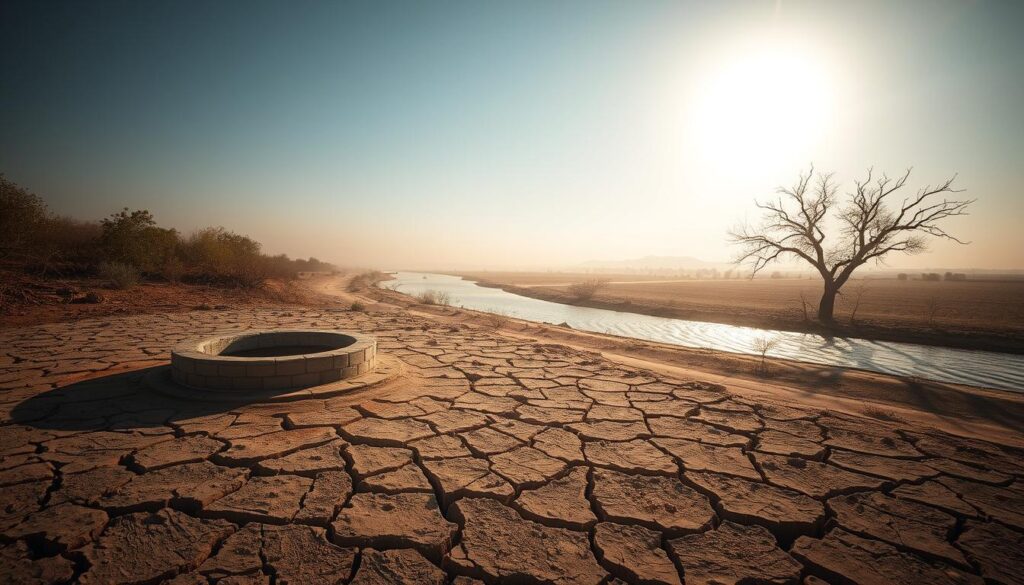
The world is facing a big problem: water scarcity. It affects millions of people, leading to a global water shortage and crisis. At least 50% of the planet’s population, or 4 billion people, face water shortages for a month each year1.
This shows how urgent it is to tackle the water scarcity crisis. It’s made worse because 703 million people lack clean water, which is 1 in 10 people globally2.
Imagine living without clean water, a reality for many. The cost to give one person clean water is just $502. This is a small price for a basic human right. So, what can we do to help communities worldwide and solve the global water shortage?
The water scarcity crisis is complex. But by understanding it, we can find solutions. By 2025, 1.8 billion people will face “absolute water scarcity,” says the Food and Agriculture Organization (FAO)1. This shows we must act now to solve the water crisis.
Key Takeaways
- Water scarcity affects at least 50% of the planet’s population, equivalent to 4 billion people1.
- 703 million people lack access to clean water, representing 1 in 10 people globally2.
- The average cost for providing one person with access to clean water is $502.
- By 2025, 1.8 billion people will face “absolute water scarcity”1.
- Agriculture utilizes about 70% of all fresh water globally1.
- Household leaks in the United States result in the wastage of nearly 1 trillion gallons of water annually1.
Understanding Water Scarcity and Its Causes
Water scarcity is a big problem worldwide, affecting millions. It’s important to know why it happens to solve it.
Definition of Water Scarcity
Water scarcity happens when we need more water than we have. It’s like when you spend more money than you make. There are two main reasons: not enough water resources and water that’s hard to use.
Climate Change Impacts
Climate change makes water harder to find. It changes how much rain we get and how much water evaporates. This means less fresh water for us3. It also melts glaciers, which are important water sources for many people.
Population Growth and Urbanization
The world’s population keeps growing, and cities are getting bigger. This means more people need clean water. The demand on water supplies is getting too high, making it essential to manage water better3.
Global Examples of Water Scarcity
Water scarcity is a big problem worldwide. Each area has its own challenges and ways to solve them. Looking at these examples helps us learn how to manage water better.
Case Study: Cape Town’s Day Zero
Cape Town, South Africa, was close to running out of water during the “Day Zero” crisis. Thanks to tough water management plans and everyone’s help, the city avoided disaster. They put in place strict water rules and started clean water initiatives.
Water Scarcity in India
India is struggling with water scarcity, affecting both country and city folks. Poor areas are hit hard, making health problems worse and slowing down the economy4. The growing population and more factories also make water even scarcer42.
Lessons from Israel’s Water Management
Israel is a top example of smart water management. They use cool tech like desalination and recycling water. These sustainable water solutions help Israel use its water wisely, showing the way for others.
| Country | Challenge | Solutions Implemented |
|---|---|---|
| Cape Town, South Africa | Imminent water depletion | Strict water restrictions, public conservation efforts |
| India | Widespread scarcity impacting health and economy | Improved water infrastructure, awareness campaigns4 |
| Israel | Limited freshwater resources | Desalination, wastewater recycling4 |
Effective Solutions for Mitigating Water Scarcity
Fixing water scarcity needs a mix of actions, tech, and policies. By using smart strategies, we can use water better and keep it clean for everyone.
Water Conservation Techniques
Water-saving steps are key at all levels. Simple actions like fixing leaks and using efficient appliances help a lot. Communities can also use rainwater and promote low-water gardens.
In factories, recycling water and improving processes saves a lot of water5.
Innovative Technologies in Water Purification
New tech is helping clean water. Desalination plants are getting better, making seawater drinkable. Membrane and UV tech also improve water quality.
These solutions increase clean water and lessen our need for old sources6.
Policy Changes for Sustainable Water Use
Changing policies is essential for water management. Water pricing reforms make wasting water expensive. Rules for industry push companies to be green.
Government support for clean water projects helps communities a lot56.
Community Engagement and Education
Helping communities fight water scarcity is key. When people get involved, we can manage water better and use it wisely.
Raising Awareness about Water Issues
Public campaigns and social media are great for teaching about water saving. Groups like the London Water Exchange run programs and workshops. They teach people how to use water efficiently7.
Involving Local Communities in Conservation
When locals help, we get creative solutions for saving water. For example, Curitiba, Brazil, uses rainwater harvesting. This has cut down water use and made water more reliable8.
Educational Programs for Future Generations
Teaching kids about saving water is important. Programs like ADI’s Community-based Sustainable Water Resource Development teach students. They learn how to save water for the future89.
By working with and teaching communities, we can make sure everyone has clean water. Your help is critical in keeping our water safe for future generations.
FAQ
What is water scarcity and why is it a global concern?
Water scarcity means there’s not enough water for everyone’s needs. It’s a big problem worldwide because it affects millions of people. It makes it hard to get clean water, hurts public health, and slows down economic growth. We need to solve it to keep our planet healthy for now and the future.
What are the primary causes of water scarcity?
The main reasons for water scarcity are climate change and population growth. Climate change changes how much rain we get and makes water evaporate faster. Population growth and cities getting bigger use up more water. Bad water management and using up all the water also make it worse.
How does climate change affect water resources?
Climate change messes with rain patterns, leading to long droughts or too much rain. It also makes water evaporate faster, lowering water levels in lakes and rivers. This messes up the natural water cycle, making it hard to keep water clean and reliable.
Can you explain the difference between physical and economic water scarcity?
Yes. Physical water scarcity means there’s not enough water for everyone, including nature. Economic water scarcity means there’s enough water, but people can’t afford to get it. Both are big problems, but need different solutions.
What strategies helped Cape Town avoid its “Day Zero”?
Cape Town almost ran out of water but didn’t thanks to big efforts. They cut down water use, put on strict rules, found new water sources, and educated people. These steps helped save the city’s water during a very tough time.
How is water scarcity impacting communities in India?
In India, water scarcity hurts both country and city areas. It makes it hard to get clean water, which affects health and jobs. In the countryside, farmers can’t water their crops enough. In cities, too many people and old water systems make it hard to get water. These problems make water very scarce and slow down progress.
What innovative approaches has Israel implemented for water management?
Israel is a leader in water management thanks to new ideas. They use advanced ways to clean water and make it from saltwater. They also use water-saving farming and recycle wastewater. These steps help Israel use its water wisely.
What are some effective water conservation techniques individuals can adopt?
There are many ways to save water. Fixing leaks, using less water in the shower, and choosing water-saving appliances are good starts. Being mindful of how much water we use and teaching others can also help a lot.
How do innovative technologies contribute to solving the water scarcity crisis?
Innovative technologies are key to solving water scarcity. They improve how we clean and make water, reuse it, and distribute it. These technologies help make more water available, reduce waste, and manage water better.
Why is community engagement essential in combating water scarcity?
Community engagement is vital in fighting water scarcity. It brings people together to save water and make a difference. When communities work together, they can find and keep solutions. This way, they can keep water safe for the long term.
Source Links
- Global water shortages are looming. Here is what can be done about them. – https://www.unep.org/news-and-stories/story/global-water-shortages-are-looming-here-what-can-be-done-about-them
- Global water crisis: Facts, FAQs, and how to help – https://www.worldvision.org/clean-water-news-stories/global-water-crisis-facts
- Water Shortage: Causes and Effects | Earth.Org – https://earth.org/causes-and-effects-of-water-shortage/
- Water Scarcity | UN-Water – https://www.unwater.org/water-facts/water-scarcity
- Exploring the Most Efficient Solutions to Water Scarcity | Earth.Org – https://earth.org/solutions-to-water-scarcity/
- Experts Name the Top 19 Solutions to the Global Freshwater Crisis – https://www.circleofblue.org/2010/world/experts-name-the-top-19-solutions-to-the-global-freshwater-crisis/
- Empowering Communities: The Role of Community Engagement in Water Management – https://medium.com/@LondonWaterExchange/empowering-communities-the-role-of-community-engagement-in-water-management-7898bb531bb3
- Community Engagement in Water Management – https://www.adi-international.org/community-engagement-in-water-management-empowering-individuals-for-collective-impact/
- Clean water leads to education: Understanding water scarcity in rural India – https://international.uiowa.edu/news/2024/04/clean-water-leads-education-understanding-water-scarcity-rural-india