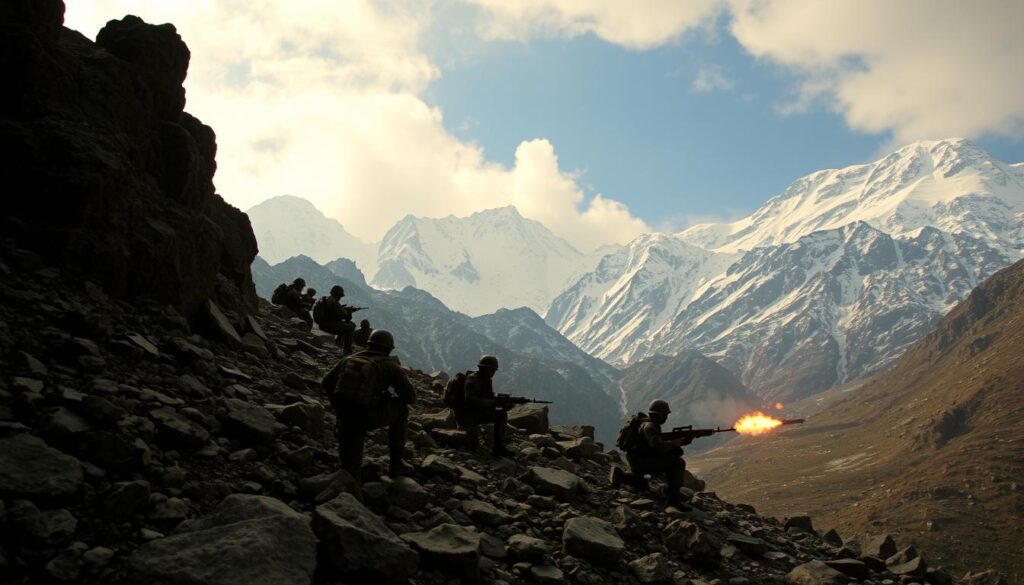
The Kargil War, also known as the Kargil conflict, was a key event in the history of India and Pakistan. It took place from May to July 1999 in the Kargil district of Ladakh and along the Line of Control (LoC)1. In India, it’s called Operation Vijay, showing the country’s efforts to take back its land. This war was part of a larger fight over Kashmir between India and Pakistan1.
Indian reports say 527 soldiers were killed, 1,363 were wounded, and 1 was taken prisoner during the Kargil War2. The war lasted for 2 months, 3 weeks, and 2 days, from May to July 19992. It started in spring 1999, causing thousands to lose their homes and jobs in places like Ganokh village3.
The Kargil conflict was a major shift in American policy towards India1. Losses in the war were different for each side. India lost over 500 men, while Pakistan’s losses were estimated between 400 to 4,0003. The U.S. Department of State said 700 soldiers were killed in the Kargil War2.
Key Takeaways
- The Kargil War was fought between India and Pakistan from May to July 1999.
- Indian official figures report 527 soldiers killed and 1,363 wounded during the conflict2.
- The conflict was part of the broader conflict over the region of Kashmir between India and Pakistan1.
- Estimates of losses in the Kargil War vary, with India reported to have lost over 500 men3.
- The Kargil conflict was a significant turning point in American foreign policy with India1.
- The U.S. Department of State estimated 700 soldiers killed during the Kargil War2.
- The conflict lasted 2 months, 3 weeks, and 2 days, from May to July 19992.
Overview of the Kargil War
The Kargil War was a major conflict in 1999. It involved intense battles and strategic moves between India and Pakistan.
Background and Causes
The Kashmir dispute had been ongoing for a long time. It escalated when Pakistani troops, disguised as Kashmiri militants, crossed into Indian territory4.
Major Players Involved
The Indian Army played a key role in the Kargil War. They were supported by political leaders and international allies. Pakistani paramilitary forces and local militants were on the other side4.
Timeline of Events
- May 1999: Pakistani forces started infiltrating5.
- June 1999: India launched Operation Vijay to take back lost territories.
- July 1999: The Indian Army won key battles, forcing Pakistan to withdraw5.
| Aspect | Details |
|---|---|
| Total Death Toll (India) | 5274 |
| Total Death Toll (Pakistan) | 357-4534 |
| Duration | May to July 19995 |
| Key Operation | Operation Vijay |
| Annual Commemoration | Vijay Diwas on July 26 |
Key Battles and Strategies
The Kargil War saw many key battles that changed the war’s outcome. The Battle of Tololing was a major turning point in the Kargil sector.
Notable Military Operations
Operation Vijay was the Indian plan to take back lost areas. Peaks like Tiger Hill and Point 4875 were fought over hard. This showed how important high ground is6.
Tactical Approaches Used
Both sides used special mountain tactics in the Kargil and Dras sectors. The Indian Army used quick infantry attacks and artillery to push out the enemy7.
Role of Technology in the Conflict
Technology was key, with the Indian Air Force doing precise strikes with Mirage 2000s in Operation Safed Sagar. Also, satellite images and UAVs gave vital info76.
| Battle | Location | Outcome | Significance |
|---|---|---|---|
| Battle of Tololing | Kargil sector | Indian victory | Gained strategic high ground |
| Battle of Tiger Hill | Kargil sector | Indian victory | Crucial for securing supply lines |
| Battle of Point 4875 | Dras sector | Indian victory | Enhanced territorial control |
Aftermath and Implications
The Kargil War’s end was a big change for India and Pakistan. India won back Kargil through Operation Vijay, making its borders stronger8.
Political Consequences for India and Pakistan
The war changed politics in both countries. In Pakistan, General Pervez Musharraf took power after the war, changing the government9. For India, winning boosted public trust and made them rethink their policies towards Pakistan9.
Impact on Military Strategies
India learned they needed better technology and military readiness after the war. Both countries increased troops along the Line of Control, leading to more militarization9. The war showed how important training for high-altitude battles and gathering intelligence are8.
Lessons Learned for Future Conflicts
The Kargil War taught big lessons about border security and quick action in conflicts. It showed the need for strong leaders and modern technology in war. The world also learned the importance of talking things out to avoid more fighting89.
FAQ
What was the Kargil War?
The Kargil War was a major fight between India and Pakistan in 1999. It happened in the Kargil sector of Kashmir. The war lasted from May to July, causing big changes for both countries.
What were the main causes of the Kargil War?
The war started because of a long dispute over Kashmir. Pakistani forces and militants crossed into Indian territory. They wanted to cut off the Kargil sector and force India to talk about Kashmir.
Who were the key players involved in the Kargil War?
The Indian Army and Pakistani forces were the main fighters. Indian Prime Minister Atal Bihari Vajpayee and Pakistani Prime Minister Nawaz Sharif made key decisions.
What was Operation Vijay and its significance in the Kargil War?
Operation Vijay was India’s plan to take back lost territory. It started in May 1999. The Indian Army showed great skill in the high-altitude battles, winning back the areas.
What were some of the key battles in the Kargil War?
The Battle of Tololing was a big win for India. They took back the Tololing peak from Pakistan. The Dras sector was also a key area, known for its tough weather and terrain.
How did technology influence the outcome of the Kargil War?
Technology was very important in the Kargil War. Air power and surveillance helped India a lot. These tools gave them the edge they needed to win in the tough Kargil terrain.
What were the long-term implications of the Kargil War for India and Pakistan?
The war changed a lot for both countries. It led to new leaders and changed public views. India became stronger in security. Both countries updated their military plans. The war showed the need for better border security and diplomacy to avoid future fights.
Source Links
- How the 1999 Kargil conflict redefined US-India ties – https://www.brookings.edu/articles/how-the-1999-kargil-conflict-redefined-us-india-ties/
- Kargil War – https://en.wikipedia.org/wiki/Kargil_War
- Kargil: The forgotten victims of the world’s highest war – https://www.bbc.com/news/world-asia-49101016
- Kargil War: History, Reason, Heroes and Result – https://www.vedantu.com/history/kargil-war
- Kargil Chronicles: Pakistan’s Objective During Kargil War – https://www.jagranjosh.com/general-knowledge/what-was-pakistans-objective-in-kargil-war-1721826969-1
- 25 Years of Kargil War – A Defining Moment in Indian History – https://raksha-anirveda.com/25-years-of-kargil-war-a-defining-moment-in-indian-history/
- Kargil War: What Key Military Strategies Were Employed by India? – https://www.upscprep.com/kargil-war-what-key-military-strategies-were-employed-by-india-2/
- Kargil Chronicles: From Infiltration to Victory, Lessons for the Future – https://www.jagranjosh.com/general-knowledge/what-are-the-lessons-from-kargil-war-1721656878-1
- Kargil Chronicles: Impact of the Kargil War on Indo-Pak Relations – https://www.jagranjosh.com/general-knowledge/kargil-chronicles-impact-of-the-kargil-war-on-indo-pak-relations-1721658822-1