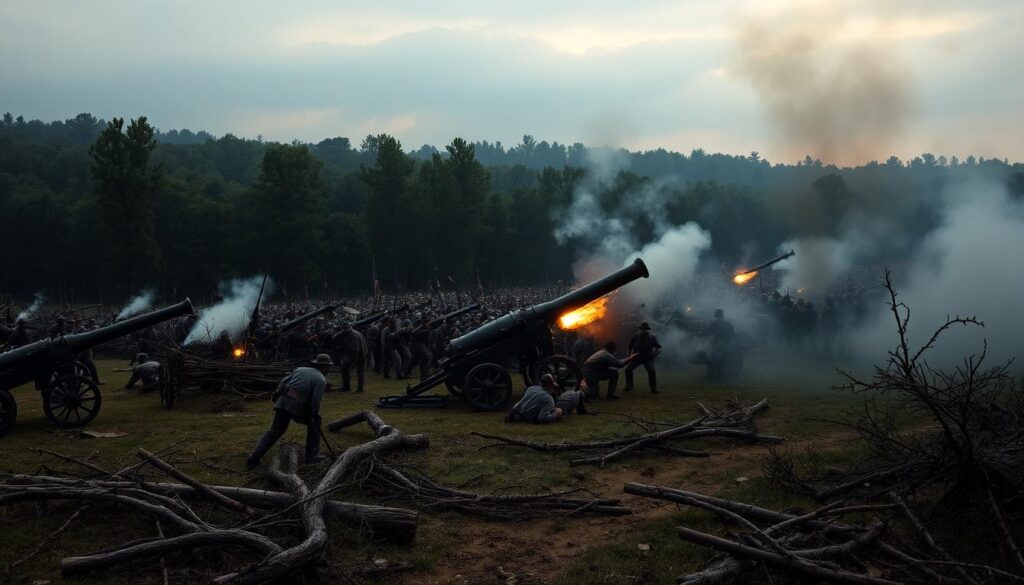
The Battle of Chancellorsville was a key event in the American Civil War. It happened from April 30 to May 6, 1863, in Spotsylvania County, Virginia. It’s seen as a big win for the Confederacy, with the Union Army having about 133,868 troops ready for battle1.
This battle is called General Robert E. Lee’s “perfect battle” because of his smart moves. These moves led to the injury of Stonewall Jackson, a big loss for the South. The Union Army had around 106,000 soldiers, minus some units1. This battle is a big part of Virginia’s Civil War history, showing how complex the war was.
The Battle of Chancellorsville was a big fight in the American Civil War. The Confederates had 60,000 veterans at Fredericksburg, facing 130,000 well-equipped Federals2. The battle caused about 12,145 casualties, including 1,082 deaths, 6,849 wounded, and 5,214 captured or missing1.
The total losses for the Chancellorsville campaign were around 17,287. This includes 1,606 killed, 9,762 wounded, and 6,919 captured or missing1. Major General Joseph Hooker took over in January, bringing skills that helped his troops’ health and morale2.
Key Takeaways
- The Battle of Chancellorsville was a major Confederate victory in the American Civil War.
- The battle took place from April 30 to May 6, 1863, in Spotsylvania County, Virginia.
- General Robert E. Lee’s strategic maneuvers led to the wounding of Stonewall Jackson.
- The Army of the Potomac had approximately 133,868 troops present for duty equipped1.
- The battle resulted in significant casualties, with approximately 17,287 total casualties1.
- Major General Joseph Hooker replaced Burnside in January, restoring the health and morale of his troops2.
Overview of the Battle
The Battle of Chancellorsville was a key moment in the American Civil War. It showed General Robert E. Lee’s strategic genius and Stonewall Jackson’s bravery. This battle, from April 30 to May 6, 1863, was a Confederate victory. It happened even though the Union had more soldiers34.
Historical Context
Before the battle, the Union had tried to take Richmond but failed. This led to changes in leadership and plans. The Union, led by Major General Joseph Hooker, had about 130,000 soldiers. They wanted to gain an advantage in the Eastern Theater45.
General Lee had around 57,400 men. Despite being outnumbered, he showed great skill and creativity in his tactics35.
Key Players
- General Robert E. Lee: Led the Confederate Army of Northern Virginia, known for his smart strategies34.
- Stonewall Jackson: A famous Confederate general whose bold tactics were key to the battle’s success45.
- Major General Joseph Hooker: Led the Union forces, whose big plans ended in a Union defeat34.
Significance of the Battle
The Battle of Chancellorsville is seen as Lee’s greatest win. It changed the war’s path. The Confederate victory lifted Southern spirits and pushed Lee to invade the North. This influenced future military plans5.
| Category | Union | Confederate |
|---|---|---|
| Dates | April 30 – May 6, 1863 | |
| Soldiers Engaged | 97,0003 | 57,0003 |
| Casualties | 14,0003 | 10,0003 |
Major Events of the Battle
The Battle of Chancellorsville took place in the Fredericksburg and Spotsylvania National Military Park. It was a place of beauty and strategy.
Initial Movements
General Hooker started by quickly moving four army corps across the river. He wanted to outflank General Lee and isolate parts of the Confederate forces6. This bold move temporarily left a quarter of Lee’s army at risk of being outnumbered.
The Flanking Maneuver
Confederate General Stonewall Jackson then led 30,000 men on a daring 12-mile march. They surprised Hooker’s right flank6. This unexpected attack made the Union flank crumble, leading to a big defeat for the Union.
Turning Point Strategies
General Lee’s decision to divide his forces showed his tactical genius. He sent divisions to counter Hooker’s attacks from different directions7. This ensured a Confederate victory, despite being outnumbered. These strategies not only won a key battle but also changed the course of the Civil War.
Aftermath and Consequences
The Battle of Chancellorsville left both armies battered. The Union lost 17,287 casualties, and the Confederacy lost 13,8218. These numbers show how costly and intense the battle was.
Casualties and Losses
The loss of life was huge for both sides. The Confederacy’s win boosted their morale. But, the death of Stonewall Jackson was a big loss for them8.
Impact on the Civil War
The Confederate win at Chancellorsville changed General Robert E. Lee‘s plans. It led to the Gettysburg campaign. This moment showed the Confederacy’s strength despite tough times8.
Lessons Learned
The battle showed the power of bold tactics and strong leadership. Lee and Jackson’s strategies are studied a lot. They teach us about military leadership and innovation.
Commemoration and Legacy
The Battle of Chancellorsville is a key part of Virginia’s Civil War history. It is celebrated and remembered through various initiatives and memorials.
Monuments and Memorials
The Fredericksburg and Spotsylvania National Military Park has many monuments and markers. They honor the bravery and sacrifice of those who fought. These structures not only commemorate the events of the battle but also serve as educational tools for visitors.
Historical Reenactments
Historical reenactments keep the legacy of Chancellorsville alive. These events allow participants and spectators to experience the strategies and challenges faced by soldiers. They provide a tangible connection to Virginia Civil War history.
Educational Resources
For those interested in delving deeper, a wealth of educational resources is available. From detailed books and documentaries to online materials, these resources offer insights into the Battle of Chancellorsville. Schools and educators often use these tools to highlight the battle’s importance in American history.
Visitors to the Fredericksburg and Spotsylvania National Military Park contribute to its ongoing preservation efforts. In 2018 alone, the park welcomed thousands of history enthusiasts9. Investments, such as the $1.6 million allocated for exhibit upgrades, ensure that future generations can continue to learn from and appreciate this event9.
FAQ
What was the Battle of Chancellorsville?
The Battle of Chancellorsville took place from April 30 to May 6, 1863, in Virginia. It was a key moment in the American Civil War. General Robert E. Lee’s “perfect battle” saw the Confederates win despite being outnumbered.
The battle is famous for its clever strategies and the serious injury of Stonewall Jackson. This injury added to the battle’s complex legacy.
Why is the Battle of Chancellorsville considered General Robert E. Lee’s greatest victory?
The Battle of Chancellorsville is seen as General Robert E. Lee’s greatest victory. He used bold tactics against a larger Union force. Lee’s decision to split his troops and Jackson’s flanking maneuver showed his strategic brilliance.
This victory lifted Confederate morale and showed Lee’s leadership skills in the Virginia Civil War.
What role did Stonewall Jackson play in the Battle of Chancellorsville?
Stonewall Jackson was key in the Battle of Chancellorsville. He led a 12-mile march around the Union army, surprising them. This attack on the Union right flank was a turning point for the Confederates.
Unfortunately, Jackson’s heroics were cut short by his serious injury. This had a lasting impact on the Confederate army.
What were the major events during the Battle of Chancellorsville?
The Battle of Chancellorsville started with Union General Joseph Hooker trying to outflank Lee’s forces. General Robert E. Lee responded with clever maneuvers, including Stonewall Jackson’s flanking march.
The battle’s turning point was when Lee divided his forces, despite being outnumbered. This led to intense battles. These events took place in what is now the Fredericksburg and Spotsylvania National Military Park.
What were the consequences of the Battle of Chancellorsville?
The Battle of Chancellorsville resulted in heavy casualties for both sides. The Union suffered a significant defeat. This victory gave Lee the confidence to invade the North, leading to the Battle of Gettysburg.
The battle also had a psychological impact. It boosted Confederate morale and demoralized Union forces. The tactics used at Chancellorsville influenced future battles in the war.
How is the Battle of Chancellorsville commemorated today?
Today, the Battle of Chancellorsville is remembered through monuments and memorials in the Fredericksburg and Spotsylvania National Military Park. Historical reenactments bring the battle to life, showing what combat and daily life were like during the Civil War.
Books, documentaries, and online materials are available for those interested in learning more. These efforts keep the legacy of Chancellorsville alive in Virginia’s Civil War history.
Source Links
- Battle of Chancellorsville – https://en.wikipedia.org/wiki/Battle_of_Chancellorsville
- The Battle of Chancellorsville – Fredericksburg & Spotsylvania National Military Park (U.S. National Park Service) – https://www.nps.gov/frsp/learn/historyculture/chist.htm
- Battle Of Chancellorsville – https://www.historynet.com/battle-of-chancellorsville/
- Civil War: Battle of Chancellorsville – https://www.ducksters.com/history/civil_war/battle_of_chancellorsville.php
- Battle of Chancellorsville tour of monuments and historical markers – https://stonesentinels.com/chancellorsville/
- Timeline of the Civil War Battle of Chancellorsville, Virginia – https://stonesentinels.com/chancellorsville/timeline-battle-chancellorsville/
- Battle of Chancellorsville ‑ Who Won, Significance & Facts | HISTORY – https://www.history.com/topics/american-civil-war/battle-of-chancellorsville
- Chancellorsville Battlefield Tour – Fredericksburg & Spotsylvania National Military Park (U.S. National Park Service) – https://www.nps.gov/frsp/learn/photosmultimedia/chancellorsville-battlefield-tour.htm
- Commemoration of the American Civil War – https://en.wikipedia.org/wiki/Commemoration_of_the_American_Civil_War