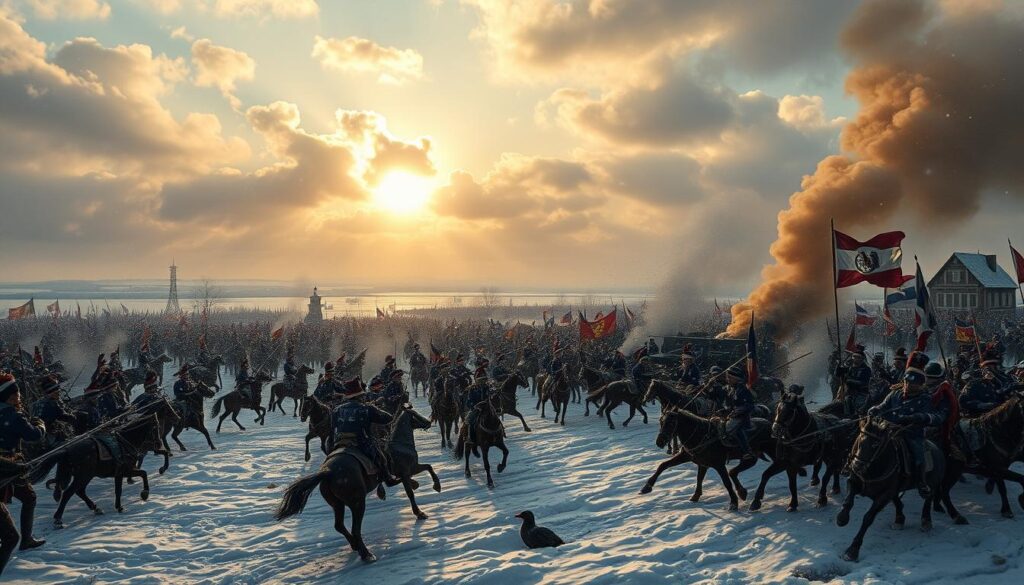
The Battle of Austerlitz, also known as the Battle of the Three Emperors, happened on December 2, 1805. It took place near Austerlitz in the Austrian Empire, now Slavkov u Brna in the Czech Republic. It was a key battle in the Napoleonic Wars1.
This battle is a major part of Austerlitz history and the Napoleonic Wars. It shows Napoleon’s strategic brilliance. The battle saw Napoleon’s 68,000 troops face off against almost 90,000 Russians and Austrians1. It’s seen as a masterclass in military strategy, making it vital to understanding the Napoleonic Wars.
The French forces, led by Napoleon, defeated the Austro-Russian army. This forced Austria to make peace with France1. This had a big impact on European history and the Napoleonic Wars. As you explore the Battle of Austerlitz, you’ll see how Napoleon’s Grande Armée marched from the Channel coast to the Rhine quickly2.
Key Takeaways
- The Battle of Austerlitz was a decisive engagement in the Napoleonic Wars, marking a turning point in European history.
- Napoleon’s strategic genius was on full display during the battle, as he outmaneuvered the Austro-Russian army.
- The Battle of Austerlitz is considered one of the greatest military victories in history, and it is a significant part of Austerlitz history.
- The Grande Armée, led by Napoleon, was a formidable force that played a critical role in the Napoleonic Wars.
- The battle’s outcome had far-reaching consequences, shaping the course of European politics and the Napoleonic Wars.
Historical Background of the Battle of Austerlitz
The early 19th century was a time of great change in Europe. Alliances shifted, and power struggles never stopped. The Austerlitz location in today’s Czech Republic was where these tensions came to a head. It was the site of a battle that would change history.
To understand the Austerlitz facts, we must look at the Napoleonic Wars. These wars changed Europe in ways that were both big and lasting.
The Napoleonic Wars Context
The Napoleonic Wars were a series of battles fought by Napoleon’s French Empire against many other European powers. Napoleon wanted to grow French power and change Europe’s politics. The War of the Third Coalition was a key moment leading up to the Battle of Austerlitz.
This battle was important because it ended threats from Austria and Russia.
Key Leaders and Forces Involved
Napoleon led the Grande Armée, starting with 198,000 soldiers but dropping to 52,000 near Brünn3. The Austro-Russian forces, led by Tsar Alexander I and Holy Roman Emperor Francis II, had about 78,000 soldiers3. Napoleon’s clever moves boosted his army to 74,000 by November 30, a 40% increase over the allies’ advance3.
Prelude to the Battle
Napoleon planned a series of moves to trick his enemies. He carefully placed his troops, with leaders like Soult, Bernadotte, Murat, and Lannes in charge4. The Pratzen plateau, at 324 meters high, was key to the battle4.
| Force | Commander | Troop Count |
|---|---|---|
| Grande Armée | Napoleon Bonaparte | 74,0003 |
| Austro-Russian Army | Tsar Alexander I & Francis II | 78,0003 |
| French I, IV, V Corps | Bernadotte, Soult, Lannes, Murat | 52,000 initially + 74,000 reinforcements34, |
The Course of the Battle
The Battle of Austerlitz was a masterfully planned event. It marked a key moment in the Austerlitz timeline.
Strategic Positioning of Forces
Napoleon made his forces look weak on the right flank. He wanted the Allied troops to attack early. This clever trick allowed the French to find and attack the enemy’s weak spots5.
Critical Turning Points in Combat
A key moment came when French troops took the Pratzen Heights. This split the Allied army. It caused confusion and disarray among the Russians and Austrians6.
Aftermath of the Battle
After the battle, the Holy Roman Empire was dissolved. The Confederation of the Rhine was formed. France’s victory changed Europe’s politics. It led to the creation of many Austerlitz monuments to honor this victory.
| Side | Casualties | Captured |
|---|---|---|
| French | 1,288 killed, 6,991 wounded | 573 captured |
| Allies | 15,000-16,000 killed or wounded | 12,000-20,000 captured |
Significance of the Battle
The Battle of Austerlitz is a key moment in Austerlitz history. It changed Europe’s politics and showed Napoleon’s skill in war.
Impact on Napoleonic Expansion
Napoleon won at Austerlitz, gaining control over Central Europe. He created the Confederation of the Rhine and ended the Holy Roman Empire4. This victory made France stronger and set the stage for more victories, boosting Napoleon’s reputation1.
Diplomatic Outcomes and Treaties
The Treaty of Pressburg came from the battle. It made Austria give up land and kept Prussia out of the fight against France1. These changes in power showed Austerlitz’s big impact on Europe’s politics.
Historical Legacy and Commemorations
Austerlitz is remembered as a lesson in strategy and leadership in military history. Today, it’s celebrated with museums and events4. Its mark on history reminds us of the battle’s lasting influence.
| Aspect | Details |
|---|---|
| Battle Date | December 2, 1805 |
| Treaty Signed | Treaty of Pressburg |
| French Troop Strength | 68,000 |
| Allied Troop Strength | Approximately 86,000 |
| Political Outcome | Dissolution of the Holy Roman Empire |
| Legacy | Strategic military studies and commemorative events |
Lessons Learned from Austerlitz
The Battle of Austerlitz teaches us a lot about military strategy and leadership. These lessons show why it’s so important in history and today’s practices.
Military Strategies Analyzed
Napoleon’s tactics were unmatched. He used tricks and the land to his advantage. He planned carefully, beating a bigger force of about 86,000 troops led by Alexander I and Francis II7.
His surprise attacks set a new standard in military strategy. This standard is followed in wars today.
Leadership Qualities Highlighted
Good leadership was key to the French win. Napoleon communicated clearly and organized well. This made sure his top generals followed his plan8.
This was different from Waterloo, where poor communication and lack of leadership hurt Napoleon’s plans.
Influence on Future Conflicts
The tactics from Austerlitz have shaped military strategies ever after. Napoleon’s focus on planning and using resources wisely is a lesson for leaders8.
Austerlitz is also a big draw for tourists interested in military history. It offers lessons for future generations8.
Today, Austerlitz is more than just a historical site. It stands for strategic brilliance. It teaches us about leadership, planning, and being adaptable for success.
FAQ
What was the significance of the Battle of Austerlitz in the Napoleonic Wars?
The Battle of Austerlitz, also known as the Battle of the Three Emperors, is seen as Napoleon Bonaparte’s greatest win. It happened on December 2, 1805. This battle was a key moment in the Napoleonic Wars, breaking the Third Coalition against France.
It made Napoleon the top ruler in Europe. This victory led to big changes in politics and land across the continent.
Where is Austerlitz located, and why was it chosen as the battlefield?
Austerlitz is in today’s Czech Republic, near Slavkov u Brna. Napoleon picked this spot for its great terrain. It helped him use his famous tactics well.
The area had natural defenses. It also helped the French forces work together, leading to a big win.
Who were the key leaders involved in the Battle of Austerlitz?
The battle had famous leaders like Napoleon Bonaparte for France, Tsar Alexander I of Russia, and Emperor Francis II of Austria. Napoleon’s smart planning was key to the French win.
Alexander and Francis had trouble working together. This led to their defeat.
What were the major consequences of the Battle of Austerlitz for Europe?
The battle’s effects were huge for Europe. It ended the Holy Roman Empire and started the Confederation of the Rhine, under French control. The Treaty of Pressburg also changed the map, weakening Austria and Russia.
How is the legacy of the Battle of Austerlitz remembered today?
Today, Austerlitz is remembered with monuments and memorials in Slavkov u Brna. It draws tourists who love military history. It’s also studied in military schools worldwide for its strategic lessons.
The battle’s lasting impact shows its importance in military tactics and European history.
What military strategies did Napoleon employ that led to his victory at Austerlitz?
Napoleon used smart strategies at Austerlitz. He weakened his right flank to trap the Allies. He also used the terrain to hide his plans and attack the Allies’ center.
This attack broke the Allies’ lines, winning Napoleon the battle quickly.
How did the Battle of Austerlitz influence future conflicts?
Austerlitz’s tactics and strategies have shaped military thinking. Napoleon’s approach to decisive battles and strategic deception has influenced many wars. It’s a prime example of great leadership and innovation in war.
What role does Austerlitz tourism play in preserving the battle’s history?
Tourism in Austerlitz is key to keeping its history alive. Visitors can see historical sites, museums, and monuments. Tours and reenactments make the battle come alive, helping people understand its importance.
Source Links
- Battle of Austerlitz | Summary, Casualties, Facts, & Napoleon | Britannica – https://www.britannica.com/event/Battle-of-Austerlitz
- The Battle of Austerlitz: Napoleon’s Masterpiece | Military History Matters – https://www.military-history.org/feature/the-battle-of-austerlitz-napoleons-masterpiece.htm
- Austerlitz: how Napoleon crushed the Austro-Russian army – https://www.historyextra.com/period/georgian/austerlitz-battle-guide-what-happened-won/
- Battle of Austerlitz – https://www.napoleon-empire.org/en/battles/austerlitz.php
- Battle of Austerlitz – https://en.wikipedia.org/wiki/Battle_of_Austerlitz
- Battle of Austerlitz – https://www.frenchempire.net/battles/austerlitz/
- The Battle of Austerlitz and the Principles of War – napoleon.org – https://www.napoleon.org/en/history-of-the-two-empires/articles/the-battle-of-austerlitz-and-the-principles-of-war/
- Leadership : Lessons from Waterloo and Austerlitz – https://www.linkedin.com/pulse/leadership-lessons-from-waterloo-austerlitz-tanguy-cathelain