The Inca Empire, known as “Tahuantinsuyu” or “Tawantinsuyu” in Quechua, was the largest before Columbus. It grew from 400,000 km2 in 1448 to 1,800,000 km2 in 1528, just before the Spanish arrived1. This vast area, from Colombia to Chile, showed the Inca’s power in architecture, engineering, and social organization. Their fall was a dramatic event that ended their thriving civilization, leaving behind a rich history.
The Inca Empire’s grandeur and sudden fall are intriguing. Understanding their centralized structure and the Sapa Inca’s role is key to knowing their collapse. Their expansion, covering about 5,500 km (3,400 miles) north to south2, was remarkable. Their governance, with 40,000 Incas ruling over 10 million subjects speaking over 30 languages2, was complex. This complexity made them vulnerable to conquest, marking the end of the Inca Empire and the Inca fall.
Key Takeaways
- The Inca Empire was the largest pre-Columbian civilization in America, covering a vast territorial expanse.
- The empire’s expansion and governance were remarkable achievements that ultimately contributed to its vulnerability to conquest, leading to the Inca fall.
- The Inca civilization spanned from around 1200 to 1533, with a significant impact on the region’s history and the Inca history.
- The Spanish conquest of the Inca Empire took place between 1532 and 1572, resulting in the decline of the Inca Empire and the end of the Inca fall.
- The Inca Empire’s legacy continues to influence indigenous cultures and inspire curiosity about the Inca history and the Inca fall.
- The Inca Empire’s history is a rich and complex topic, with many factors contributing to its rise and fall, including the Inca fall.
- Understanding the Inca Empire’s history and the Inca fall is essential to appreciating the significance of this civilization and its impact on the region, which is a critical part of the Inca history.
Historical Context of the Inca Empire
The Inca civilization started around 1200 AD in Cusco, in the Andes Mountains3. Over 300 years, it grew to be the biggest empire in Pre-Columbian America by 15333. They built over 18,600 miles of roads, called ‘qhapac ñan’, to connect different areas34.
Origins and Expansion of the Inca Civilization
The Incas began by expanding across the Andes Mountains5. They reached from modern-day Colombia to central Chile5. Their use of Quechua culture helped unite different groups4. Under Huayna Cápac, they reached their peak, covering over 3,000 square kilometers35.
Societal Structure and Governance
The Inca society was divided into many levels, with the emperor at the top5. They had a system of local officials to manage different areas3. They used quipu, a system of knotted cords, for records and communication45.
Cultural Achievements and Innovations
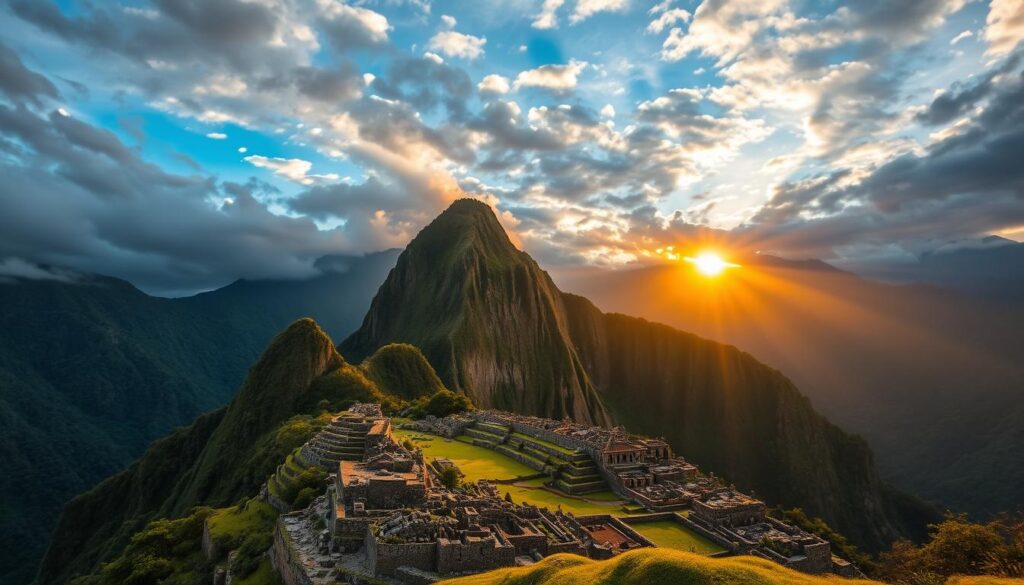
The Incas are famous for their architecture, like Machu Picchu4. They developed new ways to farm, growing crops like corn and potatoes5. Their road system showed off their engineering skills, with tunnels and bridges34.
Key Events Leading to the Fall
The Inca Empire’s decline was not sudden. It was caused by internal conflicts and external pressures. These factors weakened its foundation.
Spanish Conquest: An Overview of the Conquistadors
In the early 16th century, Spanish conquistadors arrived in South America. They were led by Francisco Pizarro and sought wealth and empire expansion6. Their advanced weapons and alliances with rival groups gave them an edge over the Incas.
The Role of Atahualpa and the Civil War
A succession crisis between brothers Atahualpa and Huascar led to a devastating civil war76. This weakened the empire from within. The Spanish captured Atahualpa at Cajamarca, a major blow to Inca leadership and morale.
European Diseases and Their Impact
European diseases like smallpox and influenza hit the Inca population hard76. They killed between 50-90% of the people in a decade. This loss severely impacted the empire’s ability to fight off the Spanish and maintain its society.
Consequences of the Inca Empire’s Collapse
The fall of the Inca Empire had a big impact on the Andean region. It caused big changes in society and the economy. These changes changed the face of South America.
Social and Economic Changes in the Region
The Inca economy fell apart, leading to a lot of trouble. Spanish rule brought new economic systems. This broke down old ways and made big social gaps8.
The death of Tupac Amaru in 1572 ended Inca resistance. This made things even worse8.
Legacy and Influence on Indigenous Cultures
The Inca legacy is very strong in Peru today. Places like Machu Picchu show Inca smartness and strength. They attract millions of visitors every year.
These sites help keep Peru’s identity alive. They show the lasting power of indigenous traditions.
Modern Interpretations and Historical Perspectives
Nowadays, historians are trying to understand the Inca Empire’s fall better. They look at how European diseases and internal fights affected things. These views give us a clearer picture of Inca history and its effects today.
FAQ
What factors contributed to the rapid fall of the Inca Empire?
The Inca Empire fell due to internal strife, like the civil war between Atahualpa and Huascar. European diseases, such as smallpox and influenza, also played a big role. The arrival of Spanish conquistadors led by Francisco Pizarro was the final blow.
How did the Inca Empire manage to govern such a vast territory?
The Inca Empire had a strong leader, the Sapa Inca, and a system of local governance. They also had a network of roads and communication. This helped them manage their vast territory from Colombia to Chile.
What are some of the most significant architectural achievements of the Inca civilization?
The Incas are famous for their buildings like Machu Picchu and Sacsayhuamán. They built structures that lasted long and fit well with the Andes Mountains. This shows their skill in architecture and urban planning.
What role did Quechua culture play in unifying the Inca Empire?
Quechua culture and language were key in uniting the Inca Empire. By using Quechua as a common language, the Incas brought people together. This helped them control their large territory.
How did European diseases impact the Inca Empire prior to the Spanish conquest?
Diseases like smallpox and influenza killed many Incas. This weakened the empire and made it easier for the Spanish to conquer. The Incas had no immunity to these diseases.
What is the legacy of the Inca Empire in modern Peru?
The Inca Empire’s legacy is strong in Peru today. Places like Machu Picchu show the Incas’ skill and strength. The preservation of Quechua culture also shows the Inca’s lasting impact.
How did the Spanish conquistadors, led by Francisco Pizarro, manage to conquer the Inca Empire?
The Spanish, led by Francisco Pizarro, used the Inca’s internal conflicts to their advantage. They had better technology and made alliances with some groups. Diseases also weakened the Incas, helping the Spanish conquer them.
Source Links
- Spanish conquest of the Inca Empire – https://en.wikipedia.org/wiki/Spanish_conquest_of_the_Inca_Empire
- Pizarro & the Fall of the Inca Empire – https://www.worldhistory.org/article/915/pizarro–the-fall-of-the-inca-empire/
- Inca civilization: rise and fall of the empire – https://incatrailmachupicchu.org/inca-civilisation/
- Inca civilization facts and history – https://kids.nationalgeographic.com/history/article/inca-civilization
- Inca | History, Achievements, Culture, & Geography | Britannica – https://www.britannica.com/topic/Inca
- Inca Empire | History Timeline – https://historytimelines.co/timeline/inca-empire-1
- Inca: Empire, Religion & Civilization | HISTORY – https://www.history.com/topics/latin-america/inca
- Disease and the Fall of the Inca Empire – https://www.doaks.org/resources/online-exhibits/epidemics/epidemics-english/century-of-sorrow/andean-transmission