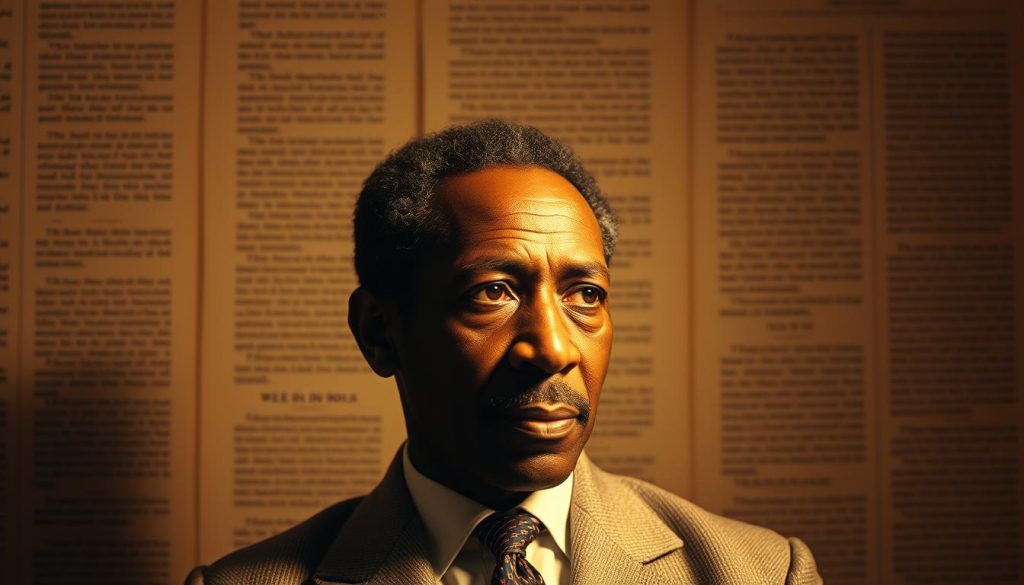
W.E.B. Du Bois was a brilliant African American author and civil rights activist. His words still guide us towards understanding and social justice1. His 1903 book “The Souls of Black Folk” changed how we view racial identity and societal issues1.
Du Bois’s quotes show his deep belief in education, democracy, and human dignity. He bravely tackled the complex racial experiences in America. His words challenge us to face hard truths about inequality and progress2.
As a trailblazing scholar, Du Bois explored identity, education, and social change through his writing. His ideas still speak to people trying to grasp race and society today2.
Key Takeaways
- Du Bois was a groundbreaking African American author and civil rights activist
- His work “The Souls of Black Folk” remains a pivotal text in understanding racial identity
- Du Bois challenged societal norms through intellectual and philosophical discourse
- His quotes continue to inspire social justice movements
- Du Bois emphasized the importance of education and understanding
QUOTES BY W. E. B. DU BOIS From The Souls of Black Folk and Early Works
W. E. B. Du Bois was a key sociologist and Pan-Africanist. He changed how we talk about racial equality in the early 1900s. His work showed the complex lives of Black Americans3.
The Souls of Black Folk, published in 1903, showed Du Bois’ deep insights. It explored racial identity and social issues. The book resonated with readers, earning a 4.31 out of 5 rating on Goodreads4.
Defining Quotes on Identity and Democracy
Du Bois challenged systemic racism with powerful quotes:
-
“The problem of the twentieth century is the problem of the color line.”
– A statement that remains critically relevant4
-
“One ever feels his twoness, — an American, a Negro…”
– Exploring the complex dual identity of Black Americans4
Du Bois led The Crisis magazine for the NAACP. For nearly 25 years, he made it a key platform for racial discussions3.
His writings exposed how laws often kept racial inequality alive. Du Bois said, “Daily the Negro is coming more and more to look upon law and justice, not as protecting safeguards, but as sources of humiliation and oppression”4.
Inspirational Quotes on Life, Education, and Social Progress
W.E.B. Du Bois saw education as a key to racial equality. He believed true learning goes beyond job training. Du Bois emphasized personal growth and intellectual development through his powerful philosophical insights5.
The Niagara Movement’s founder thought education should elevate human potential. He didn’t just want to create skilled workers. Du Bois knew social progress meant challenging systemic barriers5.
He recognized how racial discrimination affected African American communities. Du Bois called the “color line” the main social challenge of the 20th century5. His work with The Crisis magazine gave a platform to voices fighting for justice6.
Du Bois spent his 95-year life pushing for racial equality5. He organized Pan-African Congress meetings and served as NAACP research director. His message still rings true: liberty costs less than ongoing oppression5.
As the first Black American with a Harvard PhD, Du Bois showed education’s power against racism6. His legacy inspires activists and scholars today. He reminds us that progress needs brave engagement with tough social issues through strategic, principled action.
FAQ
Who was W.E.B. Du Bois and why is he important?
W.E.B. Du Bois was a trailblazing African American scholar and civil rights activist. He co-founded the NAACP and challenged racial inequality through his work. Du Bois fought for full civil rights and better education for Black Americans.
What is Du Bois’ most famous work?
“The Souls of Black Folk” is Du Bois’ most influential book, published in 1903. It explored the African American experience and racial identity. The book challenged prevailing narratives about Black life in the United States.
How did Du Bois contribute to the civil rights movement?
Du Bois advanced civil rights through various channels. He co-founded the Niagara Movement and helped establish the NAACP. Du Bois also edited The Crisis magazine and used research to challenge systemic racism.
What was Du Bois’ educational philosophy?
Du Bois believed education could transform and empower Black communities. He promoted higher education as a way to challenge racial stereotypes. Du Bois saw learning as a path to social advancement and racial progress.
How did Du Bois view Pan-Africanism?
As a leading Pan-Africanist, Du Bois championed global Black unity. He organized Pan-African Congresses to connect diaspora communities. Du Bois fought against colonialism and racial oppression across international boundaries.
What makes Du Bois’ quotes so enduring?
Du Bois’ quotes express complex ideas about race and identity with clarity. His words challenge systemic inequalities and inspire social change. The quotes resonate because they tackle ongoing issues with emotional depth.
How did Du Bois approach racial identity?
Du Bois introduced the concept of “double consciousness” in racial identity. This describes viewing oneself through personal identity and racial stereotypes. He argued that African Americans navigate between self-perception and society’s expectations.
What was Du Bois’ relationship with other civil rights leaders?
Du Bois had complex relationships with other civil rights leaders like Booker T. Washington. They often disagreed about strategies for Black advancement. While Washington favored vocational training, Du Bois pushed for liberal arts education.
Source Links
- Du Bois Quotes – W. E. B. Du Bois Center – https://duboiscenter.library.umass.edu/du-bois-quotes/
- W.E.B. Du Bois Quotes (Author of The Souls of Black Folk) – https://www.goodreads.com/author/quotes/10710.W_E_B_Du_Bois
- The Quotable W. E. B. Du Bois | The New York Public Library – https://www.nypl.org/blog/2017/02/23/quotable-w-e-b-du-bois
- The Souls of Black Folk Quotes by W.E.B. Du Bois – https://www.goodreads.com/work/quotes/1137159-the-souls-of-black-folk
- W. E. B. Du Bois – Wikiquote – https://en.wikiquote.org/wiki/W._E._B._Du_Bois
- W.E.B. Du Bois – https://naacp.org/find-resources/history-explained/civil-rights-leaders/web-du-bois