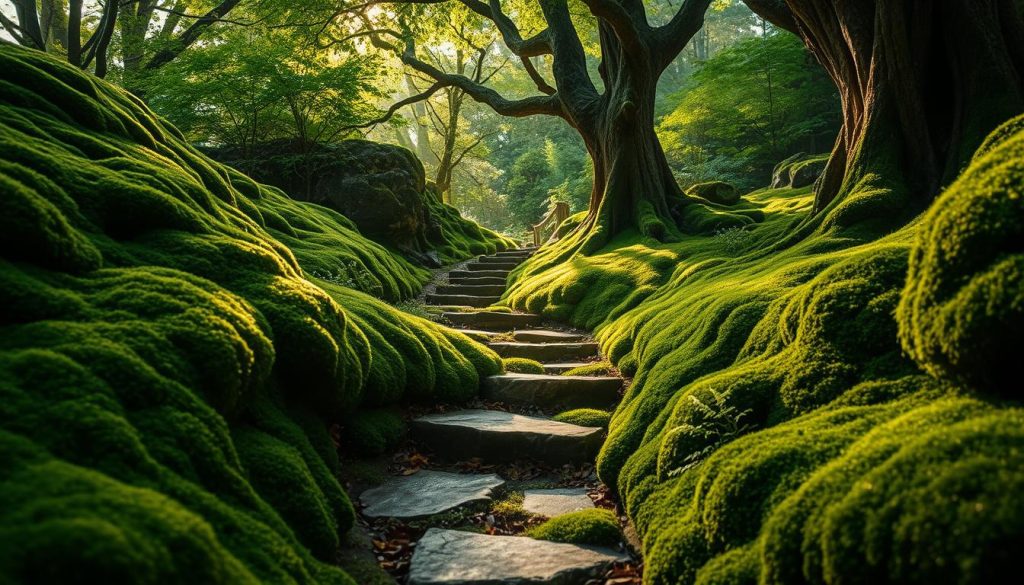
Moss is a fascinating botanical wonder that defies typical plant traits. These tiny green organisms flourish in various settings, creating stunning landscapes worldwide. Their simple structure belies a complex nature that fascinates scientists and writers.
The microscopic realm within moss teems with life. A single gram of forest moss can house an astounding array of tiny creatures. It might contain 150,000 protozoa and 132,000 tardigrades, among other microorganisms1.
Moss shows incredible toughness. It thrives in harsh environments, from frigid Arctic regions to steamy tropical zones2. Amazingly, moss can lie dormant for up to 40 years before springing back to life with water2.
Key Takeaways
- Moss exists in diverse global environments
- Microscopic ecosystems thrive within moss
- Moss can survive extreme conditions
- These plants represent nature’s simplicity and complexity
- Moss landscapes offer unique ecological insights
The Poetic Beauty of Moss in Literature
Moss has inspired writers and artists for centuries. Its delicate presence weaves through literary imagination. These plants have become powerful metaphors for resilience and beauty3.
Moss has an impressive scientific legacy. It can absorb water and nutrients up to 30 times its weight. This miraculous organism has existed for at least 350 million years3.
Artists create stunning moss wall installations and terrariums. These works celebrate nature’s persistence. They showcase the plant’s ability to survive in various conditions.
Romantic Perspectives on Moss
Romantic poets saw moss as a symbol of nature’s quiet resilience. They admired its ability to grow everywhere. From tree bark to forgotten stones, moss represented life’s unexpected beauty4.
The moss graffiti movement emerged from these romantic observations. It transforms urban landscapes with living green art. This movement blends nature and creativity in unique ways.
Contemporary Explorations
Modern authors find inspiration in moss’s unique traits. Some species show incredible drought tolerance. They recover quickly after facing seemingly impossible conditions4.
Moss represents more than just a plant. It tells a powerful story of survival and regeneration. Its adaptability continues to fascinate writers and artists alike.
- Moss art celebrates nature’s intricate designs
- Moss terrariums bring miniature ecosystems into homes
- Moss graffiti transforms urban spaces
Moss remains a symbol of nature’s quiet, persistent magic. It inspires both scientific study and artistic expression. Its enduring presence continues to captivate our imagination3.
Moss: Scientific and Natural Wonder
Mosses are botanical marvels that have survived for 450 million years. With up to 25,000 species worldwide, these tiny plants show incredible resilience. They can photosynthesize in temperatures from -15ºC to 40ºC, proving their adaptability.
Scientists have found that mosses can withstand extreme temperatures. When dry, they can survive 100ºC, and when frozen, -272ºC. These remarkable plants play crucial roles in ecosystems, keeping habitats moist and humid.
Moss preservation is becoming more important as we learn about their ecological value. These plants contribute significantly to environmental health by preventing erosion and cleaning air5. They provide winter shelter for wildlife and form spongy carpets in heaths.
Mosses developed a unique way to protect their eggs within female structures. This method is now used by all modern plants. It ensures species survival in tough land environments, showing mosses’ amazing evolution.
FAQ
What makes moss such a unique plant?
Moss is a resilient plant that thrives in diverse environments. It lacks traditional roots and survives in challenging conditions. Moss grows where other plants can’t, making it crucial for many ecosystems.
How can I start my own moss garden?
Choose a shaded, humid area with minimal direct sunlight for your moss garden. Remove debris and ensure good moisture retention in the area. You can collect moss from forests or buy starter cultures.
Keep the area consistently damp and avoid walking on the moss. Create different textures using rocks, logs, or various surfaces to encourage moss growth.
What is moss graffiti, and how is it created?
Moss graffiti is an eco-friendly art form using living moss to create artwork. Artists blend moss with buttermilk, water, and nutrients to make a paste. This paste is applied to walls, forming a living, green design that evolves over time.
Why is moss important in ecological systems?
Moss prevents soil erosion, retains moisture, and creates microhabitats for small organisms. It’s a pioneer species that prepares the ground for other plants. Moss also acts as a carbon sink and contributes to biodiversity in various landscapes.
How do I preserve moss for scientific or artistic purposes?
For scientific study, carefully dry the moss and store it in a cool, dry place. Artistic preservation methods include pressing moss between heavy books or using silica gel. Some artists use resin to encapsulate moss permanently or special techniques to maintain its color.
Can moss grow in terrariums?
Yes, moss terrariums are popular in home decor. They require minimal maintenance and thrive in enclosed, humid environments. Choose complementary moss varieties and use activated charcoal for drainage.
Maintain consistent moisture in your terrarium. These mini landscapes offer a beautiful way to bring forest ecosystems into your home.
What are some unique adaptations of moss?
Moss can completely dry out, become dormant, and revive when moisture returns. Some species live in Arctic environments, while others thrive in tropical rainforests. Moss absorbs water and nutrients directly through its leaves, unlike plants with root systems.
Source Links
- Moss Quotes (30 quotes) – https://www.goodreads.com/quotes/tag/moss
- TOP 25 MOSS QUOTES (of 169) | A-Z Quotes – https://www.azquotes.com/quotes/topics/moss.html
- The many meanings of moss – https://www.theguardian.com/environment/2022/nov/03/the-many-meanings-of-moss
- The Wild Beauty of Moss (Published 2023) – https://www.nytimes.com/2023/11/21/t-magazine/moss-flowers-arrangements.html
- ‘Moss Appreciation Week’: a lot of celebration for a very little plant – https://www.houstonpublicmedia.org/npr/2025/02/14/nx-s1-5297194/moss-appreciation-week-a-lot-of-celebration-for-a-very-little-plant/