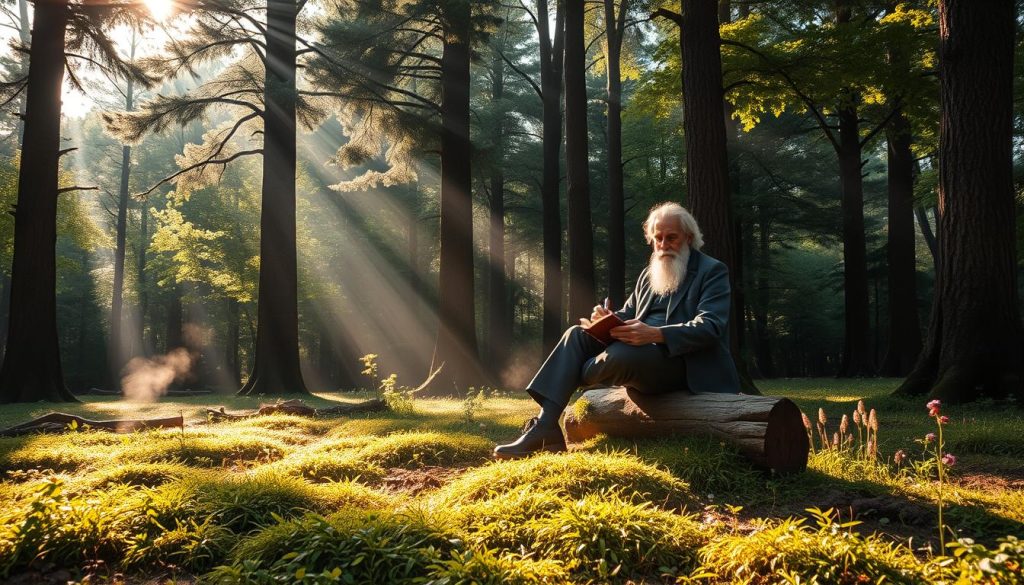
Walt Whitman’s nature quotes show his deep bond with the environment. His words reflect transcendentalism, offering a fresh view of the natural world1. Whitman’s 494 quotes about nature highlight his respect for our surroundings1.
“Leaves of Grass” blends nature poetry with deep thoughts. Whitman challenges book learning, preferring real-life experiences. He once said, “A morning-glory at my window satisfies me more than the metaphysics of books”1.
This view echoes transcendentalism, stressing nature’s spiritual importance2. Whitman believed that “Nature remains” after all else fades1. This shows how much he valued the natural world.
His work explores how humans connect with the universe. He saw great meaning in small things. Even a grass leaf, he said, contains the “journey-work of the stars”2.
Key Takeaways
- Whitman’s nature quotes emphasize the spiritual power of the natural world
- His poetry challenges intellectual pursuits in favor of natural experiences
- Transcendentalism plays a crucial role in his understanding of nature
- Each natural element is seen as a miraculous part of the universe
- Whitman viewed nature as a source of ultimate fulfillment
The Essence of Nature in Walt Whitman’s Poetry
Walt Whitman’s view of nature goes beyond traditional Romantic poetry. He connects deeply with the natural world, turning simple elements into profound thoughts3.
“Song of Myself” explores the link between humans and nature. Whitman celebrates how all living things are connected. He shows that every part of nature is important4.
Nature as a Spiritual Sanctuary
Whitman saw nature as a way to refresh the spirit. He found deep peace in natural settings. Daily, he would immerse himself in nature, feeling strong emotions5.
- Recognized six distinct natural elements: soil, sun, ground, ocean, forest, and sky
- Experienced nature as a constant source of emotional balance
- Viewed natural interactions as fundamentally healing
Humanity’s Intimate Connection with Nature
The poet believed humans are part of nature, not separate from it. His philosophy emphasized that every atom connects us to the broader ecological system3.
“I believe a leaf of grass is no less than the journey-work of the stars.” – Walt Whitman
Celebrating Natural Simplicity
Whitman’s poetry captures nature’s simple beauty. He found wonder in everyday parts of the environment. His words turn ordinary sights into amazing insights4.
| Natural Element | Whitman’s Interpretation |
|---|---|
| Grass | Symbol of universal connection |
| Ants | Representation of ecological diversity |
| Ocean | Metaphor for infinite possibilities |
Whitman changed how we see nature in poetry. He invites us to view nature as part of our human experience. His work makes us feel closer to the world around us3.
Nature’s Influence on Whitman’s Philosophy
Walt Whitman’s ideas about nature deeply explored human connection to the natural world. His approach to 19th century American literature was groundbreaking. Whitman saw nature as a living force that shapes our consciousness6.
He viewed the environment as more than just scenery. For Whitman, nature was a living entity linked to human experience. His philosophical insights reflected this deep connection.
Roots of Transcendental Thought
Whitman’s vision was rooted in transcendentalist ideas. He urged readers to look beyond surface-level interactions with nature7. He believed nature could restore human vitality.
Whitman criticized society’s growing disconnect from outdoor experiences. The average American spent only 7% of their time outdoors. This contrasted sharply with Whitman’s push for immersive natural experiences7.
Personal Transformation through Nature
Whitman believed nature offered profound lessons for personal growth. In 1873, after a stroke, he spent two years recovering outdoors7. This experience reinforced his belief in nature’s healing power.
His writings show that nature provides both physical and spiritual renewal. Whitman saw nature as embodying democratic ideals of equality and interconnectedness6.
Universal Wisdom of the Natural World
Whitman viewed nature as a universal teacher. He believed it offered insights about resilience, change, and interconnectedness. He judged art and literature against natural standards7.
Whitman thought true creativity comes from direct experiences with nature. His view challenged common literary trends. He pushed for a more authentic representation of human experience6.
FAQ
How did nature influence Walt Whitman’s poetry?
Nature was central to Whitman’s poetic vision. It served as a source of spiritual renewal and philosophical insight. In “Leaves of Grass,” Whitman saw nature as part of human experience, offering deep spiritual meaning.
What makes Whitman’s approach to nature poetry unique?
Whitman broke from traditional pastoral poetry. He presented nature as a living entity that humans are part of. His transcendentalist view celebrated the divine interconnectedness of all natural elements.
How did Whitman’s nature quotes reflect philosophical ideas?
His quotes embodied profound philosophical concepts. They highlighted nature as a source of divine truth and personal growth. Whitman believed direct experience with nature could reveal fundamental lessons about life.
What role did the Romantic era play in Whitman’s nature writing?
The Romantic era greatly influenced Whitman’s approach. It encouraged a more emotional connection to nature. Whitman expanded on Romantic ideals, presenting nature as a democratic, all-encompassing experience.
What are some key themes in Whitman’s nature poetry?
Key themes include spiritual renewal and the interconnectedness of all living things. Personal transformation and the beauty of simple natural elements are also prominent. Whitman used nature imagery to explore broader philosophical questions.
How did Whitman view the relationship between humans and nature?
Whitman saw humans as an integral part of nature. He believed people could find wisdom through engaging with the natural world. This connection offered profound self-understanding and spiritual meaning.
Which of Whitman’s works best represent his nature poetry?
“Leaves of Grass” and “Song of Myself” showcase Whitman’s nature-inspired poetry. These works demonstrate his unique perspective on nature. They reveal his ability to find extraordinary meaning in ordinary natural elements.
Source Links
- Walt Whitman Quotes About Nature | A-Z Quotes – https://www.azquotes.com/author/15605-Walt_Whitman/tag/nature
- Walt Whitman Quotes on Nature, Spirituality and Mysticism – https://www.successconsciousness.com/blog/quotes/walt-whitman-quotes/
- NATURE, CONTAINING ALL – https://inthewordsofwaltwhitman.com/nature-2/nature/
- Walt Whitman and The Celebration of Nature | Blog | Integration and Application Network – https://ian.umces.edu/blog/walt-whitman-and-the-celebration-of-nature/
- THE POET IN NATURE – https://inthewordsofwaltwhitman.com/nature-2/the-poet-in-nature/
- The Poetry of Democracy: Walt Whitman – https://whitmanarchive.org/item/anc.00073
- Walt Whitman’s Speciman Days – https://thelongbrownpath.com/2017/11/04/walt-whitmans-speciman-days/