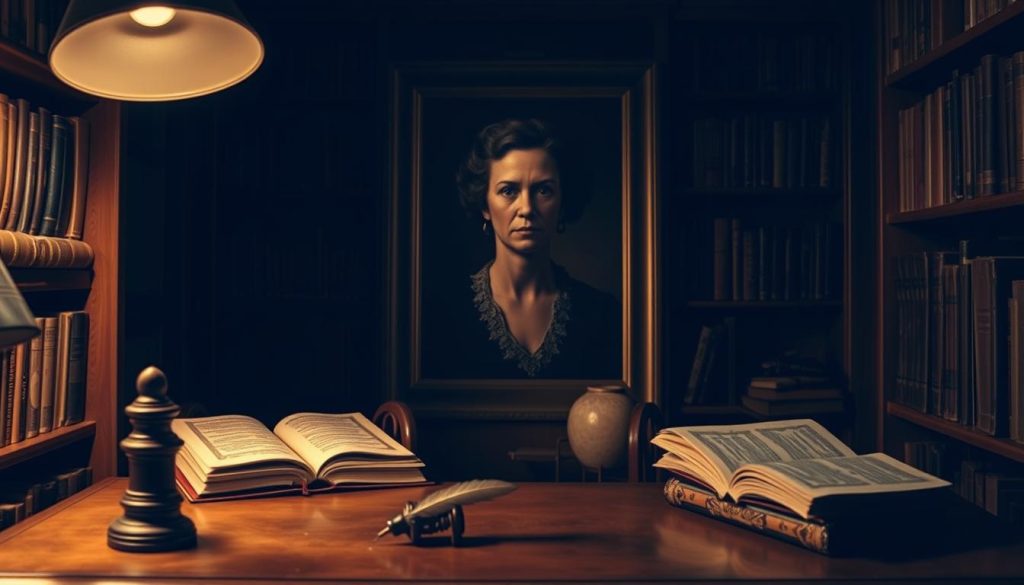
Emily Dickinson’s poetry offers a unique view of death. Her words turn this somber topic into a thoughtful journey. Dickinson’s quotes reveal a deep understanding of mortality1.
Living in seclusion in Amherst shaped Dickinson’s thoughts on death. Her quotes explore the thin line between life and death. She saw death not as an end, but as a transformative experience1.
Death was a recurring theme in Dickinson’s work. She faced mortality with bravery and deep thought. Her powerful metaphors still touch readers today, long after her death in 18861.
Key Takeaways
- Dickinson viewed death as a profound spiritual transition
- Her poetry challenged traditional perceptions of mortality
- She approached death with philosophical curiosity
- Her quotes reveal a nuanced understanding of life’s impermanence
- Dickinson’s work continues to inspire deep reflection on mortality
Emily Dickinson’s Most Famous Death Poems and Their Meanings
Emily Dickinson’s death poetry explores mortality through her unique lens. Her works delve into the relationship between life and death. Her powerful narrative captivates readers worldwide2.
Dickinson crafted numerous poems examining death from various angles. Only about a dozen were published during her lifetime. Her posthumous collection holds significant importance2.
A Poetic Journey Through Mortality
Her famous death quotes reveal a deep understanding of dying. The poems reflect personal introspection and universal themes. They explore transition and uncertainty in human experiences.
Analyzing “Because I could not stop for Death”
This iconic poem personifies death as a courteous gentleman. It presents a unique metaphorical journey. The poem suggests death is a calm, inevitable passage2.
- Death as a gentle companion
- A slow, deliberate journey towards eternity
- Symbolic representation of life’s progression
Exploring “I heard a Fly buzz – when I died”
Dickinson presents a remarkable perspective on death in this poem. She juxtaposes the mundane with the profound experience of dying. This creates a hauntingly realistic portrayal2.
Understanding “My life closed twice before its close”
This poem explores emotional deaths and profound loss before physical death. Dickinson masterfully captures the intensity of grief and personal transformation.
Her poetry continues to resonate with readers today. It offers deep insights into mortality and emotional depth3.
Emily Dickinson Quotes About Death and the Journey of the Soul
Emily Dickinson’s quotes on mortality offer deep insights into death and the soul’s journey. Her poetry explores the delicate balance between life and death. Dickinson transforms mortality into a nuanced examination of human existence through her introspective poetry4.
Dickinson saw death as a transformative passage, not an ending. Her unique insights suggest death is an adventure, not a finality5.
“Dying is a wild night and a new road”
- Death as a transition
- Soul’s continuous journey
- Immortality through memory
Her poetic perspective bravely embraces the unknown. Dickinson believed emotional connections transcend physical existence.
Unable are the loved to die, for love is immortality reflects this belief. She wrote at least 20 poems directly addressing the soul’s journey4.
Dickinson’s exploration of mortality was deeply personal and philosophical. Her quotes suggest death is a mysterious continuation of consciousness6.
Conclusion
Emily Dickinson’s death views offer a unique perspective on mortality. Her quotes challenge 19th-century romantic notions of passing. Dickinson’s approach transformed our understanding of life’s final transition7.
Her poetry presents death as a transformative passage, not just an endpoint. Dickinson portrays death as a liberator, finality, and awakening7. Her work invites readers to explore mortality beyond traditional boundaries8.
Dickinson’s legacy continues to inspire and challenge readers today. Her creative period from 1861-1865 produced compelling meditations on death8. She personified abstract concepts and explored intimate moments of transition.
Dickinson reminds us that death reflects life itself. Her words encourage us to embrace uncertainty and complexity. She invites us to consider the potential transformation in our final human journey.
FAQ
Why was Emily Dickinson so fascinated with death in her poetry?
Emily Dickinson’s fascination with death stemmed from her reclusive lifestyle and 19th-century New England culture. Her unique view turned death into a complex, intimate experience in her poetry. Dickinson’s deep thoughts on mortality shaped her profound and introspective works.
What is the most famous Emily Dickinson poem about death?
“Because I could not stop for Death” is her most well-known poem about mortality. Dickinson portrays Death as a polite suitor taking the speaker on a journey. This poem presents death as a peaceful transition, not a scary ending.
How did Dickinson view death in her poetry?
Dickinson saw death as a transformative journey, not a final end. She often showed it with curiosity, acceptance, and even a bit of whimsy. Her poems suggest death is a passage to another state of being.
Did Emily Dickinson’s religious beliefs influence her writing about death?
Yes, Dickinson’s religious background greatly shaped her view on death. She grew up in a Puritan community, learning complex ideas about mortality and afterlife. Her poetry explores these spiritual concepts, often challenging traditional religious views on death.
What are some of Dickinson’s most powerful quotes about death?
Two powerful quotes are: “Unable are the loved to die, for love is immortality”. And “We never know we go when we are going”. These reveal her belief in lasting human connections and death’s mysterious nature.
How did Dickinson’s personal life impact her writing about death?
Dickinson’s reclusive lifestyle gave her time for deep thought about death. She experienced loss of close friends and family members. These personal encounters with death fueled her profound exploration of mortality in her poetry.
Why is Emily Dickinson considered unique in her approach to death in poetry?
Dickinson treated death as a philosophical and intimate experience, not a scary concept. She used unusual imagery and a conversational tone in her poems. Her work challenged 19th-century views on mortality, making it timeless and deeply personal.
Source Links
- Emily Dickinson and Death – Emily Dickinson Museum – https://www.emilydickinsonmuseum.org/emily-dickinson/biography/special-topics/emily-dickinson-and-death/
- The Ultimate Guide to the 15 Best Emily Dickinson Poems – https://reedsy.com/discovery/blog/emily-dickinson-poems
- I Measure Every Grief I Meet: Emily Dickinson on Love and Loss – https://www.themarginalian.org/2021/05/28/emily-dickinson-grief/
- Emily Dickinson – Wikiquote – https://en.wikiquote.org/wiki/Emily_Dickinson
- Emily Dickinson | Biography, Poems, Death, & Facts | Britannica – https://www.britannica.com/biography/Emily-Dickinson
- Emily Dickinson: Examining the Influences and Impact – https://www.abookgeek.com/emily-dickinson-examining-the-influences-and-impact-of-her-revolutionary-poetry/
- The theme of death in Emily Dickinson’s poetry – https://www.enotes.com/topics/emily-dickinson/questions/the-theme-of-death-in-emily-dickinson-s-poetry-3126819
- ‘Because I Could Not Stop for Death’ by Emily Dickinson: Analysis – https://blog.prepscholar.com/emily-dickinson-because-i-could-not-stop-for-death-analysis