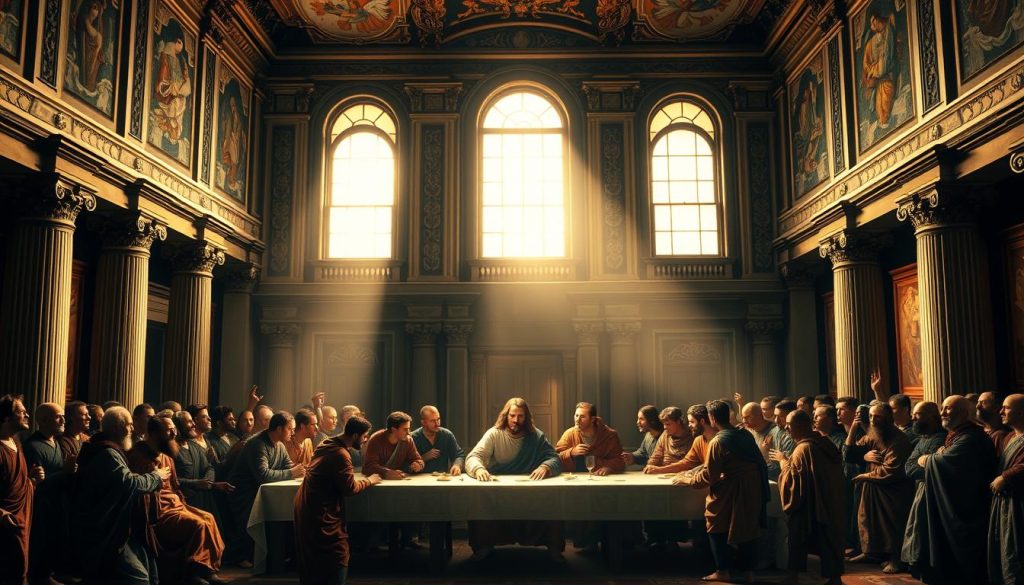
The Last Supper is a key moment in Christian theology. Leonardo da Vinci’s famous painting captures this sacred meal. It shows Jesus’s final gathering with his disciples, sharing powerful words that echo through time12.
Da Vinci’s mural has become a global symbol of this crucial event. It took place during the Festival of Unleavened Bread. Artists and scholars continue to explore its deep meaning1.
Jesus’s words, “This is my body given for you; do this in remembrance of me,” still inspire believers today1. These words symbolize sacrifice and remembrance in Christian faith.
Key Takeaways
- The Last Supper is a crucial moment in Christian history
- Leonardo da Vinci’s mural painting immortalized this sacred event
- Jesus’s words during the meal hold deep spiritual significance
- The event symbolizes sacrifice and remembrance
- Renaissance Art captured the spiritual essence of this moment
Biblical Significance of the Last Supper
The Last Supper is a key moment in Christian history. It shows Jesus and His Apostles at a crucial point in the story of salvation3. This event changed spiritual understanding forever.
At this gathering, Jesus set up deep religious ideas. The meal was more than just Passover. It was the start of a new spiritual agreement34.
Jesus’s Words of Institution
During this meal, Jesus shared important new teachings. He talked about His coming sacrifice and shared deep truths3. His words gave new meaning to bread and wine4.
“This is my blood of the covenant, which is poured out for many” – Mark 14:24
The New Covenant Message
The Last Supper started a new spiritual deal between God and people. This agreement was foretold long ago3. It promised spiritual renewal and redemption for everyone.
- Introduced in Luke 22:20
- Fulfilled prophetic promises
- Signaled a transformative spiritual relationship
Symbolic Elements of Bread and Wine
The bread and wine had deep spiritual meaning. Jesus called Himself the “true bread”, linking food to eternal life4. These items became central to Christian worship.
They represent Christ’s love and sacrifice3. Christians still use them in their services today.
| Element | Symbolic Meaning |
|---|---|
| Bread | Body of Christ |
| Wine | Blood of the New Covenant |
Memorable Quotes from Religious Leaders and Saints
The Last Supper has deeply influenced Christian thought and art. Saints and scholars have captured its spiritual essence. Their insights continue to inspire believers across generations5.
“It was wonderful love that Christ should rather die for us than for the angels that fell. They were creatures of a more noble extract, and in all probability might have brought greater revenues of glory to God; yet that Christ should pass by those golden vessels, and make us clods of earth into stars of glory — Oh, the hyperbole of Christ’s love!” – Thomas Watson
The Eucharist is more than a simple memorial. It represents a deep connection between divine love and human redemption6.
Religious leaders stress how this sacred moment transcends history. They highlight the transformative power of faith in this context.
- The Last Supper symbolizes Christ’s ultimate sacrifice
- It represents a new covenant between God and humanity
- The event bridges divine love with human understanding
Renaissance art beautifully portrayed these theological ideas. Artists created visual stories exploring deep Christian spiritual experiences5.
Saints’ and theologians’ quotes shed light on this key moment. They reveal the many meanings within this crucial Christian tradition6.
| Saint | Key Perspective |
|---|---|
| Thomas Watson | Divine Love’s Extraordinary Nature |
| Saint Peter | Transformation through Faith |
These deep thoughts encourage believers to ponder the Eucharist’s spiritual aspects. They connect history with personal faith journeys56.
Conclusion
The Last Supper is a crucial moment in Christian iconography. It inspires believers worldwide as a profound biblical scene. This event symbolizes Jesus’ ultimate sacrifice and reminds us of spiritual unity and redemption7.
Leonardo da Vinci’s famous mural in Milan captures the gathering’s emotional intensity. It’s located in the Santa Maria Della Grazie convent. This artwork helps explore the depth of this sacred moment8.
Christians worldwide connect with the Last Supper through Communion. This ritual provides spiritual sustenance and enhances believers’ faith. It reminds them of service, love, and sacrifice7.
The Last Supper bridges historical narrative with personal spiritual experience. It continues to resonate with modern religious communities. This sacred practice keeps the biblical scene alive today.
1 Corinthians 11:26 beautifully captures the Last Supper’s lasting importance. It states, “For whenever you eat this bread and drink this cup, you proclaim the Lord’s death until he comes.” This verse shows the event’s ongoing relevance in Christian faith.
Believers are invited to ponder its deeper spiritual meaning. They can explore its transformative power through historical and artistic interpretations. The Last Supper remains a powerful symbol of hope and redemption.
This timeless symbol of spiritual connection continues to inspire believers. It touches generations across the world. The Last Supper represents more than just a historical event.
FAQ
What is the historical significance of Leonardo da Vinci’s Last Supper painting?
Leonardo da Vinci’s Last Supper is a Renaissance masterpiece in Milan, Italy. It shows Jesus’s final meal with his disciples. The mural, painted from 1495-1498, captures the moment Jesus reveals his betrayal.
How is the Last Supper portrayed in the Gospels?
The Gospels describe the Last Supper as a transformative moment. Jesus breaks bread and shares wine with his Apostles. This act symbolizes his body and blood, establishing the sacrament of Holy Communion.
Why is the Last Supper considered a crucial event in Christian theology?
The Last Supper represents a profound moment of sacrifice and redemption. Jesus predicts his betrayal and establishes the Eucharistic tradition. He gives his disciples a message of love, forgiveness, and spiritual transformation.
How have artists throughout history represented the Last Supper?
Artists have interpreted the Last Supper through various mediums since the Renaissance. Leonardo da Vinci’s mural is the most famous. These works often show the emotional complexity and dramatic tension of the moment.
What are the symbolic meanings of bread and wine in the Last Supper?
In Christian theology, bread represents Christ’s body, while wine symbolizes his blood. These elements signify Jesus’s sacrificial mission. They represent spiritual nourishment and the new covenant between God and humanity.
How do different Christian denominations interpret the Last Supper?
Most Christian denominations view the Last Supper as a sacred moment of spiritual communion. Some traditions emphasize the literal transformation of bread and wine. Others see it as a symbolic remembrance of Christ’s sacrifice.
Where can people see Leonardo da Vinci’s Last Supper?
The original Last Supper mural is in Santa Maria delle Grazie, Milan, Italy. Visitors must book tickets in advance due to its delicate condition. Viewing time is limited to protect this priceless Renaissance artwork.
Source Links
- The Top Bible Verses about The Last Supper in Scripture – https://www.biblestudytools.com/topical-verses/bible-verses-about-the-last-supper/
- TOP 25 LAST SUPPER QUOTES | A-Z Quotes – https://www.azquotes.com/quotes/topics/last-supper.html
- What is the meaning and importance of the Last Supper? – https://www.gotquestions.org/Last-Supper.html
- Why Is the Lord’s Supper Significant in the Bible? – https://bibleproject.com/articles/lords-supper-in-the-bible/
- Communion – Grace Quotes – https://gracequotes.org/topic/communion/
- Saint Peter and the Last Supper – The American Catholic – https://the-american-catholic.com/2018/03/29/saint-peter-and-the-last-supper/
- The Last Supper – Bible Story, Verses & Meaning – https://www.biblestudytools.com/bible-stories/the-last-supper.html
- Analysis of the Last Supper – Last Supper Ticket – https://lastsupperticket.com/blog/analysis-of-the-last-supper/