
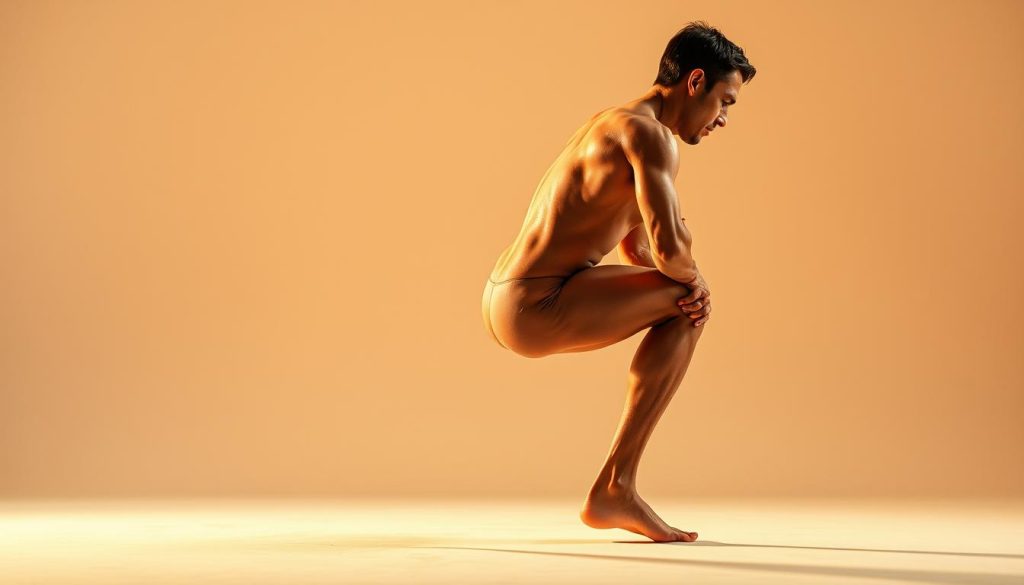
Reverse lunges are a game-changer for boosting lower body strength and stability. They engage multiple muscle groups for an efficient workout. This technique offers a safer approach compared to traditional forward lunges1.
Reverse lunges mainly target quads, glutes, hamstrings, calves, and core. They provide better knee control and reduce injury risk. This makes them an exceptional compound movement for strength training1.
Athletes love reverse lunges for building strength while minimizing joint stress. They allow precise muscle engagement, focusing on hamstrings and glutes. During the movement, two-thirds of your body weight should be on the front leg12.
Key Takeaways
- Reverse lunges are more knee-friendly than forward lunges
- Targets multiple muscle groups simultaneously
- Improves balance and lower body strength
- Reduces risk of knee strain
- Adaptable for various fitness levels
Understanding Reverse Lunges and Their Benefits
Reverse lunges are a powerful lower body exercise. They offer unique advantages for fitness enthusiasts and athletes. This dynamic movement provides a safer approach to lower body training3.
What Sets Reverse Lunges Apart
Reverse lunges have key features that make them a superior exercise choice. They’re more knee-friendly than forward lunges, reducing joint stress while engaging muscles3.
These lunges offer comprehensive fitness advantages4. They improve muscle stability and enhance single-leg strength.
- Reduced knee joint pressure
- Improved muscle stability
- Enhanced single-leg strength
Key Benefits for Your Body
Reverse lunges offer extensive and impactful benefits. They work multiple muscle groups at once, boosting muscle growth and metabolism4.
Athletes and fitness fans can expect big improvements in:
- Balance and coordination
- Core strength
- Lower body muscle development
Muscles Targeted During Reverse Lunges
Reverse lunges work several major muscle groups. This makes them an efficient exercise. The main muscles used are:
| Muscle Group | Level of Engagement |
|---|---|
| Glutes | High |
| Hamstrings | Moderate to High |
| Quadriceps | Moderate |
| Core Stabilizers | High |
For best results, do 2 to 3 sets of 8 to 12 repetitions for each leg4. This helps develop muscles evenly and lowers the risk of imbalances3.
Do a Reverse Lunge: Step-by-Step Instructions
To start a reverse lunge, stand with feet hip-width apart. Keep your shoulders back and core engaged. Remember to maintain an upright posture throughout the exercise.
Step back about 2 feet to get balanced. This reverse lunge form tip helps you stay stable5.
Bend both knees to create 90-degree angles as you lunge backward. Keep your front knee above your ankle. Lower your back knee to 2-3 inches from the floor5.
Focus on controlled, precise movements during the exercise. Keep your hips level and don’t let your front knee go past your toes6.
To return, push through your front heel and stand up. For a challenge, try reverse lunge variations with light weights5.
Beginners can start with 5-10 lb dumbbells. Increase weight as you get stronger. Aim for 8-12 reps per leg, 2-3 sets, 2-3 times a week5.
Avoid using a narrow stance or rushing the movement. Keep a hip-width stance and move deliberately. This helps engage muscles and reduce injury risk6.
Regular practice of reverse lunges improves strength and flexibility. It also boosts overall lower body performance5.
FAQ
Are reverse lunges suitable for beginners?
Yes! Reverse lunges are great for beginners. They put less stress on knee joints than forward lunges. Start without weights and adjust the movement to your fitness level.
The controlled backward step helps maintain balance and proper form. You can easily modify this exercise to suit your needs.
How many reverse lunges should I do in a workout?
Most fitness levels should aim for 3 sets of 10-12 repetitions on each leg. Beginners can start with 8-10 reps and increase gradually.
Listen to your body and adjust repetitions based on your goals. Your current ability should guide your workout intensity.
Can reverse lunges help with knee pain?
Reverse lunges can benefit people with knee concerns. They place less stress on knee joints than forward lunges. These exercises strengthen muscles around the knee.
If you have knee issues, consult a physical therapist first. A fitness professional can guide you before starting any new routine.
What are some common mistakes to avoid when doing reverse lunges?
Avoid leaning forward and letting your front knee extend past your toes. Keep your core engaged and maintain a straight back throughout the movement.
Keep your upper body upright and your core tight. Ensure your front knee aligns with your ankle during the exercise.
Can I add weights to reverse lunges?
Yes! After mastering bodyweight reverse lunges, add challenge with dumbbells, kettlebells, or a barbell. Start light and focus on proper form.
Hold weights at your sides, on your shoulders, or in a goblet position. These variations effectively increase difficulty.
Do reverse lunges work the same muscles as forward lunges?
Reverse lunges target similar muscle groups but emphasize glutes and hamstrings more. They engage quadriceps, glutes, hamstrings, and calves.
The backward movement creates a different muscle activation pattern. This helps improve overall lower body strength and balance.
How often should I incorporate reverse lunges into my workout routine?
Include reverse lunges 2-3 times weekly in lower body or full-body workouts. Allow one day of rest between sessions for muscle recovery.
Consistency and proper form are key to seeing improvement. Regular practice helps prevent injury and boosts strength gains.
Source Links
- Forward Lunge Vs Reverse Lunge: What’s The Difference? – https://sweat.com/blogs/fitness/forward-vs-reverse-lunges
- Reverse the Lunge, Build Big Hard Legs – https://t-nation.com/t/reverse-the-lunge-build-big-hard-legs/281735
- Switch Up This Basic Exercise to Supercharge Your Next Leg Workout – https://www.self.com/story/difference-between-forward-and-reverse-lunges
- Benefits of Lunges: 11 Benefits, Types, and More – https://www.healthline.com/health/exercise-fitness/lunges-benefits
- How to Do a Reverse Lunge: 11 Steps (with Pictures) – wikiHow – https://www.wikihow.com/Do-a-Reverse-Lunge
- This Lunge Variation Is Easy On Your Knees, but Still Effective. Here’s How to Do It – https://www.onepeloton.com/blog/reverse-lunge/

