
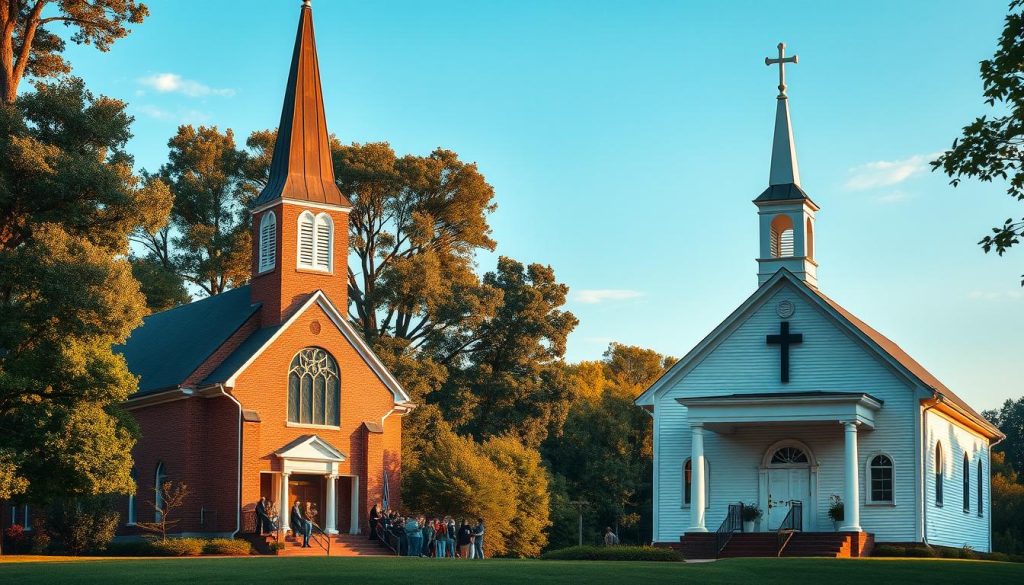
Methodist and Baptist beliefs showcase the diversity within Protestant denominations. These Christian traditions share core beliefs but have unique theological views. Both emerged from the Protestant Reformation with distinct approaches to faith and worship.
Methodists and Baptists are major branches of Christian theology. They interpret biblical teachings differently but agree on key Christian principles. These include the Holy Trinity and Christ’s resurrection1.
These denominations have a large global presence. Methodists have about 100 million members worldwide. Baptists represent around 80 million followers globally2. Their sizeable congregations highlight the impact of their theological perspectives.
Key Takeaways
- Methodist and Baptist beliefs stem from Protestant Reformation roots
- Both denominations affirm core Christian doctrines
- Significant differences exist in baptism and communion practices
- Each denomination has unique approaches to biblical interpretation
- Worldwide membership demonstrates significant religious influence
Core Theological Distinctions in Baptist and Methodist Faith
Baptist and Methodist traditions showcase fascinating theological nuances within Protestant Christianity. Both share core Christian beliefs but differ in interpreting faith, scripture, and sacraments. These differences create a rich tapestry of spiritual exploration.
Salvation and Grace Perspectives
Baptist theology emphasizes individual faith and eternal security. They believe salvation is permanent once a person is saved.
Methodists view salvation as a lifelong spiritual journey. They allow for potential spiritual transformation throughout one’s life.
- Baptists: Salvation through faith alone
- Methodists: Salvation as a progressive process
- Both affirm Christ’s divinity and justification by faith3
Biblical Authority and Interpretation
Scripture is central to both denominations’ faith. Baptists typically interpret the Bible more literally. Methodists embrace a more contextual approach to biblical understanding3.
Sacraments and Religious Practices
Baptism and communion highlight key differences in their religious practices. Baptists practice believer’s baptism by immersion, requiring a personal faith profession4.
Methodists allow various baptism modes, including infant baptism. Their communion is open to all believers.
- Baptist communion: Symbolic memorial4
- Methodist communion: Open to all believers
- Both view sacraments as sacred spiritual experiences3
These theological distinctions show the diversity within Protestant Christianity. They reveal how different denominations interpret and practice their faith3.
Difference Between Methodist and Baptist Church Governance
Methodist and Baptist churches have distinct ways of governing. Both follow Protestant traditions, but their organizational structures are quite different. Methodists use a top-down model, while Baptists prefer a bottom-up approach.
Baptist churches value independence in decision-making. Each church chooses its own pastor and handles its affairs. This congregational governance shows their commitment to church freedom and local leadership5.
Methodists use a system where bishops play a key role. Regional conferences assign pastors to churches. This creates a more centralized way of running things6.
These different models shape how churches make decisions. They also affect how resources are used and leaders are developed. The contrasts reveal deeper views on church authority and community5.
FAQ
What are the main differences between Methodist and Baptist beliefs?
Methodist and Baptist beliefs differ in several key areas. Their views on salvation, biblical interpretation, and church governance vary significantly. Baptists focus on individual faith and eternal security. Methodists see salvation as an ongoing process.
Church structures also differ between the two denominations. Baptists have more congregational autonomy. Methodists follow a more hierarchical church structure.
How do Methodist and Baptist churches differ in their approach to salvation?
Baptists believe in eternal security. Once saved, they think a person can’t lose their salvation. Methodists view salvation as a continuous growth process. They believe individuals can potentially turn away from faith.
Do Methodist and Baptist churches practice baptism differently?
Yes, baptism practices differ greatly between these churches. Baptists use full immersion for believers who can profess their faith. Methodists practice both infant and believer’s baptism. They may use sprinkling, pouring, or immersion.
How are leadership and church governance different between these denominations?
Baptist churches are usually congregationally governed. Local churches make most of their own decisions. Methodist churches have a more connectional system with a hierarchical structure. Bishops and regional conferences play a significant role in church leadership.
What are the core theological similarities between Methodists and Baptists?
Both are Protestant Christian traditions with shared core beliefs. They believe in the Trinity and Jesus Christ’s salvation. The Bible’s authority and personal faith are important to both denominations.
Evangelism and community service are emphasized in both churches. However, their approaches to these activities may differ.
How do Methodist and Baptist churches approach communion?
Both denominations practice communion, but their views differ. Methodists see it as a means of grace open to all believers. They often receive communion more frequently. Baptists view communion more symbolically and may have stricter participation rules.
Can someone transition between Methodist and Baptist churches easily?
Transitioning between these churches may require some adjustments. Understanding the differences in worship style and theology can help. Church governance and practices also vary between the denominations.
Do Methodist and Baptist churches have different worship styles?
Worship styles can vary widely in both denominations. Methodist churches often have more structured, liturgical services. Baptist churches tend to have more informal, contemporary worship styles. Individual congregations may differ in their approaches.
Source Links
- What’s the Difference Between Methodist and Baptist Beliefs? – https://www.wikihow.com/Difference-Between-Methodist-and-Baptist
- Baptist vs. Methodist Beliefs – Denomination Differences – https://denominationdifferences.com/compare/baptist-vs-methodist
- Baptist Vs Methodist Beliefs: (10 Major Differences To Know) – https://biblereasons.com/baptist-vs-methodist/
- Baptists: Beliefs, History, Faith and Religion Explained – https://www.christianity.com/church/denominations/the-most-well-known-protestant-denomination-10-things-everyone-should-know-about-baptists.html
- Baptist vs Methodist vs Lutheran: Key Differences – https://bibleslessons.com/baptist-vs-methodist-vs-lutheran-key-differences/
- Methodist vs Baptist vs Pentecostal: Key Differences – https://bibleslessons.com/methodist-vs-baptist-vs-pentecostal-key-differences/

