
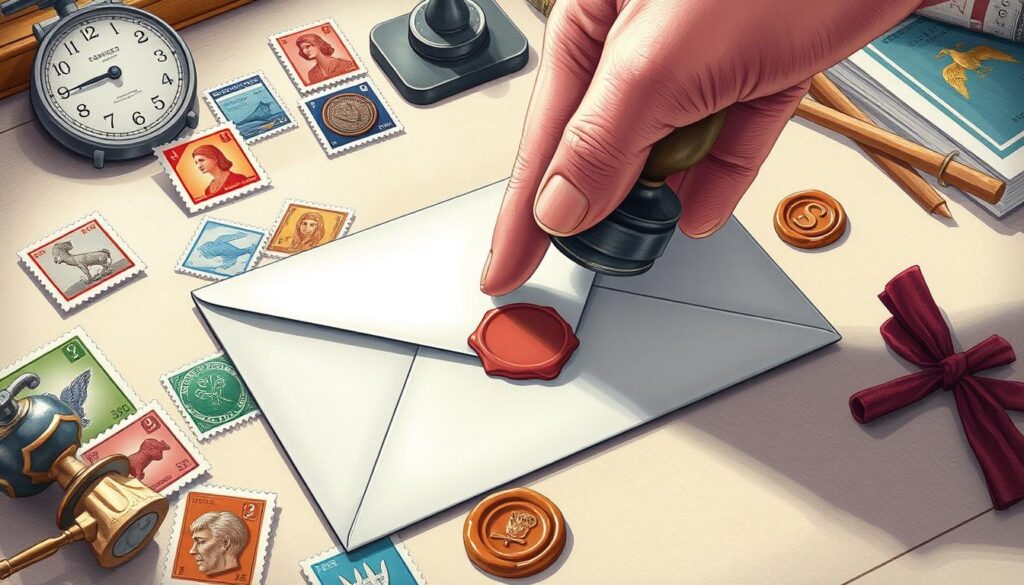
Proper stamping is key for successful letter sending. The U.S. Postal Service handles millions of letters daily. Knowing how to stamp correctly ensures your mail reaches its destination1.
Postal services have specific steps for preparing envelopes. Different sizes and weights affect postage needs. It’s vital to know the basics of stamping2.
This guide will help you navigate mailing supplies confidently. You’ll learn about selecting stamps and understanding postage calculations1.
Key Takeaways
- Learn the correct placement of stamps on envelopes
- Understand different postal service requirements
- Choose the right stamp for your mail
- Avoid common stamping mistakes
- Save time and money by knowing postal regulations
Understanding the Basics of Stamping Envelopes
Philately offers fascinating insights into stamped mail and postage stamps. Understanding stamps is crucial for effective communication. It’s important for both casual senders and aspiring collectors.
What is a Stamp?
A postage stamp proves payment for postal services. These tiny paper pieces are more than just postal fees. They’re miniature artworks that tell stories of culture and history3.
Custom address stamps have gained popularity. They offer unique ways to personalize your mail4.
Types of Stamps Available
- Adhesive stamps
- Lickable stamps
- Custom monogram stamps
- Return address stamps
Choosing the Right Stamp for Your Needs
Selecting the perfect stamp depends on several factors:
- Envelope size
- Destination
- Postal weight
- Personal style
| Stamp Type | Best Used For | Design Options |
|---|---|---|
| Standard Postage | Regular mail | Limited government designs |
| Custom Address Stamp | Personal correspondence | Multiple fonts and styles4 |
| Commemorative Stamps | Special occasions | Unique historical themes |
Pro tip: Always place your stamp in the top right corner of the envelope for proper postal processing4.
Remember, the right stamp not only ensures delivery but also adds a personal touch to your stamped mail.
Steps to Stamp an Envelope Properly
Knowing how to seal and mail envelopes correctly can prevent postal issues. Proper envelope stamping is key for your mail to reach its destination safely and on time.
Preparing Your Envelope
Gather your supplies and set up a clean workspace. The USPS reports that 25% of mail items have incorrect addresses5.
To avoid this, follow these postal etiquette guidelines:
- Write the return address in the top left corner
- Include full name, street address, city, state, and zip code
- Ensure all information is clearly written
Placing the Stamp
Proper stamp placement is vital for successful mail delivery. Always put the stamp in the upper right corner of the envelope.
Keep these tips in mind when applying the stamp:
- Use clean hands or stamp tongs to prevent damage
- Ensure the stamp is fully attached with no wrinkles
- Check that the stamp covers the entire postage area
Checking for Correct Postage
Verifying postage is the final crucial step. A single stamp costs about fifty-eight cents, covering one ounce of mail6.
Heavier items need extra stamps. Forever stamps are great as they stay valid even if postal rates increase6.
“Proper postage ensures your mail reaches its destination without delay.” – Postal Experts
Common Mistakes to Avoid When Stamping Envelopes
Proper mailing supplies and technique are vital for successful letter sending. Many people make errors that can compromise their mail’s journey. Understanding potential pitfalls can save time and prevent delivery issues7.
Incorrect stamp placement is a critical mistake. Always put postage in the top right corner of the envelope. This ensures clear visibility for postal workers7.
Overlapping or misplaced stamps can cause processing delays. They might even prevent your letter from reaching its destination at stamp collecting communities.
Weight and size considerations are often overlooked in letter sending. Different envelope sizes and contents need specific postage amounts. Underpaying can lead to returned mail or extra fees.
Postal services suggest weighing your envelope carefully. Select appropriate stamps to ensure smooth delivery7.
Protecting your stamps is crucial for successful mailing. Avoid damaging stamps through rough handling. Keep them away from moisture and extreme temperatures.
By focusing on these details, your mail will reach its destination efficiently. Your letters will arrive in a professional manner.
FAQ
How do I determine the correct postage for my envelope?
Visit the post office or use the USPS website to calculate postage. Consider your envelope’s weight, size, and mailing class. Factor in package dimensions, destination, and mail type when figuring out costs.
Where should I place the stamp on the envelope?
Put your stamp in the upper right corner of the envelope. Make it fully visible and not overlapping with other markings or addresses. This ensures proper postal processing.
What types of stamps can I use?
You can choose between adhesive sticker stamps and traditional lickable stamps. Pick based on your preference and postage needs. Some collectors like mint stamps, while others use standard postage stamps.
How do I handle stamps properly?
Wash your hands before handling stamps or use stamp tongs. This prevents oil and grime transfer. Don’t touch the adhesive side or write on the stamp.
Store stamps in a cool, dry place away from direct sunlight. This helps maintain their quality and value over time.
Can I use multiple stamps if the postage is higher?
Yes, you can combine stamps to meet the required postage amount. Place them neatly in the upper right corner without overlapping. This helps avoid postal processing issues.
What information should I include on the envelope?
Write your return address in the top left corner. Include your full name, street address, city, state, and zip code.
Put the recipient’s address in the center. Write their name, street address, city, state, and zip code on separate lines.
How do I preserve stamps for collecting?
Keep stamps in special albums, stock books, or glassine envelopes. Look at the stamp’s condition, centering, and cancellation quality. Handle mint condition stamps with care and avoid touching the gum side.
What should I do if I’m sending an oversized envelope?
Ask your local post office for specific instructions on oversized envelopes. Special mailings like wedding invitations may need different postage rates. They might also require unique handling procedures.
Source Links
- How to Mail a Letter? A Step-by-Step Guide for Beginners – bibliomantics – https://bibliomantics.com/how-to-mail-a-letter-a-step-by-step-guide-for-beginners/
- How to address an envelope correctly: Envelope etiquette – https://www.howjoyful.com/addressing-envelope/
- Stamped envelope – https://en.wikipedia.org/wiki/Stamped_envelope
- How to Guide: How to Decorate an Envelope – https://www.thestampmaker.com/how-to-decorate-envelopes.aspx?srsltid=AfmBOorsJuL-KSi3h3BxOAtpWuXEA1WzW_Lx7mG2bnAy7a3WCL0KpLnA
- How To Address an Envelope Properly – https://www.simplystamps.com/blog/how-to-address-envelopes-properly?srsltid=AfmBOoqZ-9Mfa3EttcAMpzE6f7jiUDUrjn7gZZGFzIQWBEl-sKw0cnEA
- How to Address and Stamp an Envelope – https://www.handwrytten.com/resources/how-to-address-and-stamp-an-envelope/
- Avoid These Direct Mail Design Mistakes | USPS Delivers – https://www.uspsdelivers.com/avoid-pitfalls-when-designing-your-direct-mailpiece/

