
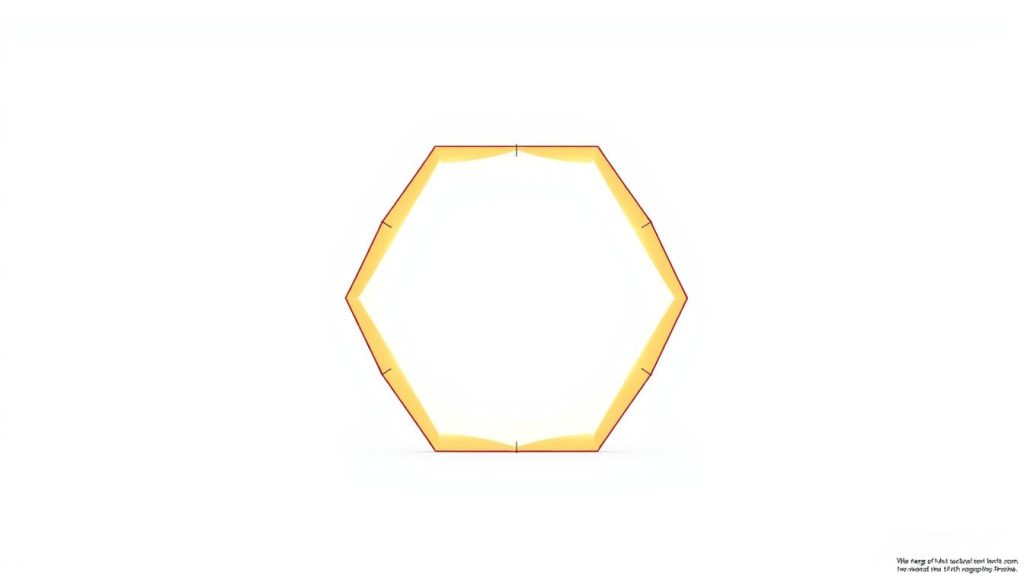
Hexagon geometry opens up a world of polygon area calculation. This six-sided shape bridges math, architecture, and natural design. Its unique properties make it visually appealing and mathematically intriguing1.
A regular hexagon has six equal sides and vertices. Each interior angle measures exactly 120 degrees1. This symmetry allows for precise calculations across various fields.
Hexagons aren’t just abstract concepts. They appear in nature and human-made structures. From honeycombs to molecular designs, hexagons showcase efficiency and elegance.
These shapes are crucial in understanding spatial relationships. They play a key role in area calculations for many scientific and design disciplines.
Key Takeaways
- A hexagon is a six-sided polygon with unique geometric properties
- Regular hexagons have equal side lengths and consistent interior angles
- Area calculation involves understanding the shape’s specific measurements
- Hexagons appear in numerous natural and engineered designs
- Mathematical precision is crucial in hexagon geometry
Understanding Hexagon Basics
Hexagons are fascinating six-sided shapes. They play a key role in math and design. Their unique properties make them both mathematically elegant and visually appealing.
Regular hexagons have six equal sides and angles. This creates a balanced, symmetrical form2. Their precision is crucial for understanding shape properties and complex math concepts.
Key Characteristics of Hexagons
- Total sides: 63
- Total diagonals: 92
- Sum of interior angles: 720 degrees2
- Each interior angle measures: 120 degrees3
Important Measurements
Hexagons offer intriguing insights into perimeter and area calculations. The perimeter is the side length times six. The area formula is A = (3√3 × s²) / 2, where s is the side length3.
Practical Applications
Hexagons aren’t just math concepts. They appear in nature, architecture, and design. You can find them in honeycombs and tile patterns.
Their geometric properties help solve complex spatial problems. Engineers, designers, and mathematicians use hexagons in their work.
Calculate the Area of a Hexagon
Knowing side length is key to finding a hexagon’s area. Regular hexagons have six equal sides and angles. This makes area calculation easy with specific formulas4. The main method uses (3√3 × s²) / 2, where ‘s’ is side length5.
STEM education shows various ways to calculate hexagon areas. You can split the shape into six equal triangles. Or use the apothem and perimeter method4. A hexagon with 5 cm sides has about 65 square centimeters of area4.
Students can use online hexagon calculators for complex geometric math5. Engineers and architects often use these geometric rules. The formula A = (1/2) × Apothem × Perimeter helps quickly find hexagonal areas4.
A hexagon’s internal angles always add up to 720 degrees. This cool fact shows the shape’s unique math features4. Hexagon area calculations have real-world uses beyond school.
They’re useful in designing honeycomb structures and building layouts. Side length measurement helps with spatial design and math precision5. Learning these skills improves understanding of geometry and its everyday importance.
FAQ
What exactly is a hexagon?
A hexagon is a six-sided polygon with straight sides and interior angles. Regular hexagons have equal sides and 120-degree angles. These shapes appear in nature and human-made designs.
Hexagons fascinate us in honeycomb structures and architectural marvels. They bridge the gap between natural wonders and engineering feats.
How do I distinguish between a regular and irregular hexagon?
Regular hexagons have equal sides and 120-degree angles. Irregular hexagons have different side lengths and varied angles. The symmetry of regular hexagons simplifies area calculations.
What are the primary methods for calculating a hexagon’s area?
Three main methods exist for calculating a hexagon’s area:
• Using the side length formula: A = (3√3 × s²) / 2
• Using the apothem and perimeter: A = (a × P) / 2
• Dividing the hexagon into six equilateral triangles and calculating their combined area
Why is understanding hexagon geometry important?
Hexagon geometry plays a crucial role in math, engineering, architecture, and biology. It helps design structures, analyze natural formations, and solve complex problems. This concept bridges theoretical math with real-world applications in STEM education.
What key measurements are important when working with hexagons?
Key measurements include side length, apothem, circumradius, and inradius. The apothem is the distance from the center to any side. These measurements are vital for accurate area and perimeter calculations.
Can hexagons be found in nature?
Hexagons are common in nature, with honeycomb structures being the most famous example. They showcase incredible natural geometric precision. Other examples include basalt rock formations, snowflakes, and certain molecular structures.
These shapes represent an efficient, space-maximizing design in nature. They demonstrate how geometry shapes our world in fascinating ways.
What’s the difference between area and perimeter for a hexagon?
Area measures the space inside a hexagon in square units. Perimeter measures the distance around the hexagon’s exterior in linear units. For regular hexagons, calculations depend on side length or apothem.
Source Links
- How to Calculate the Area of a Hexagon? – GeeksforGeeks – https://www.geeksforgeeks.org/how-to-calculate-the-area-of-a-hexagon/
- Hexagon | Area of Hexagon | Regular Hexagon – Properties – https://byjus.com/hexagon-formula/
- Area of Hexagon – Formula, Derivation and Solved Examples – https://www.vedantu.com/maths/area-of-hexagon
- Area of Hexagon – Definition, Formula, Derivation and Examples – https://byjus.com/maths/area-of-hexagon/
- How to Find the Area of a Hexagon in 3 Easy Steps — Mashup Math – https://www.mashupmath.com/how-to-find-the-area-of-a-hexagon

