
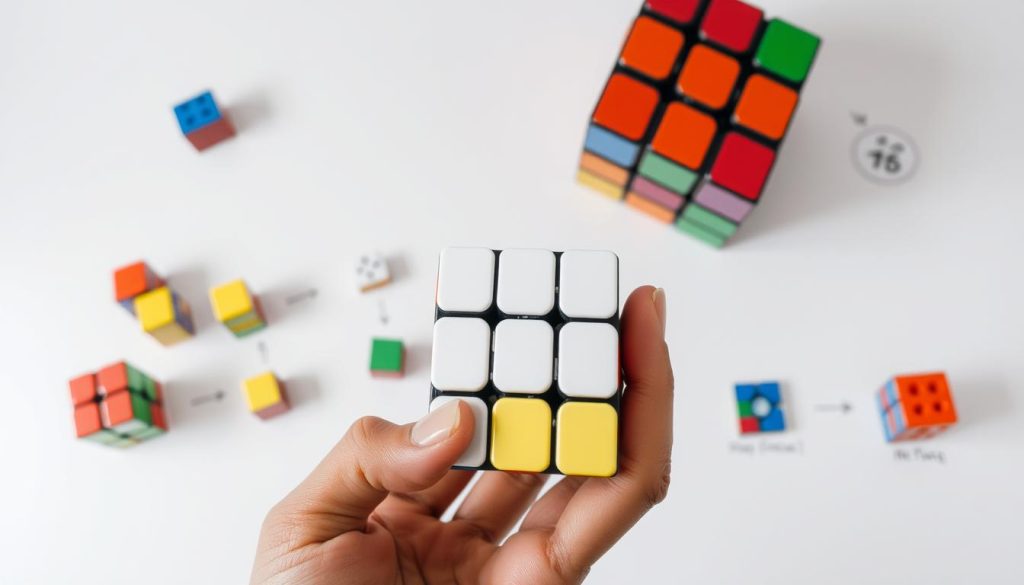
The Rubik’s Cube puzzles minds worldwide with its staggering 43 quintillion combinations1. This legendary game has enthralled puzzle lovers for decades. With the right algorithms, anyone can conquer this colorful challenge1.
Hungarian professor Ernő Rubik invented this 3D puzzle in 1974. It’s since grown from a tricky challenge into a competitive sport. Skilled cubers can solve it systematically, despite its mind-boggling complexity1.
Modern techniques have simplified cube-solving. Strategic approaches make the once-impossible task achievable. The discovery of God’s Number at 20 moves changed our understanding of the puzzle1.
Speedcubing has turned the Rubik’s Cube into an exciting brain workout. It’s no longer an insurmountable challenge, but a fun mental exercise.
Key Takeaways
- The Rubik’s Cube has 43 quintillion possible combinations
- God’s Number proves the cube can be solved in 20 moves
- Anyone can learn systematic solving techniques
- Speedcubing is a competitive and engaging mental challenge
- Solving the cube improves problem-solving skills
Understanding Rubik’s Cube Fundamentals and Notation
Rubik’s Cube is a fascinating puzzle that challenges your mind. It helps develop spatial reasoning and problem-solving skills. The cube has 54 stickers and 20 movable pieces, making it a complex challenge2.
A Rubik’s Cube has six faces with unique patterns. There are over 43 quintillion possible arrangements. That’s an incredible number of combinations to solve3!
Basic Cube Terminology
To master the cube, you need to know its parts:
- Corner pieces (8 total)
- Edge pieces (12 total)
- Center pieces (6 total)
Cube Movement Notation
Learning standard notation is key to understanding cube moves. The basic moves are represented by letters:
- F (Front)
- R (Right)
- U (Up)
- L (Left)
- D (Down)
Letters alone mean clockwise turns. An apostrophe (‘) shows counterclockwise turns. For example, F’ is a counterclockwise front turn3.
Color Schemes and Orientation
Center pieces are crucial. They determine the final color of each face. With practice, you can solve the cube in under a minute3.
Speedcubers use muscle memory to make moves quickly. Regular practice helps them become more efficient3.
Solve a Rubik’s Cube in 20 Moves: Layer-by-Layer Method
The Rubik’s Cube offers an exciting puzzle-solving challenge. It requires strategic memory techniques to master. The layer-by-layer method breaks down this complex task into manageable stages4.
There are about 43 quintillion possible cube configurations. This might seem overwhelming at first. However, with practice, solving the cube becomes achievable4.
Each solving stage uses specific algorithms to test your skills. Begin by making a white cross on the first layer. Next, place the white corners correctly.
These first steps improve spatial reasoning and pattern recognition. The ultimate goal is solving the cube in 20 moves. This method needs mental agility and strategic thinking5.
Memory techniques are key to learning cube-solving algorithms. Regular practice builds muscle memory and understanding of cube rotations. The second and third layers need precise moves and pattern recognition.
Solving the Rubik’s Cube isn’t just memorization. It’s about grasping the logic behind each turn5.
Solving the Rubik’s Cube is an exciting mental workout. It sharpens your problem-solving skills. With patience and practice, you’ll become a skilled cuber.
You’ll learn to navigate the complex world of cube-solving algorithms. Each challenge boosts your brain power4.
FAQ
How difficult is it to solve a Rubik’s Cube?
Solving a Rubik’s Cube is achievable with practice and the right approach. Break down the process into manageable steps and learn basic algorithms. With patience, you’ll develop spatial reasoning and problem-solving skills.
What are the basic components of a Rubik’s Cube?
A standard Rubik’s Cube has three key components: edges, corners, and center pieces. Edges have two colors, corners have three, and center pieces are fixed.
Understanding how these pieces interact is crucial to mastering the cube’s solution method.
What is the layer-by-layer solving method?
The layer-by-layer method is a beginner-friendly approach to solving the Rubik’s Cube. It involves solving one layer at a time, starting from the bottom.
This method helps you understand the cube’s mechanics and develop a structured solving strategy.
How long does it take to learn to solve a Rubik’s Cube?
Learning time varies depending on individual practice and dedication. Most beginners can learn the basic method in a few hours to days.
As you become more comfortable with algorithms and cube movements, your solving time will naturally decrease.
What is speedcubing?
Speedcubing is a competitive activity where participants solve the Rubik’s Cube as quickly as possible. Advanced cubers use complex algorithms to reduce their solving time.
World records for speedcubing are under 4 seconds. It’s an exciting way to challenge yourself and improve cognitive skills.
Do I need special skills to solve a Rubik’s Cube?
No special skills are required to solve a Rubik’s Cube. It’s a great tool for developing spatial reasoning and problem-solving skills.
Anyone can learn to solve it with practice, patience, and willingness to understand algorithms and cube mechanics.
What are some common challenges when learning to solve the cube?
Common challenges include memorizing algorithms, understanding cube rotations, and maintaining patience. It’s normal to feel frustrated at first.
Breaking down the solution into smaller steps and practicing consistently will help you overcome these obstacles.
Can solving a Rubik’s Cube improve my cognitive skills?
Solving a Rubik’s Cube enhances spatial reasoning, memory, pattern recognition, and problem-solving skills. It challenges your brain to think strategically.
This puzzle is an excellent brain teaser that helps develop mental flexibility and strategic thinking.
Source Links
- God’s Number Explained: How Only 20 Moves Proved Enough to Solve Any Rubik’s Cube Position – https://www.cubelelo.com/blogs/cubing/how-to-solve-rubiks-cube-in-20-moves?srsltid=AfmBOor_HtroGKxUMUch3VSnXytQr1p7OhMa7xlYZ2lmsBqSjSu6NdRF
- SolveTheCube – https://solvethecube.com/
- Rubik’s Cube Tutorial – https://ryanstutorials.net/rubiks-cube-tutorial/
- God’s Number Explained: How Only 20 Moves Proved Enough to Solve Any Rubik’s Cube Position – https://www.cubelelo.com/blogs/cubing/how-to-solve-rubiks-cube-in-20-moves?srsltid=AfmBOoo35bgHgommDKsljjIQE0zI97e2ot9YRWWiouavHGRBZXUBVmET
- Rubik’s Cube Solving In 20 Moves: God’s Number Puzzlcrate – https://puzzlcrate.com/rubiks-cube-solving-in-20-moves-gods-number/

