
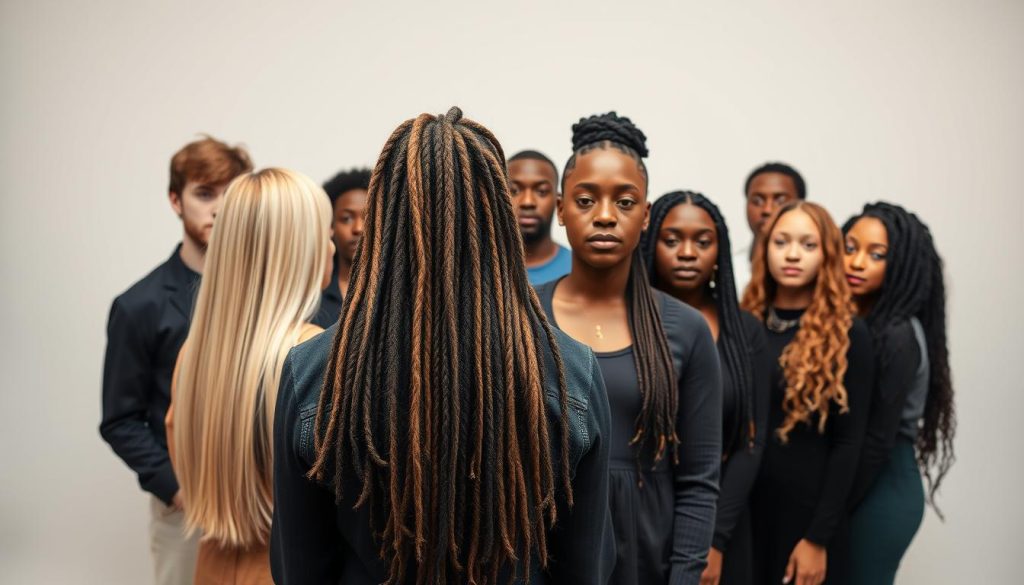
Dreadlocks are more than just a hairstyle. They hold deep cultural meaning for Black communities. When white people wear dreadlocks, they often ignore this rich history and significance1.
Cultural appropriation of hairstyles is a hot topic today. It’s especially problematic when dominant groups adopt styles without understanding their importance. This can feel disrespectful to the cultures these styles come from2.
Black Americans face unfair treatment for their natural hair. About 80% report hair discrimination at work. This makes it even more hurtful when white people freely wear these styles2.
The issue goes beyond just hair. It’s part of a bigger problem of cultural erasure. Dominant groups often take from marginalized communities without showing respect1.
Black women often feel pressure to change their natural hair. They’re pushed to fit white beauty standards at work. This adds to the frustration when white people wear dreadlocks2.
A survey shows 70% of Black people think non-Black folks shouldn’t wear dreadlocks. This view comes from years of racism and cultural oppression21.
Key Takeaways
- Dreadlocks have profound cultural significance beyond fashion
- Cultural appropriation erases meaningful cultural traditions
- Black Americans face significant discrimination for natural hairstyles
- White individuals wearing dreadlocks can be seen as disrespectful
- Understanding cultural context is crucial before adopting hairstyles
The Historical Origins and Cultural Significance of Dreadlocks
Dreadlocks are a powerful cultural symbol that go beyond race and beauty norms. This ancient hairstyle links diverse cultures through shared spiritual and cultural identities34.
Ancient Roots Across Civilizations
Dreadlocks have been around for thousands of years. Archaeological finds show they existed in many ancient cultures. Ancient civilizations saw this hairstyle as more than just looks.
- Vedic scriptures document twisted locks as early as 1500 BC3
- Egyptian mummies have been discovered with intact dreadlocks4
- Pre-Colombian Incan civilization featured locked hairstyles3
Spiritual and Religious Significance
Dreadlocks hold deep spiritual meanings in various cultures. In Hinduism, the Ganges is said to flow from Lord Shiva’s matted locks.
This symbolizes a divine connection3. Indian religious ascetics, called sadhus, wear locks to reject materialism3.
Cultural Identity and Resistance
For many groups, dreadlocks are more than just hair. They represent resistance and cultural pride. The Rastafarian movement made locks a symbol of African identity.
Rastas use dreadlocks to show spiritual separation from oppressive systems45.
Dreadlocks are a testament to cultural resilience and personal expression beyond conventional beauty standards.
Dreadlocks spark talks about race, diversity, and cultural appreciation. They challenge old ideas and celebrate unique cultural heritage5.
Understanding Cultural Appropriation vs. Appreciation in Hair Culture
Cultural sensitivity is key in grasping hairstyle adoption across communities. Dreadlocks symbolize cultural identity with deep historical roots. They’re more than just a fashion choice, as shown in this BBC article6.
Respect and understanding separate cultural appreciation from appropriation. Appreciation involves genuine learning and honoring a culture’s traditions. Appropriation happens when dominant groups take cultural elements without acknowledging their importance7.
- Recognize the historical context of hairstyles
- Understand the spiritual significance
- Respect cultural boundaries
Racial identity can affect how hairstyles are perceived. Locks on white individuals might seem trendy. The same style on black individuals can cause professional and social issues6.
Inclusivity means acknowledging power dynamics and marginalized communities’ experiences. Cultural appropriation discussions aim to ensure respectful cultural exchange. It’s not about preventing cultural sharing7.
| Cultural Appreciation | Cultural Appropriation |
|---|---|
| Respectful learning | Superficial adoption |
| Understanding context | Ignoring historical significance |
| Acknowledging origins | Disconnected usage |
Embracing cultural sensitivity can turn conflicts into opportunities. It fosters mutual understanding and respect among diverse communities.
White People with Dreadlocks: The Contemporary Debate
A viral video from San Francisco State University sparked a heated debate about white people wearing dreadlocks. This incident highlighted tensions surrounding cultural appropriation and racial microaggressions8. It led to a nationwide discussion about the fine line between appreciating and disrespecting cultures9.
Social media has become a key platform for sharing views on this topic. Millions of posts about cultural appropriation have spread online recently. Celebrities like Justin Bieber have faced criticism for their hairstyle choices8.
This backlash shows growing concern about how dominant groups interact with marginalized hair traditions9. The debate goes beyond personal style, touching on deeper issues of power and discrimination.
Workplace discrimination remains a major problem for Black individuals. The U.S. Circuit Court of Appeals ruled that banning dreadlocks at work can be legal10. Such decisions highlight ongoing struggles against racial microaggressions and cultural erasure9.
The dreadlocks debate reveals complex discussions about privilege, respect, and cultural understanding. It pushes people to recognize the historical importance of hairstyles. It also highlights the intricate nature of cultural identity9.
FAQ
What are dreadlocks and why are they culturally significant?
Dreadlocks are rope-like hair strands with deep cultural roots. They’re found in ancient Egyptian, Indian, and Rastafarian traditions. These hairstyles often represent identity, resistance, and heritage beyond fashion.
Why do some people consider white people wearing dreadlocks cultural appropriation?
Cultural appropriation happens when dominant groups adopt elements from marginalized cultures without respect. Dreadlocks are deeply connected to Black identity and cultural pride. When white people wear them without understanding, it can seem disrespectful.
What’s the difference between cultural appropriation and cultural appreciation?
Cultural appreciation involves learning about and respecting another culture’s history. Appropriation means adopting cultural elements without context, often by a dominant group. The key differences are respect, understanding, and power dynamics.
Are there any circumstances where white people can wear dreadlocks responsibly?
Responsible engagement requires deep understanding and respect for the hairstyle’s cultural origins. It means educating oneself, avoiding stereotypes, and being open to dialogue. However, some argue that certain cultural expressions aren’t meant for universal adoption.
How do power dynamics impact the dreadlocks debate?
Power dynamics are crucial in understanding cultural appropriation. Black people often face discrimination for natural hairstyles like dreadlocks. White individuals wearing the same style may be seen as “trendy” with fewer consequences.
This unequal treatment highlights systemic inequalities in the debate.
What was the San Francisco State University dreadlocks incident?
A white student with dreadlocks was confronted by a Black student about cultural appropriation. The interaction went viral, sparking a nationwide conversation. It raised questions about cultural ownership, respect, and racial identity in hair culture.
How can people be more culturally sensitive about hairstyles?
Cultural sensitivity involves continuous learning and listening to marginalized voices. It means understanding historical context and respecting cultural boundaries. People should educate themselves, be open to critique, and acknowledge privilege.
Source Links
- Dear white people with dreadlocks – https://simmonsvoice.com/2976/2015-2016/dear-white-people-with-dreadlocks/
- Are dreadlocks okay for people who are not black? – https://thoselovelylocks.com/are-dreadlocks-okay-for-people-who-are-not-black/
- Twisted Locks of Hair: The Complicated History of Dreadlocks – https://www.esquire.com/uk/style/grooming/a34465402/history-of-dreadlocks/
- The Cultural History of Dreadlocks – https://medium.com/equality-includes-you/the-cultural-history-of-dreadlocks-9dd40c8e5ac5
- Dreadlocks – https://en.wikipedia.org/wiki/Dreadlocks
- Dreadlocks on white folks: Things to consider | CNN – https://www.cnn.com/2016/03/31/living/white-dreadlocks-cultural-appropriation-feat/index.html
- Are dreadlocks cultural appropriation? – https://medium.com/@overtake/are-dreadlocks-cultural-appropriation-b2489a271601
- The ‘white people with dreadlocks’ controversy just won’t quit | CBC News – https://www.cbc.ca/news/trending/white-people-dreadlocks-justin-bieber-cultural-appropriation-1.3522221
- Are Dreadlocks Cultural Appropriation? – https://helpfulprofessor.com/are-dreadlocks-cultural-appropriation/
- The Dreadlocks Debate: How Hair Is Sparking the Conversation of the Moment – https://www.vogue.com/article/dreadlocks-hair-debate-moment

