
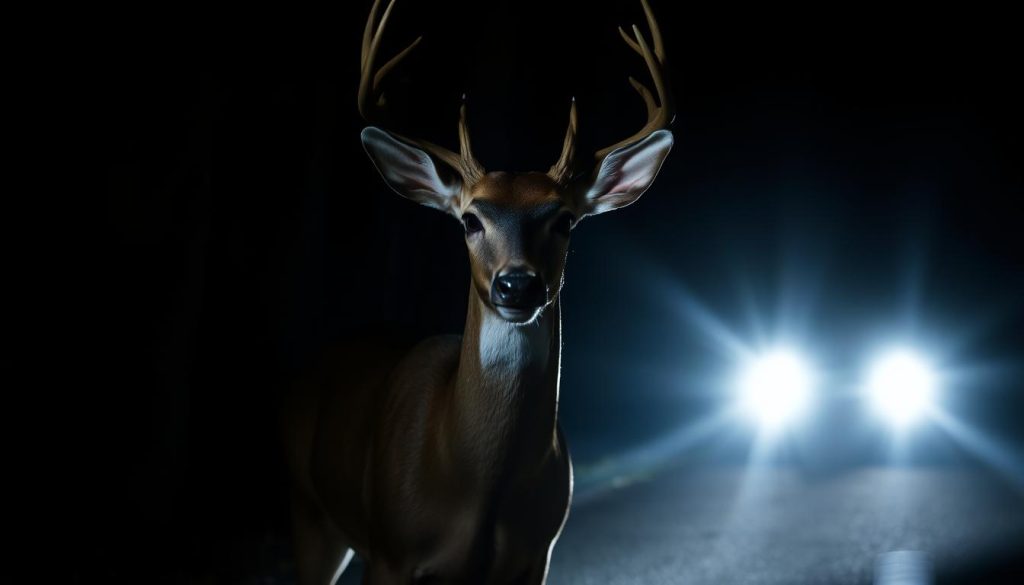
Have you ever felt frozen during a shocking or stressful moment? The “deer in headlights” look describes this paralyzing feeling perfectly12. This powerful phrase captures the moment when someone becomes completely still when facing an unexpected scary situation2.
The term “deer in headlights” became popular in the 1980s. It was widely used during the 1988 American presidential campaign1. The phrase comes from how deer act when caught in bright car lights at night.
Studies show this reaction is common in humans. About 70% of people have a “fight or flight” response that can cause freezing in stressful situations1. Surveys reveal that 60% of individuals have had at least one “deer in headlights” experience2.
Key Takeaways
- A universal expression describing momentary paralysis
- Rooted in actual deer behavior and human psychological responses
- Commonly experienced across different age groups
- Represents a natural stress reaction
- Reflects the brain’s complex response to unexpected situations
Understanding the Deer in Headlights Meaning
The “deer in headlights” expression describes intense psychological paralysis. It captures a person’s frozen reaction when overwhelmed by fear or shock. This vivid metaphor illustrates a stunned appearance in people3.
The phrase stems from a real biological response in deer. When faced with bright vehicle headlights, deer display a speechless demeanor. Their eyes, full of light-sensitive rods, become disoriented by intense light4.
This disorientation causes deer to freeze in place. Their unique visual processing triggers this stunned reaction4.
Exploring the Expression’s Origins
The idiom gained popularity in the late 1980s during political debates. Politicians’ alarmed faces perfectly demonstrated this psychological state3.
The phrase became culturally significant in the 1988 presidential race. It was used to describe reactions during the contest between Bush and Dukakis3.
Common Linguistic Variations
- A deer caught in the headlights
- Rabbit caught in the headlights
- Frozen with fear
- Struck dumb
These variations describe a similar psychological state. They all portray sudden, immobilizing shock that stops clear thinking. This state renders a person temporarily unable to react5.
Physical and Psychological Signs of the Deer in Headlights Response
The “deer in headlights” response is a deep psychological state. It shows up as a terrified look when faced with intense stress. This freeze response is an involuntary survival mechanism67.
Physical signs include wide-open eyes and stiff muscles. The body stops moving for a moment. Heart rate increases and adrenaline surges, making clear thinking hard67.
People might feel cut off from their surroundings. Experts call this a state of psychological paralysis8.
The freeze response can cause long-term issues like procrastination and sleep problems. About 31.1% of U.S. adults may have anxiety symptoms linked to trauma responses67.
Knowing these signs is key. Experts suggest mindfulness practices to help manage startled behavior6.
FAQ
What does the phrase “deer in headlights” actually mean?
This phrase describes a state of extreme shock or paralysis. It’s like a deer caught in car headlights at night. A person becomes temporarily frozen, unable to react or think clearly.
This happens during moments of overwhelming panic or sudden surprise. It leaves someone momentarily stunned and unable to move.
Where did the “deer in headlights” expression originate?
The phrase comes from real deer behavior when confronted by vehicle headlights. Deer freeze when bright lights suddenly illuminate them. This makes them vulnerable to potential danger.
This biological response has become a powerful metaphor. It represents human reactions to unexpected, overwhelming situations.
How is the “deer in headlights” expression commonly used?
People use this expression in various contexts. It applies to public speaking when someone becomes suddenly nervous. In job interviews, it describes being caught off-guard by tough questions.
It’s also used during high-stress moments. It describes someone who appears completely bewildered and unable to respond effectively.
Are there physical signs of being “deer in headlights”?
Yes, typical physical signs include wide-open eyes and a rigid body posture. Shallow breathing and a complete halt in movement are also common.
Psychologically, the person experiences a sudden surge of adrenaline. They temporarily lose the ability to process information or make decisions.
Can someone overcome the “deer in headlights” response?
Absolutely! Deep breathing, mindfulness, preparation, and practice can help. These techniques reduce the likelihood of freezing in stressful situations.
Recognizing the response early is crucial. Having pre-planned strategies helps individuals regain composure more quickly.
Are there similar expressions in other languages?
Many languages have comparable idioms describing similar states of shock. In French, people might say “being stuck like a chicken.”
German speakers use an expression about being “like a rabbit in front of a snake.” These phrases capture the same idea of sudden paralysis.
Is the “deer in headlights” response a sign of weakness?
Not at all. It’s a natural biological response rooted in our survival instincts. The freeze response is an ancient protective mechanism.
It helps individuals assess potential threats quickly. Understanding this can reduce feelings of embarrassment or self-criticism.
Source Links
- Deer in the Headlights – Origin & Meaning – https://grammarist.com/idiom/deer-in-the-headlights/
- be like a deer/rabbit caught in the headlights – https://dictionary.cambridge.org/us/dictionary/english/be-like-a-deer-rabbit-caught-in-the-headlights
- Deer in Headlights Meaning (where does this phrase come from?) – https://worlddeer.org/deer-in-headlights-meaning/
- Why Do Deer Get Transfixed By Car Headlights And Freeze In Place? – https://www.scienceabc.com/nature/animals/why-do-deer-get-transfixed-by-car-headlights-and-freeze-in-place.html
- Deer Caught in Headlights – https://learningenglish.voanews.com/a/deer-caught-in-headlights/5578858.html
- 13 Signs You’re Experiencing a Freeze Stress Response – https://www.menshealth.com/health/a42474702/signs-youre-experiencing-a-freeze-stress-response/
- Fight, Flight, Freeze, Fawn: Our Natural Response to Threats – https://www.mountainside.com/blog/fight-flight-freeze-fawn-our-natural-response-to-threats/
- Fight, Flight, Freeze, Fawn: The Four Mental Health Trauma Responses Explained – https://www.mavehealth.com/blogs/fight-flight-freeze-fawn-mental-health-trauma-responses

