
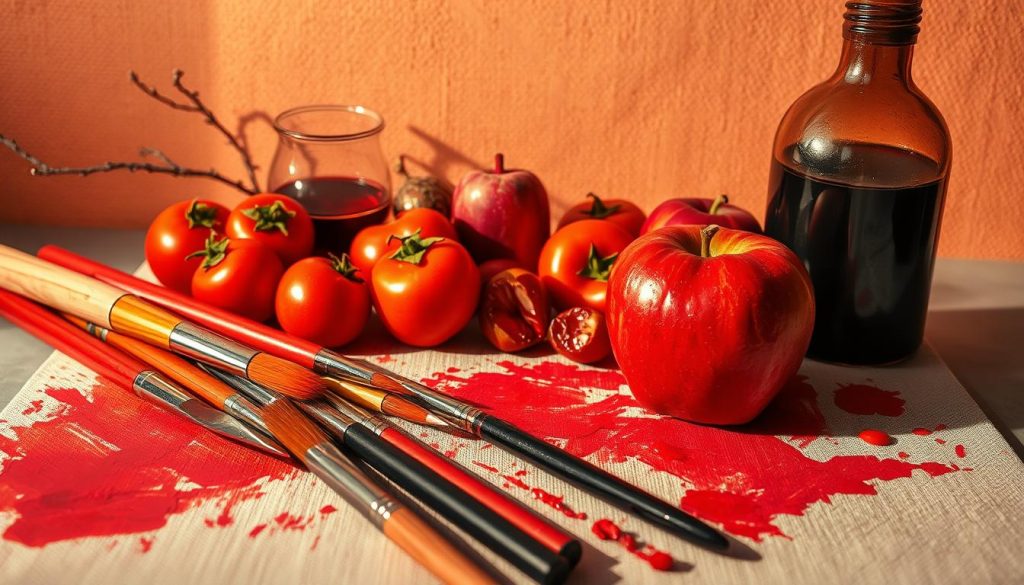
Red is a fascinating primary color with unique traits in color theory. It can’t be created by mixing other colors1. Artists exploring warm colors must grasp the basics of mixing for red2.
Red is one of three primary colors, along with blue and yellow1. While pure red can’t be mixed, artists can create many stunning variations within the red spectrum2.
Mixing colors for red involves subtle techniques. Adding small amounts of other colors can change red’s look dramatically. A bit of yellow creates orange-red tones, while blue produces violet-red hues1.
Precise color mixing needs careful balance. Adding green to red can make reddish-brown tones. But too much might result in muddy gray1.
Key Takeaways
- Red is a primary color that cannot be created by mixing
- Subtle color additions can generate unique red variations
- Understanding color theory is crucial for effective mixing
- Small increments of complementary colors transform red’s appearance
- Over 400 different shades of red exist for creative exploration
Understanding Red as a Primary Color
Color theory unveils fascinating insights into red pigments and their artistic role. Red is a cornerstone of color understanding. It has unique properties that make it essential for visual creativity3.
The Essence of Primary Colors
Red holds a special place in color theory as a primary color. It can’t be created by mixing other colors3. Our understanding of color mixing has evolved over time.
This evolution challenges long-held beliefs about primary colors. Red remains fundamental in both RGB and RYB color models4.
- Red is fundamental in both RGB and RYB color models4
- Wavelength of red light is approximately 700 nanometers3
- Red plays a crucial role in creating secondary colors like purple and orange3
The Science of Color Mixing
Subtractive color mixing creates an intricate landscape of color creation. The traditional red, yellow, and blue model is now considered ineffective. It doesn’t produce a wide range of colors5.
| Color Model | Primary Colors | Key Characteristics |
|---|---|---|
| Subtractive (Print) | Cyan, Magenta, Yellow | Most effective for color reproduction |
| Additive (Light) | Red, Green, Blue | Used in digital displays |
Red’s Role in Color Harmony
Red shows remarkable versatility in color wheels and design. Color harmony relies on understanding how red interacts with other colors. This interaction creates vibrant and dynamic visual compositions4.
Red is not just a color, but a powerful visual language that speaks through intensity and emotion.
Designers can create various shades of red by adding white or black. Adding white produces pink tones. Incorporating black generates deeper red hues3.
Red’s cultural and emotional associations make it compelling in visual communication. It’s a powerful tool for artists and designers alike.
Mixing Colors for Red Variations and Shades
Color mixing opens up a vibrant world of artistic expression. Artists create stunning variations by understanding pigment interactions. Color mixing techniques transform pure red into diverse hues.
Alizarin Crimson offers a rich, bluey-red color for starter paint sets6. Complementary colors can dramatically shift red’s appearance. Mixing red with green produces muted tones, while adding white creates lighter tints7.
Cadmium Red Genuine mixed with white produces bright pinks6. Color harmony emerges when carefully balancing pigments. Professional artists know color mixing requires precision.
Mixing four parts red with one part white creates slightly lighter tones8. Rose Madder Quinacridone offers an intense, semi-transparent cherry red6. Experimenting with different ratios helps develop a nuanced understanding of red’s versatility.
Mastering red variations requires understanding color theory and practicing intentional mixing. Each combination tells a unique visual story. Magenta, with its deep red-pink and violet bias, shows red’s incredible range6.
FAQ
Why can’t I mix other colors to create red?
Red is a primary color. It’s a fundamental building block in color theory. You can’t create red by mixing other colors.
How do complementary colors affect red?
Complementary colors can dramatically change red’s appearance. Green, red’s complementary color, can mute or neutralize red tones. This creates more complex and sophisticated color variations.
What are some ways to create different shades of red?
You can create different red shades by adding white to make tints like pink. Adding black creates shades like burgundy. Mixing with small amounts of complementary colors also works.
You can adjust temperature by incorporating warm or cool undertones. This gives you even more options for red variations.
How does subtractive color mixing work with red?
In subtractive color mixing, pigments absorb certain wavelengths of light. Mixing red pigments removes different light wavelengths. This process creates new colors and variations of red.
Can I mix red in different media?
Yes! Red can be mixed in various media including acrylic paints, oil paints, and watercolors. Digital color platforms and food coloring also work well.
Each medium has unique properties that slightly alter how colors mix and appear.
What are some classic red color combinations?
Classic red combinations include crimson, a deep, rich red. Scarlet is a bright, vibrant red. Burgundy is a dark, wine-like red.
Vermilion is an orange-red tone that’s also popular. These variations offer different moods and styles.
How does color temperature affect red?
Red can have warm and cool variations. Warm reds tend to have orange or yellow undertones. Cool reds have blue or purple undertones.
These subtle differences can dramatically change the mood and perception of a color.
Source Links
- 4 Ways to Make Red – wikiHow – https://www.wikihow.com/Make-Red
- What Colors Make Red and How Do You Mix Different Shades of Red? – https://www.color-meanings.com/what-colors-make-red/
- What Colors Make Red? Understanding Color · PrepScholar – https://blog.prepscholar.com/what-colors-make-red
- What Colors Make Red – Guide for Mixing Shades of Red – https://artincontext.org/what-colors-make-red/
- Primary Colors Are Red, Yellow and Blue, Right? Not Exactly – https://science.howstuffworks.com/primary-colors.htm
- Colour Mixing: Six Restricted Red Palettes – Jackson’s Art Blog – https://www.jacksonsart.com/blog/2020/12/18/eight-reds-in-six-restricted-palettes/
- What Color Does Red And White Make When Mixed? – GeeksforGeeks – https://www.geeksforgeeks.org/what-color-does-red-and-white-make-when-mixed/
- Color Mixing Guide For Real Milk Paint – https://www.realmilkpaint.com/help/resources/color-mixing/?srsltid=AfmBOoppDhe2QxLiDih37if0ISuB8PUpQpJZZVud-Kbs3nftQmQmpG_O

