
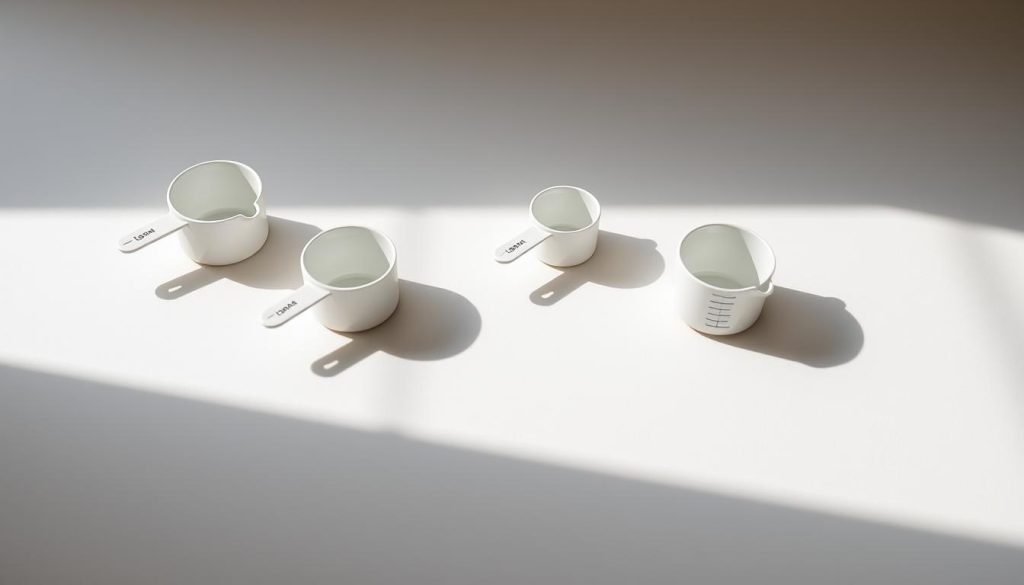
Converting cups to milligrams can be tricky. It requires knowing about density and measurement standards1. A U.S. cup equals 237 milliliters, making volume-to-mass conversion complex1.
Accurate ingredient conversions are crucial in cooking and science. Each substance has a unique density. This makes the cups-to-milligrams transformation vary for different ingredients.
Mastering volume conversion ensures recipe and experiment accuracy. It benefits both kitchen enthusiasts and scientists. Understanding these relationships is key to precise measurements.
Key Takeaways
- Cups measure volume, milligrams measure mass
- Conversion depends on ingredient density
- U.S. standard cup equals 237 milliliters
- Precision matters in cooking and scientific work
- Each ingredient requires unique conversion approach
Understanding Volume and Mass Measurements
Precise ingredient quantities are crucial for perfect cooking and baking results. Knowing the differences between volume and mass measurements is key for accurate recipe conversions. Professional chefs prefer weighing ingredients for more reliable baking calculations.
Cup Measurement Explained
Standard cup measurements vary across different systems. In the US customary system, 1 cup equals 237 ml2.
International standards differ:
- US customary cup: 237 ml
- Metric cup: 250 ml
- Japanese cup: 200 ml
Milligram Measurements Fundamentals
Milligrams are a precise unit of mass for ingredient measurements. One milligram equals 1/1,000 of a gram. Density is crucial when converting between cups and milligrams3.
Volume vs. Mass: Key Differences
Ingredient quantities can change dramatically based on density. Here are some examples:
- Water: 1 cup = 236,588 mg
- All Purpose Flour: 1 cup = 125,155 mg
- Cooking Oil: 1 cup = 208,198 mg
These differences show why weight measurements are better for precise recipe conversions3.
For accurate measurements, use this formula: milligrams = cups × 236,588.236 × density3. This method ensures consistent ingredient measurements across various cooking and baking tasks.
Cups to Milligrams Conversion Formula
Kitchen math is crucial for precise cooking and baking. The formula for converting cups to milligrams multiplies volume by ingredient density. This method ensures accuracy in recipe conversion techniques.
The standard formula is: milligrams = cups × 236,588.236 × density (in g/mL). This calculation considers the weight of different ingredients4. Water has a simple conversion, while flour needs more complex math5.
- Water conversion: 1 cup = 236.59 grams
- Flour conversion: 1 cup ≈ 141.6 grams
- Salt conversion: 1 cup ≈ 287 grams
Always consider the ingredient’s specific density for precise measurements. Accurate conversions can significantly impact a recipe’s outcome. Kitchen unit transformations demand attention to detail6.
Pro tip: When exact density isn’t known, use standard reference values for common ingredients.
Common Kitchen Ingredient Conversion Guide
Mastering food measurement is vital for all cooks. Precise conversions can transform your cooking experience. A standard measuring cup ensures consistent results7.
Cup sizes range from 1/8 to 1 full cup. This variety helps maintain accuracy in cooking and baking7.
Liquid measurements are simpler than dry ones. One cup equals 8 fluid ounces. Sixteen tablespoons make up a single cup8.
When using recipe conversions, note ingredient-specific weights. A cup of granulated sugar weighs about 7 ounces. All-purpose flour typically weighs around 4 1/4 ounces per cup9.
Different ingredients need unique conversion methods. Baking requires exact measurements. A cup of almond flour weighs 3 3/8 ounces. Packed brown sugar weighs 7 1/2 ounces per cup9.
Understanding these measurement techniques will boost your cooking skills. You’ll create tasty dishes consistently with this knowledge.
FAQ
Why is converting cups to milligrams important in cooking and baking?
Precise measurements are vital in cooking and baking. Converting cups to milligrams ensures accuracy, especially for scientific recipes. Weight measurements provide more reliable results than volume measurements.
What’s the difference between a cup and a milligram?
A cup measures volume, while a milligram measures mass. Different ingredients have varying weights in the same cup. For example, a cup of flour weighs differently than a cup of sugar.
How do I convert cups to milligrams for different ingredients?
To convert cups to milligrams, you need to know the ingredient’s density. Multiply the volume (cups) by the ingredient’s density. Conversions vary for different substances.
Water converts easily, but dry ingredients like flour need more precise calculations. The conversion depends on factors such as how tightly packed the ingredient is.
Are conversion measurements the same for all ingredients?
No, conversion measurements differ between ingredients. Water converts easily (1 cup = 236,588 milligrams). Dry ingredients like flour can vary based on packing, humidity, and measurement method.
What tools can help me convert cups to milligrams?
Several tools can assist with conversions:
– Digital kitchen scales
– Online conversion calculators
– Conversion charts for specific ingredients
– Measuring cups with weight markings
Professional bakers and chefs often recommend using a digital scale for the most accurate measurements.
Why do professional chefs prefer weight measurements?
Weight measurements are more consistent and precise. Volume can vary due to ingredient compaction, humidity, and measuring technique. Weight measurements eliminate these variables, ensuring more reliable results in cooking and baking.
How do I handle recipes that use cup measurements if I want to use milligrams?
To convert cup measurements to milligrams:
– Use a reliable conversion chart
– Invest in a digital kitchen scale
– Look up the specific density of the ingredient
– Multiply the volume by the ingredient’s density
Always double-check your calculations to ensure accuracy in your recipes.
Are there any challenges in converting cups to milligrams?
Yes, several challenges exist:
– Varying ingredient densities
– Different measurement standards (US vs. metric)
– Potential measurement errors
– Ingredient-specific variations
Careful attention and precise tools can help overcome these challenges and ensure accurate conversions.
Source Links
- ml to cups converter – Free Online Converter – GeeksforGeeks – https://www.geeksforgeeks.org/ml-to-cups-converter/
- Measurement Equivalents | Exploratorium – https://www.exploratorium.edu/food/measurements
- Cups to Milligrams Converter – (c to mg) – Inch Calculator – https://www.inchcalculator.com/convert/cup-to-milligram/
- Finally: A Liquid Measurement Conversion Chart for Any Recipe – https://www.bhg.com/recipes/how-to/bake/convert-liquid-measurements/
- Grams to Cups Converter – https://www.omnicalculator.com/food/grams-to-cups
- PDF – https://www.georgebrown.ca/sites/default/files/uploadedfiles/tlc/_documents/apothecary,_household_and_metric_systems_of_measurement.pdf
- Cooking Measurement Conversion – https://www.webstaurantstore.com/guide/582/measurements-and-conversions-guide.html?srsltid=AfmBOoq7nzMOBYRzV5xbsMIeJB_ovZJKpU6lxuUZvxcO-whdwKLkHvUx
- This Chart Shows You How to Convert Cooking Measurements – https://www.tasteofhome.com/article/cooking-measurement-conversion/?srsltid=AfmBOoqYaFINTF6DXu9dJeJDNTKzg3IInDQOQlvHGSjOuIijwNwpyncy
- Ingredient Weight Chart – https://www.kingarthurbaking.com/learn/ingredient-weight-chart

