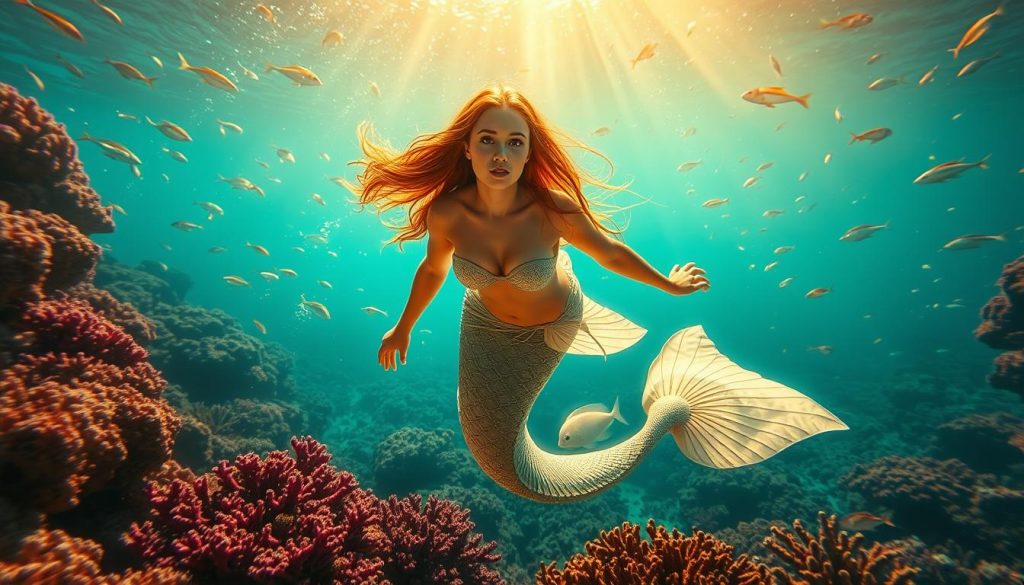
Mermaids have fascinated humans for ages, mixing marine legends with mythical creatures. These sea beings spark curiosity about their possible existence1. Mermaid tales appear in cultures worldwide, showing a deep interest in these water-dwelling humanoids1.
The National Ocean Service states there’s no proof of mermaids. Yet, people remain intrigued2. Belief in these magical creatures dates back to early human history2.
Even Christopher Columbus reported seeing mermaids. These sightings were later found to be marine mammals2.
Today, mer-culture is making a comeback. Disney’s 2023 “The Little Mermaid” remake has renewed interest in these sea myths2. The Netflix show “MerPeople” also fuels curiosity about these legendary beings2.
Events like the “Mystical Mermaid March” in St. Pete show ongoing love for these creatures2.
Key Takeaways
- Mermaids exist primarily in cultural mythology
- No scientific evidence supports their biological existence
- Mermaid legends appear in cultures worldwide
- Modern media continues to fuel mermaid fascination
- Historical accounts often misidentified marine mammals as mermaids
The Ancient Origins of Mermaid Mythology
Mermaid myths blend human imagination and sea culture. These water beings have fascinated us for millennia. They emerge from cultural tales and cryptozoology3.
The first half-fish, half-human creature, Oannes, appeared in the 4th century BCE. This marked an early point in mermaid lore3.
Exploring Ancient Maritime Legends
Cultures worldwide have embraced mysterious mermaid sightings. These sightings have grown into rich storytelling traditions.
Atargatis, a deity from northern Syria, is one of the earliest mermaid-like figures. She was worshipped 3,000 to 4,000 years ago4.
Her legend shows how water spirits became complex cultural symbols. They went beyond simple mythological figures.
Global Mermaid Representations
- Mesopotamian water spirits
- Greek mythological marine creatures
- African water goddess Mami Wata
- Iranian water deities
Explorers often reported seeing mermaids. Christopher Columbus noted mermaid sightings in 1492. These were later identified as manatees3.
Henry Hudson described a mermaid in 1608. It had a porpoise-like tail and long dark hair4.
Cultural Significance of Merfolk
Mermaids are more than just myths. They represent deep meanings across cultures. From Iranian water goddesses to African fertility spirits, these beings hold great significance5.
Early Greek art showed bearded male figures. Later, more complex female forms appeared. This shift reflects changing cultural views5.
“Mermaids are not just myths, but mirrors of human imagination and cultural expression.”
Modern Pop Culture and Mer-Culture Evolution
Mermaids have transformed from ancient legends to a vibrant cultural phenomenon. Disney’s “The Little Mermaid” reshaped public perception of these mythical sea creatures6. The 1989 film reimagined mermaids as romantic, relatable characters, sparking widespread fascination with marine legends.
Social media has thrust mer-culture into the spotlight, giving rise to “finfluencers”. Mermaid-themed events and online communities have become platforms for exploring ocean mysteries7. Netflix’s “MerPeople” and the “Mystical Mermaid March” showcase the ongoing cultural obsession.
Scientific organizations like NOAA stress that no evidence supports the existence of mermaids7. Sightings are often mistaken for marine life such as manatees or dugongs. Yet, the cultural imagination swims on.
Mermaids have evolved from mythological figures into symbols of fantasy and creative expression6. They now represent inclusivity and serve as a canvas for modern storytelling.
FAQ
What exactly are mermaids?
Mermaids are mythical sea creatures with a human female upper body and fish tail. They’ve captured human imagination for thousands of years. These beings appear in folklore, legends, and stories across various civilizations worldwide.
Are there any historical records of mermaid sightings?
Sailors have reported mermaid sightings throughout history. These range from ancient Greek myths to Christopher Columbus’s Caribbean logs. However, scientists often attribute these sightings to misidentified marine mammals like manatees.
How do different cultures view mermaids?
Mermaid myths vary widely across cultures. Greek mythology links them to sirens and sea gods. Scandinavian tales portray them as beautiful yet dangerous creatures. Some Pacific Island cultures see similar beings as ocean guardians.
What impact has pop culture had on mermaid perception?
Disney’s “The Little Mermaid” changed how people see these mythical beings. They’ve become symbols of beauty and adventure, rather than mysterious creatures. Social media has further popularized mermaid aesthetics through costumes and digital content.
Is there any scientific evidence of mermaids?
No credible scientific proof supports the existence of mermaids as real creatures. Despite investigations, no conclusive evidence has been found. Reported sightings are usually explained by natural phenomena or misidentified marine life.
How have mermaid myths evolved over time?
Mermaid myths have changed from cautionary tales to romantic stories. Early legends often portrayed them as dangers to sailors. Modern interpretations emphasize their mystical and romantic qualities. This shift reflects changing attitudes towards the ocean.
Can people dress up as mermaids today?
Yes! Mermaid culture has become a popular subculture. It includes professional performers, themed events, and special swimwear. Mermaid conventions and swimming classes have made this a trendy hobby.
What’s the connection between mermaids and marine conservation?
Mermaid imagery helps raise awareness about ocean conservation. Many marine protection groups use these mythical creatures as powerful symbols. They draw attention to environmental issues and the importance of protecting our oceans.
Source Links
- Do Mermaids Really Exist? Diving into the Supernatural – https://medium.com/illumination/do-mermaids-really-exist-diving-into-the-supernatural-4ad54989bf14
- Are mermaids real or a fin-tastic fable? The history and myths behind mermaid culture – https://www.today.com/life/are-mermaids-real-rcna144275
- From Mermaids to Manatees: the Myth and the Reality – https://ocean.si.edu/ocean-life/marine-mammals/mermaids-manatees-myth-and-reality
- Tails from the deep: separating the real folklore of mermaids from Disney stories – https://www.historyextra.com/period/early-modern/mermaids-legends-sirens-myths-folktales-hans-christian-andersen-disney/
- Mermaids: Myth, Kith and Kin – JSTOR Daily – https://daily.jstor.org/mermaids-myth-kith-and-kin/
- What is a mermaid? – https://www.rmg.co.uk/stories/topics/what-mermaid
- Are Mermaids Real: Truth or Myth? – Ocean Info – https://oceaninfo.com/exploration/myths-and-legends/are-mermaids-real/