
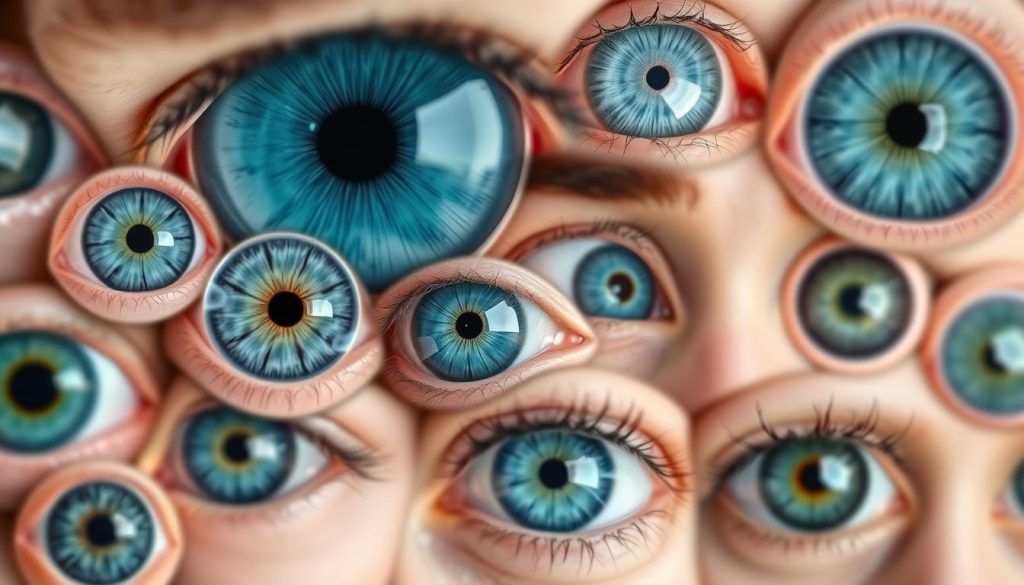
Blue-green eyes are a rare and captivating feature of human diversity. They blend the mesmerizing qualities of blue and green pigmentations. These extraordinary eyes represent one of the most uncommon genetic expressions12.
Blue-green eyes showcase a remarkable genetic phenomenon. They highlight how human genetics create unique visual traits. Blue eyes make up about 27% of the American population1.
Green eyes account for only 9% of Americans1. The combination of blue and green is even more exceptional. This rarity stems from specific melanin production patterns.
Eye color results from complex genetic mechanisms. Blue-green eyes demonstrate the incredible variability of human genetic expression2. They’re a testament to nature’s ability to create unique features.
Key Takeaways
- Blue-green eyes are extremely rare in the global population
- Genetic factors determine eye color complexity
- Less than 2% of people worldwide have green eyes
- Eye color results from multiple genetic interactions
- Human genetic diversity creates extraordinary eye color variations
Understanding Eye Color Genetics and Pigmentation
Eye color genetics unveils the complex mechanisms behind our iris pigmentation. Multiple genes and molecular interactions influence human eye color. It’s a fascinating field that explains our unique eye hues3.
The Molecular Science of Eye Pigmentation
Melanin is key in determining eye color. The amount and type of melanin create the spectrum of colors we see. Surprisingly, more than 150 genes contribute to eye color variations3.
Key Genetic Factors in Eye Color
The OCA2 gene is crucial in eye color determination. It impacts melanin storage in the iris. Specific genetic variations in OCA2 lead to different eye colors3.
- The HERC2 gene controls OCA2 expression
- Genetic polymorphisms can reduce melanin production
- Inheritance involves at least three gene pairs
Genetic Inheritance Patterns
Eye color inheritance follows complex genetic rules. The bey2 gene has alleles for brown and blue eyes. Brown is the dominant trait in this gene3.
Interestingly, blue-eyed children can come from brown-eyed parents. This happens if both parents carry recessive blue alleles3.
| Gene | Role in Eye Color | Inheritance Pattern |
|---|---|---|
| OCA2 | Melanin Storage | Primary Determinant |
| HERC2 | Gene Expression | Modifier |
| Bey2 | Color Variation | Dominant/Recessive |
Twin studies have uncovered intriguing facts about eye color genetics. Research shows that dominant genetic factors cause 74% of eye color variability. The OCA2 gene plays a crucial role in this process4.
Genetic variations can lead to unique eye color expressions, making each individual’s iris a genetic masterpiece.
Blue-Green Eyes Rarity: Global Distribution and Statistics
Eye color diversity is fascinating, with blue-green eyes being exceptionally rare. Eye color distribution shows interesting patterns across populations5. Globally, brown eyes are most common, with over 50% of people having this dark hue5.
Blue and green eyes are uncommon variants. About 2% of people have green eyes5. Blue eyes make up 8-10% of global eye colors6.
In the United States, eye color statistics differ:
Blue-green eyes are an extraordinary genetic phenomenon. Their rarity comes from specific genetic combinations. Regional differences greatly affect eye color distribution5.
The genetic dance that creates blue-green eyes is a complex interplay of inherited traits, making these eyes a true genetic marvel.
Eye color prevalence varies widely across regions. In Europe, Iceland has many blue-eyed people. Armenia and Kazakhstan have mostly brown-eyed populations5.
Conclusion
Blue-green eyes showcase the complex genetics behind our unique traits. These rare colors stem from intricate genetic interactions affecting melanin in the iris7. Eye color isn’t just a simple genetic trait.
Blue-green eyes highlight the incredible variation within human populations. While brown eyes dominate globally, blue-green variations remain exceptionally uncommon7. They’re a true genetic marvel8.
The genetics of eye color reveal the complexity of human inheritance. Each blue-green eye tells a story of ancestral genetic mutations. These rare colors reflect our rich evolutionary history8.
Blue-green eyes remind us of the extraordinary genetic tapestry in humans. They showcase the beauty of genetic variation. These rare colors celebrate human diversity and individual uniqueness.
FAQ
What makes blue-green eyes so rare?
Blue-green eyes are incredibly rare, occurring in less than 3% of people worldwide. This unique eye color results from complex genetic interactions. Specific variations in the OCA2 and HERC2 genes control melanin production in the iris.
How do genetics determine eye color?
Eye color depends on melanin amounts in the iris. Genes like OCA2 control melanin production. Humans once had only brown eyes. Genetic mutations over time led to lighter eye colors.
Blue-green eyes have a delicate balance of low to moderate melanin. This balance makes them a remarkable example of human genetic diversity.
Can eye color change over time?
Eye color can change subtly throughout life. Babies often have blue or gray eyes that may darken as melanin develops. Some people experience slight color variations due to age, emotions, or lighting.
Dramatic eye color changes are rare. They usually point to an underlying health issue.
Are blue-green eyes more common in specific regions?
Blue-green eyes are most common in Northern and Eastern European populations. Countries like Iceland, Russia, and parts of Scandinavia have more light-eyed people. However, blue-green eyes remain exceptionally rare worldwide.
Do blue-green eyes have any unique genetic characteristics?
Blue-green eyes show a fascinating genetic interplay. They’re not just a simple color mix. Instead, they result from complex genetic traits, light reflection, and melanin distribution.
Scientists study these rare eye colors to better understand human eye color variation.
How do lighting conditions affect blue-green eye appearance?
Lighting greatly impacts how blue-green eyes look. Natural daylight, artificial light, and surrounding colors can make eyes appear more blue or green. This chameleon-like quality makes blue-green eyes particularly captivating.
Is eye color completely determined by genetics?
Genetics play the main role in eye color, but it’s not simple. Multiple genes contribute to eye color inheritance. Environmental factors and genetic variations can influence the final eye color.
This complexity explains why parents with the same eye color can have kids with different colors. It’s also why rare combinations like blue-green eyes occur.
Source Links
- Which Eye Colors Are the Rarest? – https://www.allaboutvision.com/eye-care/eye-anatomy/eye-color/rarest/
- What’s the Rarest Eye Color, and Why? – https://www.aarp.org/health/conditions-treatments/info-2022/rarest-eye-color.html
- Genetics of Eye Color – https://www.news-medical.net/health/Genetics-of-Eye-Color.aspx
- What colour are your eyes? Teaching the genetics of eye colour & colour vision. Edridge Green Lecture RCOphth Annual Congress Glasgow May 2019 – Eye – https://www.nature.com/articles/s41433-021-01749-x
- All About Eye Colors (and What They May Say About Your Health) – https://www.healthline.com/health/eye-health/eye-color-percentages
- Eye colors: Most common and percentages – https://www.medicalnewstoday.com/articles/eye-color-percentage
- What is the rarest eye color in humans? – Optical Academy – https://optical-academy.com/blog/what-is-the-rarest-eye-color-in-humans/
- Blue-eyed humans have a single, common ancestor – https://www.sciencedaily.com/releases/2008/01/080130170343.htm

