
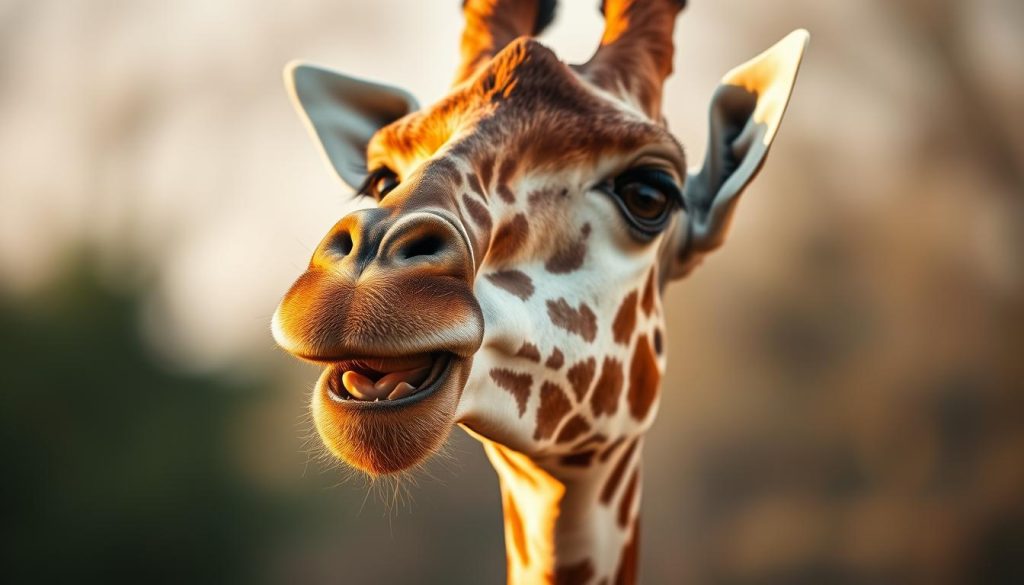
Giraffes aren’t the silent giants we once thought. These majestic animals actually communicate through unique sounds. Researchers have found that giraffes produce a fascinating range of vocalizations1.
Giraffe sounds are surprisingly diverse. They range from low-frequency humming to subtle communication methods. Scientists have recorded nearly 947 hours of giraffe sounds across three European zoos2.
Giraffes can produce sounds from 14 Hz to over 200 Hz1. Their acoustic communications include humming, grunting, and specific social interaction sounds. Male giraffes make unique vocalizations when interested in a potential mate1.
Key Takeaways
- Giraffes are not silent animals as previously believed
- They produce low-frequency sounds between 14-200 Hz
- Researchers have recorded nearly 947 hours of giraffe vocalizations
- Different sounds serve various communication purposes
- Giraffe vocalizations are rare but scientifically significant
Understanding Giraffe Sounds and Communication Methods
Giraffes aren’t silent creatures. These tall mammals use complex communication methods. They combine vocal and visual signals to interact in unique ways.
Scientists once thought giraffes were quiet. Now, we know they have a rich communication system.
Exploring Historical Misconceptions
Researchers used to think giraffes were silent giants. New studies show they can make sounds. Giraffes have a larynx with vocal folds like horses.
Their communication includes several interesting vocal expressions:
Anatomical Influences on Sound Production
A giraffe’s long neck makes it hard to vocalize. Their trachea is about 13 feet long. This affects how sound travels.
Physical limits reduce air speed and pressure. This makes it tougher for giraffes to produce sounds.
Visual and Auditory Communication Strategies
Giraffes use more than just sounds to communicate. They use visual signals during the day. Their excellent eyesight helps with this.
At night, giraffes make a humming sound at 92Hz. Humans can barely hear this low frequency.
| Communication Type | Characteristics |
|---|---|
| Vocal Sounds | Grunts, hisses, moans |
| Visual Signals | Body language, neck movements |
| Nocturnal Communication | Low-frequency humming |
Giraffe noises and visual signals are complex. They’re more advanced than we once thought.
Discovering the Mystery of Giraffe Sounds
Scientists have unveiled a fascinating world of giraffe communication. Researchers spent over 900 hours studying giraffe vocalizations, revealing surprising insights. These gentle giants produce intriguing sounds, challenging our understanding of their communication4.
Giraffe humming is a remarkable discovery. These animals produce low-frequency sounds mainly at night, creating a mysterious acoustic landscape. Their snorting and humming patterns suggest a complex communication system5.
- Nighttime sounds occur during herd separation
- Low-frequency hums can travel vast distances
- Communication methods remain partially mysterious
Mother giraffes use distinctive sound patterns for communication. These include both audible and infrasonic communications. Unique head movements produce these sounds, rather than traditional vocal cord vibrations5.
| Sound Type | Characteristics | Purpose |
|---|---|---|
| Giraffe Humming | Low-frequency | Nighttime communication |
| Giraffe Snorting | Short, sharp sounds | Immediate herd alerts |
Genetic diversity helps giraffes maintain effective communication. They’ve developed robust strategies, unlike animals with nerve-related vocal challenges. Their low-frequency sounds travel far across savannahs, ensuring effective herd communication5.
Conclusion
Giraffe vocalizations have sparked new research into these magnificent creatures. Scientists once thought giraffes were silent. Recent studies show they communicate at night. The groundbreaking research reveals complex snoring and low-frequency sounds6.
The purpose of these unique vocalizations remains a mystery. Giraffe mooing-like sounds at night suggest social interactions. However, researchers haven’t found definitive explanations yet7.
Night-vision gear and long-term observation are key to solving these acoustic puzzles. These tools might uncover hidden communication patterns. Such patterns could have gone unnoticed for centuries6.
Future studies must decode the sound patterns of these gentle giants. This could offer insights into giraffe behavior and social structures. Understanding their communication methods could also aid conservation efforts7.
Nature still holds many secrets waiting to be discovered. The once-silent reputation of giraffes has changed forever. This invites us to listen more closely to the animal kingdom6.
FAQ
Do giraffes actually make sounds?
Yes, giraffes do make sounds! They’re not as vocal as other animals, but they produce various vocalizations. Scientists have discovered a fascinating nocturnal humming sound made by giraffes.
What kind of sounds do giraffes make?
Giraffes can snort, hum, and make low-frequency vocalizations. Their sounds are typically quiet compared to other large mammals. This is why they were thought to be silent for many years.
Why couldn’t scientists hear giraffe sounds before?
Giraffes’ long necks and special larynx made it hard to detect their vocalizations. Many of their sounds are in low-frequency ranges that human ears struggle to hear.
This led to the long-standing belief that giraffes were silent animals.
When do giraffes make sounds?
Giraffes are most vocal at night, producing a humming sound after dark. They also communicate through sounds during social interactions and potential mating behaviors.
These vocalizations can serve as warning signals in their natural habitat.
How do giraffes communicate if they don’t make many sounds?
Giraffes use visual communication and subtle vocalizations. They communicate through body language, neck movements, and ear positioning. Their low-frequency sounds can travel long distances across their habitat.
Can giraffes roar or make loud noises like lions?
No, giraffes don’t roar like lions. Their vocalizations are much more subtle and typically low-frequency. They produce soft snorts, grunts, and low humming sounds that are barely audible to humans.
Do baby giraffes make different sounds than adult giraffes?
Baby giraffes (calves) may be more vocal than adults. They use sounds to communicate with their mothers and signal distress or hunger.
However, like adult giraffes, their vocalizations are still relatively quiet compared to other mammals.
Why are giraffe sounds important to study?
Studying giraffe sounds helps researchers understand their social behavior and communication methods. These discoveries challenge previous assumptions about giraffe interactions.
The findings provide insights into their complex social life and potential survival strategies.
Source Links
- What Sound Does a Giraffe Make in the Wild? | PetMojo – https://www.petmojo.com/what-sound-does-giraffe-make-in-wild/
- Nocturnal “humming” vocalizations: adding a piece to the puzzle of giraffe vocal communication – https://pmc.ncbi.nlm.nih.gov/articles/PMC4565008/
- What Sound Does a Giraffe Make? | Ultimate Kilimanjaro – https://www.ultimatekilimanjaro.com/what-sound-does-a-giraffe-make/
- What does the giraffe say? Our animal mystery sound extravaganza! – https://www.brainson.org/episode/2021/09/07/what-does-the-giraffe-say-our-animal-mystery-sound-extravaganza
- Silent Giants? The Mystery of Giraffe Sounds – https://entara.co.tz/silent-giants-the-mystery-of-giraffe-sounds/
- What does a giraffe sound like? Solving the puzzle of giraffe communication – https://blogs.biomedcentral.com/bmcseriesblog/2015/09/10/giraffe-sound-like-solving-puzzle-giraffe-communication/
- What Sound Does a Giraffe Make? You’re in for a Beautiful Surprise – https://africafreak.com/what-sound-does-a-giraffe-make

