
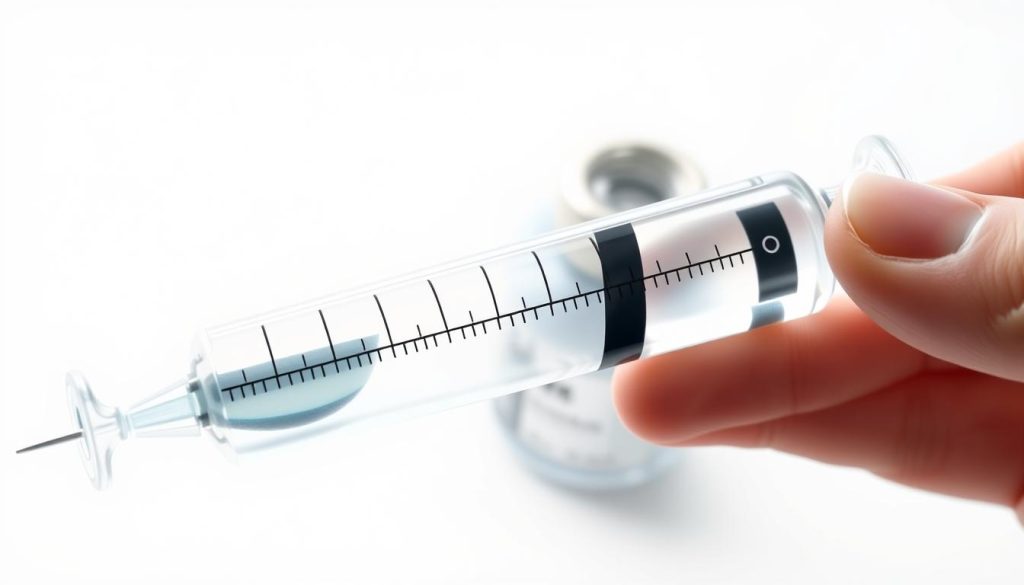
Insulin concentration is key for managing diabetes effectively. In the U.S., most insulin products use U-100, which has 100 units per milliliter1. This standard helps patients and doctors dose insulin accurately2.
Insulin vials come in various sizes. Humalog® offers 3 mL vials with 300 units and 10 mL vials with 1000 units1. Other insulin types usually follow this packaging standard1.
U-100 is the most common insulin concentration. However, U-200 and U-500 exist for patients needing more concentrated insulin2. In the U.S., Humalog U-200 is a unique high-concentration option2.
Key Takeaways
- Standard insulin concentration is 100 units per mL (U-100)
- Insulin vials typically contain 300 or 1000 units
- Concentration varies from U-40 to U-500 for different patient needs
- Accurate insulin measurement is critical for diabetes management
- Specialized insulin concentrations provide flexible treatment options
Understanding Insulin Concentration Basics
Insulin dosage is crucial for managing diabetes. It requires careful attention to concentration and volume. Different strengths are designed to meet specific patient needs in blood glucose control3.
Insulin comes in several standard concentrations. Healthcare providers use these to customize treatment:
- U-100: The most common concentration with 100 units per milliliter4
- U-200: Contains 200 units per milliliter5
- U-300: Delivers 300 units per milliliter5
- U-500: A high-concentration insulin with 500 units per milliliter3
Critical Concentration Considerations
Patients must be extremely careful when managing insulin volume. Concentrated insulin should never be transferred between different devices. This prevents potentially dangerous dosing errors5.
Individual insulin regimens are uniquely tailored. They often require careful adjustment based on specific patient needs3.
Precision in insulin dosage can make the difference between effective diabetes management and serious health complications.
Understanding Measurement Accuracy
Most insulin syringes are calibrated for U-100 insulin. Each unit marking represents one unit of insulin5. Patients with significant insulin resistance might need more concentrated insulin formulations5.
Absorption rates can vary by injection site. The abdomen provides the fastest absorption3.
Always consult healthcare professionals about insulin concentration. They can determine the best delivery method for your diabetes management needs.
Insulin Delivery Methods and Storage Requirements
Managing insulin therapy involves various medication techniques and storage guidelines. Patients can choose from syringes, pens, and pumps for insulin delivery6. Insulin typically comes in 100 units per milliliter, with some forms offering the same units in smaller volumes6.
The right delivery method depends on personal needs and lifestyle. Insulin pens come in disposable or reusable options for flexibility with different storage needs. For comfort, use 4 mm needles for pens and 6 mm for syringes7.
Proper storage keeps insulin effective. Keep unopened insulin in the fridge between 36°F to 46°F. Opened insulin can stay at room temperature for up to 28 days6.
Avoid exposing insulin to extreme temperatures and direct sunlight during transport7. Always follow your doctor’s specific guidelines for insulin storage and therapy management.
FAQ
How many insulin units are typically in 1 mL?
U-100 insulin, the most common type, has 100 units per milliliter. Other concentrations like U-200, U-300, and U-500 exist for specific patient needs. These higher concentrations are for those requiring larger doses or more concentrated formulations.
What’s the difference between U-100 and U-500 insulin?
U-100 insulin has 100 units per mL, the standard for most users. U-500 insulin is five times stronger, with 500 units per mL. Doctors prescribe U-500 for patients needing very large doses due to insulin resistance.
How do I choose the right insulin syringe?
Pick a syringe based on your insulin dose and concentration. For U-100 insulin, a 1 mL (100-unit) syringe is common. Always match the syringe to your insulin type for accurate dosing.
This prevents dangerous medication errors and ensures proper treatment.
What are the main insulin delivery methods?
The main methods are insulin syringes, pens (disposable and reusable), and pumps. Each has its own benefits and drawbacks. Your choice depends on your diabetes management needs, lifestyle, and personal preferences.
How should I store my insulin?
Keep unopened insulin in the fridge at 36-46°F (2-8°C). Once opened, you can store it at room temperature for 28 days. Check your insulin’s specific storage instructions for best results.
Avoid exposing insulin to extreme temperatures or direct sunlight.
Can I mix different types of insulin?
Some insulin types can be mixed, but it depends on the specific formulations. Always ask your doctor or pharmacist before mixing insulins. Proper technique and timing are crucial when combining rapid-acting and long-acting insulins.
What should I do if I miss an insulin dose?
Take the missed dose as soon as you remember, unless it’s near your next scheduled dose. Never double up on insulin to make up for a missed dose.
Contact your doctor for specific guidance. The best approach varies based on your insulin plan and blood sugar levels.
Source Links
- Taking Insulin – https://www.nationwidechildrens.org/family-resources-education/health-wellness-and-safety-resources/resources-for-parents-and-kids/managing-your-diabetes/chapter-five-taking-insulin
- How to Convert Insulin Units to mL? – https://4allfamily.com/blogs/diabetes/how-to-convert-insulin-units-to-ml?srsltid=AfmBOoqtancvlVtX1pSpLSv0AIPq72zRNXT4xrzyiQ8ueSAMuppVJcZ3
- Administration of insulin – https://www.consumermedsafety.org/insulin-safety-center/insulin-basics/administration-of-insulin
- Insulin Basics | ADA – https://diabetes.org/health-wellness/medication/insulin-basics
- Insulin Concentration and Types of Insulin – https://pressbooks.uiowa.edu/pedsendocrinology/chapter/insulin-concentration-and-types-classes-of-insulin/
- Patient education: Type 1 diabetes: Insulin treatment (Beyond the Basics) – https://www.uptodate.com/contents/type-1-diabetes-insulin-treatment-beyond-the-basics
- EADSG Guidelines: Insulin Storage and Optimisation of Injection Technique in Diabetes Management – https://pmc.ncbi.nlm.nih.gov/articles/PMC6437255/

