
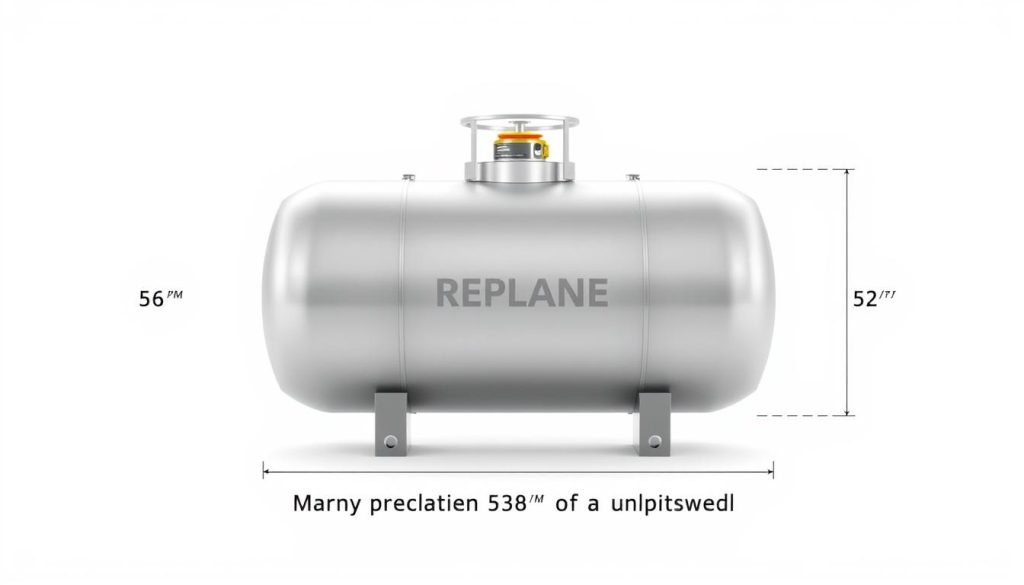
Propane tank sizes are essential for homeowners and outdoor enthusiasts. They range from small portable units to large stationary systems. These tanks serve various purposes, from residential to commercial use1.
Standard propane tanks come in different sizes for various needs. A typical 20-pound tank holds about 5 gallons of propane. This size is ideal for portable cooking equipment2.
Your home’s energy needs determine the right residential propane tank size1. Larger homes often require bigger tanks for efficient energy supply.
The most common residential tank size is 500 gallons. These tanks can hold around 400 gallons of propane at 80% capacity2.
Key Takeaways
- Propane tank sizes range from 20-pound portable tanks to 1,000-gallon stationary units
- Tanks are only filled to 80% capacity for safety reasons
- Residential needs determine the appropriate tank size
- Larger tanks can provide cost savings on propane
- Regular evaluation of propane usage is recommended
Understanding Standard Propane Tank Capacities
Safety is key when it comes to propane storage. Tanks are filled to 80% of their total water capacity. This allows room for propane expansion and prevents pressure-related issues34.
Propane cylinders come in various sizes. They range from small 20-lb containers to massive 2,000-gallon systems3. Let’s look at some common tank sizes:
- Portable 20-lb tanks hold approximately 4.6 gallons of propane3
- 120-gallon tanks can store 96 gallons when full4
- 500-gallon tanks typically hold 400 gallons at 80% capacity3
Propane storage capacity is vital for homes and businesses. Your tank size depends on your energy needs. Residential options range from 100 to 1,500 gallons3.
Remember: Always leave 20% of tank space empty for safe propane expansion!
| Tank Size | Actual Propane Capacity | Fill Percentage |
|---|---|---|
| 20-lb Tank | 4.6 gallons | 80% |
| 250-gallon Tank | 200 gallons | 80% |
| 1,000-gallon Tank | 800 gallons | 80% |
Pro tip: Always consult with a professional when determining the right propane tank size for your specific needs.
Gallons of Propane in a Tank: Size-by-Size Breakdown
Knowing propane tank capacity is key for measuring levels and estimating weight. Tanks come in various sizes for different needs3.
Propane tanks are never filled to 100% capacity. They’re typically filled to 80% to ensure safe storage and expansion3.
Residential Tank Sizes
Homeowners can choose from several propane tank sizes. These range from compact to large-scale storage solutions:
- 120-gallon tanks typically hold 96 gallons of propane when full3
- 250-gallon tanks can store 200 gallons of usable propane4
- 500-gallon tanks provide space for 400 gallons of propane3
- 1,000-gallon tanks can accommodate 800 gallons of propane4
Pro tip: Propane tanks are never filled to 100% capacity, typically allowing only 80% fill to ensure safe storage and expansion3.
Portable Tank Sizes
Portable propane tanks are used for various purposes. These include RV use and outdoor cooking:
- 20-lb portable tanks hold approximately 4.6 gallons of propane3
- 30-lb RV tanks can store 7 gallons of propane4
- 100-lb tanks provide up to 23 gallons of propane storage4
Choosing the right tank size depends on your specific propane consumption needs and storage capabilities.
Above Ground vs Underground Tank Storage Options
Choosing the right propane tank storage requires careful thought. Above-ground and underground tanks offer unique benefits for home energy needs. Propane tank sizes range from 20 pounds to 1,000 gallons, fitting various property needs.
Above-ground tanks offer significant advantages for homeowners. They have lower installation and maintenance costs compared to underground options. Propane tank refilling is easier with above-ground units, as suppliers can access them easily.
These tanks are bolted down for stability during extreme weather. Underground tanks provide discrete storage solutions and better temperature control. They protect fuel from environmental extremes and maintain a consistent fuel environment.
Despite higher initial costs, underground tanks can be a long-term investment. Consider installation costs, maintenance needs, and local rules when choosing between options. The total cost of an underground tank can be triple that of an above-ground unit.
Your choice depends on your property and refilling preferences. Think about what works best for your specific situation and energy needs567.
FAQ
How many gallons of propane are in a standard residential tank?
Residential propane tanks come in sizes from 120 to 1,000 gallons. A 120-gallon tank holds 96 gallons of propane. A 500-gallon tank stores about 400 gallons.
Tanks are never filled to 100% for safety reasons. Regulations require leaving 20% of the tank’s capacity empty.
Why aren’t propane tanks filled completely to 100%?
Safety is the main reason propane tanks aren’t filled to 100%. The 80% fill rule allows room for propane to expand with temperature changes.
This extra space prevents excessive pressure buildup and potential safety risks. It ensures safe storage and prevents tank damage.
How do I calculate the actual propane capacity of my tank?
To find your tank’s usable propane capacity, multiply its total size by 0.8. A 250-gallon tank will hold about 200 gallons of propane.
Always check your tank’s specific specifications. Dimensions and capacities can vary slightly between manufacturers.
What’s the difference between above-ground and underground propane tanks?
Above-ground tanks are easier to install and maintain. Underground tanks offer better looks and protection from extreme temperatures.
Underground tanks need more complex installation and may cost more initially. Your choice depends on local rules, property layout, and personal preferences.
How often should I check my propane tank’s level?
Check your propane tank level monthly, especially during high-use seasons like winter. Many modern tanks have gauges that make this easy.
For heating and cooking, keep track to avoid running out unexpectedly. Consider setting up automatic delivery with your propane supplier.
Can I use different sizes of propane tanks for different purposes?
Yes! Propane tanks come in various sizes to suit different needs. Portable 20-pound tanks are great for grills.
120-gallon tanks work well for home heating and cooking. Larger 500 or 1,000-gallon tanks are ideal for whole-home systems.
Choose a tank size that matches your specific propane consumption requirements.
What safety precautions should I take with propane tanks?
Keep propane tanks in well-ventilated areas, away from ignition sources. Check for leaks regularly using a soap solution.
Keep tanks away from direct sunlight and heat sources. Install carbon monoxide detectors and have your system inspected yearly.
Never store propane tanks indoors or in enclosed spaces. Ensure proper connections for all propane equipment.
Source Links
- Residential Propane Tanks: How to Figure Out What Size Propane Tank You Need for Your Home – https://www.kauffmangas.com/blog/residential-propane-tanks-how-to-figure-out-what-size-propane-tank-you-need/
- Understanding Propane Gas Tank Sizes & Prices: Everything You Need to Know – https://www.kauffmangas.com/blog/understanding-propane-gas-tank-sizes-and-prices/
- Understanding Propane Tank Sizes: A Complete Guide – https://www.amerigas.com/about-propane/propane-tank-sizes
- Propane Tank Sizes Guide | Small to Large – https://www.ferrellgas.com/tank-talk/blog-articles/understanding-the-various-propane-tank-sizes/
- Above Ground vs Underground Propane Tank: Which Is Better? – https://www.kauffmangas.com/blog/above-ground-vs-underground-propane-tank/
- Above Ground vs. Underground Propane Tank | Foster Fuels – https://fosterfuels.com/blog/above-ground-vs-underground-propane-tank/
- Comparing Above and Underground Propane Tanks | Santa Energy – https://www.santaenergy.com/above-or-underground-propane-tanks/

