
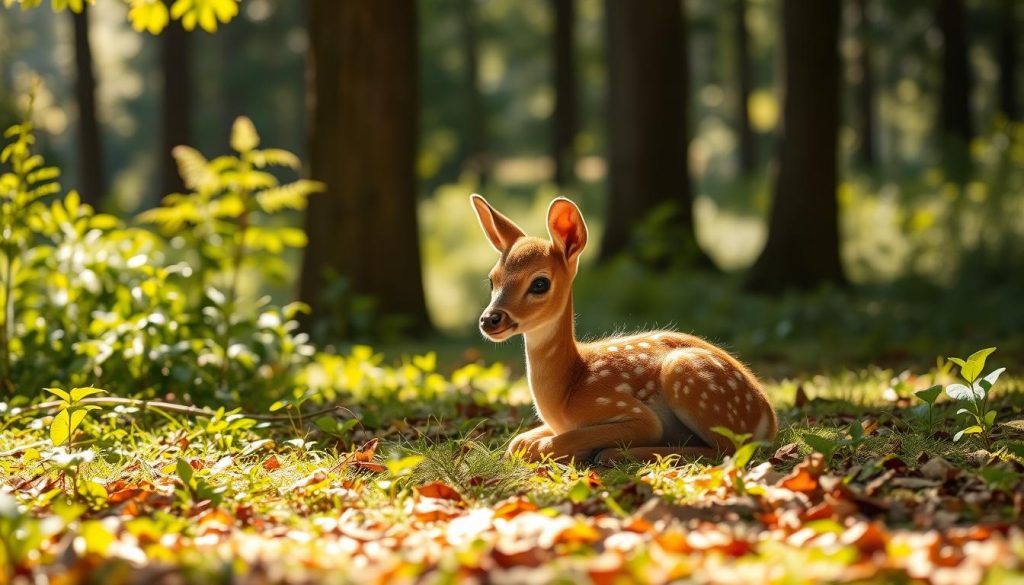
A baby deer is called a fawn. This term has deep roots in animal naming. Fawns charm nature lovers with their delicate looks and clever survival tricks.
Female deer, or does, usually have one or two fawns. The word “fawn” comes from Old and Middle English. It’s used for young deer and caribou.
Fawns have amazing survival skills. They stay still when danger is near. This helps them avoid predators.
Twin fawns can be far apart, up to 200 feet. Their mother comes back now and then to feed them.
Key Takeaways
- A baby deer is called a fawn
- Fawns have unique survival strategies
- Does typically give birth to one or two fawns
- The term “fawn” has deep linguistic roots
- Young deer have remarkable camouflage techniques
Understanding Young Deer Names Across Different Species
Deer terminology is fascinating, with unique names for these graceful animals at different life stages. From spotted fawns to mature deer, their nomenclature offers insights into these remarkable creatures.
Wildlife enthusiasts use specific terms for young deer. “Fawn” is the most common name for a baby deer1. This term covers various species, though larger deer have different classifications.
Exploring Deer Name Variations
Different deer species have unique names for their young:
- Whitetail fawn: The standard term for baby white-tailed deer
- Deer calf: Used for larger species like elk and moose1
- Spotted fawn: Describing young deer with distinctive coat patterns
Age-Specific Deer Terminology
Newborn fawns typically weigh six to eight pounds, with males usually heavier1. These cute creatures can stand and move within hours of birth1.
Bambi has made the term “fawn” widely recognized in popular culture. Mother deer nurse their young four to five times daily1.
Fawns start nibbling grass by their second week. By the second month, they begin chewing on seedlings1.
Male deer grow small bumps called pedicles around four months old. These bumps are the start of their antlers1.
Female fawns usually stay with their mothers for two years. Male fawns typically leave after one year1.
Essential Facts About Young Deer Names and Their Development
Fawns, baby deer, have a clever way to stay safe. They’re born with white spots that help them hide in forests. This camouflage keeps them safe from predators in their first weeks.
Different deer species grow in unique ways. White-tailed deer usually have one to three fawns in late spring2. These babies depend on their moms for months, sometimes staying close for up to two years2.
Muntjacs have a special pattern. They have one fawn every seven months after carrying it for 210 days3. This shows how deer adapt to their environments.
As young deer grow, they change a lot. Their white spots fade away slowly. This marks their shift from helpless babies to more independent young deer.
Learning about fawn growth teaches us about wildlife protection. It also shows us how these beautiful animals survive in nature. Their strategies are truly amazing.
FAQ
What is the most common name for a baby deer?
Fawn is the most common name for a baby deer. It’s used for various deer species, especially whitetail and mule deer. Fawns are young deer from birth to their first year.
Why do baby deer have spots?
Fawns’ spots provide excellent camouflage in forests. This pattern breaks up their outline, making them hard for predators to spot. The spots fade away when fawns are about 3-4 months old.
Are there different names for baby deer in different species?
Fawn is the most common term for baby deer. Some species have unique names, like roe deer kid for roe deer. Deer calf is sometimes used, but it’s less common.
How long do baby deer stay with their mothers?
Fawns usually stay with their mothers for 6-8 months. They stick close for protection and nursing in the first weeks. As they grow, fawns become more independent and learn survival skills.
Where did the name “Bambi” come from?
Bambi comes from a 1923 Austrian novel by Felix Salten. It became famous worldwide through Disney’s 1942 animated film. The name now represents cute, innocent baby deer in popular culture.
How quickly do fawns develop?
Fawns develop incredibly fast. They can stand and nurse within hours of birth. In a few weeks, they explore and eat plants. By a few months, fawns can outrun many predators.
Do all baby deer have spots?
Most fawns are born with white spots, especially whitetail deer. These spots provide excellent camouflage. They help fawns hide from predators during their vulnerable early weeks.
How do mothers protect their fawns?
Doe deer use clever strategies to protect their young. They hide fawns in tall grass or dense vegetation. Mothers return periodically to nurse them.
The doe’s scent is minimized around the fawn to avoid attracting predators. Fawns instinctively stay still and quiet when left alone.
Source Links
- What is a Baby Deer Called? [Names of Baby Deer] – World Deer – https://worlddeer.org/what-is-a-baby-deer-called/
- White-tailed deer | Season Watch – https://seasonwatch.umn.edu/white-tailed-deer
- British Deer Species Guide from Deer Aware – https://www.deeraware.com/british-deer/

