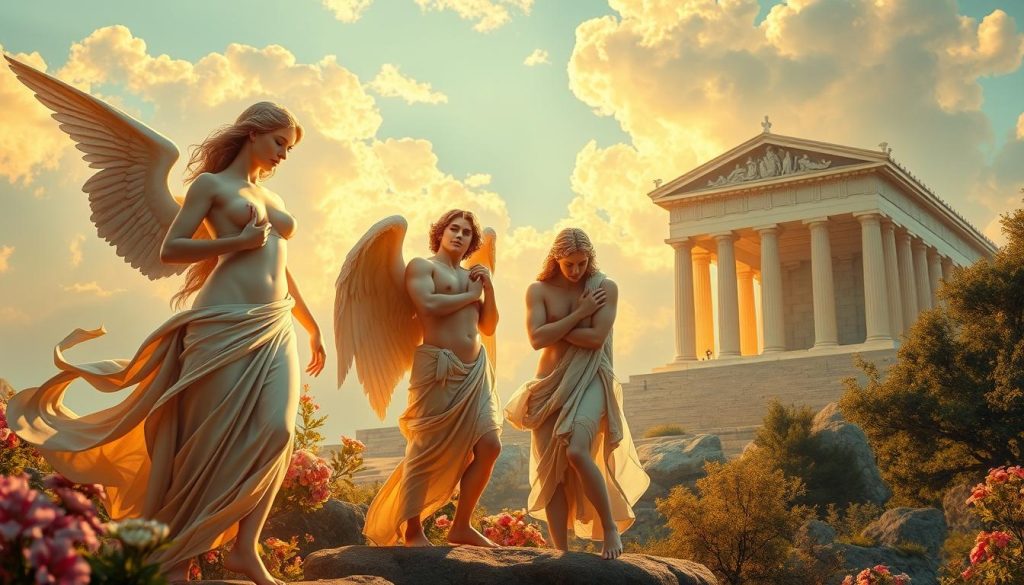
Ancient Greek mythology offers a rich array of love deities beyond the well-known tales. These gods embody complex emotional landscapes that go beyond simple romantic stories1. They represent various aspects of love, desire, and human connection in ancient Greek culture2.
Eros is a key figure among the love deities. He’s portrayed as both a primordial god and a youthful divine being1. Eros is closely linked to passion and desire.
The Erotes, a group of winged gods, expand the love pantheon. They include deities like Himeros and Pothos1. Each represents unique emotional experiences.
Ancient Greeks had a complex understanding of love. They used specific terms for different emotional states1. These ranged from passionate Eros to familial Storge and brotherly Agape.
Key Takeaways
- Greek mythology features multiple complex love deities
- Eros represents both primordial and youthful aspects of love
- Love gods embodied different emotional experiences
- Ancient Greeks had sophisticated terminology for love
- Winged gods like the Erotes symbolized various love concepts
The Greek gods of love in ancient mythology
Greek love deities show a complex view of romantic emotions. These divine figures embodied various aspects of love, desire, and passion. They captured the intricate landscape of human connections34.
Divine Origins and Hierarchy
Aphrodite, the goddess of love, beauty, and sexuality, stands at the center of divine romance. She’s the main figure in the network of love deities3.
Her son Eros, often shown as a winged youth, wields a powerful bow and arrows. He represents the irresistible force of attraction3.
Primary Deities of Passion
- Eros: God of passionate love5
- Himeros: Embodiment of intense desire3
- Pothos: Symbolizing profound yearning5
- Anteros: Punisher of unrequited love3
Secondary Love Entities
A fascinating array of love gods existed beyond the primary deities. Peitho represented persuasion and seduction. Hymenaios was invoked during wedding celebrations3.
These lesser-known figures added depth to the Greek understanding of love’s many faces4.
The Erotes, a group of winged love gods, demonstrated the Greeks’ sophisticated conception of romantic and emotional experiences5.
These divine romance figures weren’t just mythological characters. They were also philosophical symbols. Plato used these deities to explore complex love concepts like Agape and Philia3.
Divine attributes and powers of erotic deities
Greek love gods formed a complex pantheon of divine romantic forces. Each god embodied unique traits that shaped ancient views on passion. These erotic deities were powerful entities with intricate personalities and remarkable abilities.
Eros, the main love deity, emerged as a primordial force. His divine attributes included symbolic weapons that influenced human emotions. These weapons were golden arrows, leaden arrows, and a flaming torch.
- Golden arrows to kindle passionate love
- Leaden arrows to create emotional aversion
- A flaming torch representing desire’s intensity
Greek mythology saw dramatic changes in love deity portrayals. Early depictions showed Eros as a cosmic unifying force. Later interpretations highlighted his playful and mischievous nature.
The Erotes, a group of love spirits, appeared as winged youths or children. Each spirit embodied different aspects of emotional connection. Their worship was deeply woven into Greek cultural practices.
Thespiae held festivals honoring Eros every five years. This showed the spiritual importance of these divine beings. Sacred symbols like roses, hares, and rams linked them to love and fertility.
Greek love gods represented more than just romantic feelings. They symbolized complex psychological and spiritual bonds. This revealed the nuanced Greek understanding of human relationships6.
Complex relationships and mythological connections
Ancient Greek mythology unveils intricate networks of love deities beyond simple romantic tales. Love gods like Adonis and Eros played crucial roles in divine interactions. These legendary tales explore the nuanced dynamics of relationships.
Divine family ties among love deities were captivating. Eros was often portrayed as Aphrodite’s assistant or her child with Ares7. These connections symbolized various aspects of love, from passion to family bonds.
Divine Interpersonal Dynamics
Love deities often interacted with other Olympian gods, shaping cosmic events through passionate interventions. Eros’s arrows could affect all beings, including powerful gods and legendary heroes7.
- Apollo’s unrequited love for Daphne
- Medea’s intense passion for Jason
- Divine romantic entanglements across mythology
Mythological Tale Contributions
Love deities were key players in numerous legendary narratives of ancient Greek mythology. Their complex relationships and divine powers drove many pivotal storylines. These tales showed how love was a fundamental cosmic force7.
Love in Greek mythology was never simple—it was a powerful, transformative energy that could move mountains and change destinies.
Eros was widely worshipped across various Greek cities7. His representation in art and literature went beyond mere romantic figures. These love deities embodied complex emotional and spiritual dimensions that still fascinate us today.
Conclusion
Greek love gods tell a deep story about human emotions. These ancient figures show love’s many sides through complex relationships and powerful symbols8. Their tales prove that love goes beyond romance, diving into passion, desire, and change9.
In Greek myths, love is never simple. Eros’ powers and Zeus’ affairs reflect the tricky emotions we still face today8. These gods stand for more than just attraction.
They represent mind connections, personal growth, and the dance between want and result9. People still love these old stories because they speak to us now.
They show us truths about love, passion, and how we relate to others10. These ancient tales help us see the depth of human feelings across time8.
Greek love gods remind us that emotion can change us. Their myths show love’s highs and lows. They reveal that love’s core stays the same throughout history9.
FAQ
Who are the most famous Greek gods of love besides Aphrodite?
Eros, Aphrodite’s son, is a key Greek love deity. He’s often shown as a mischievous winged youth. Pothos embodies longing and desire, while Himeros represents sexual desire. These gods showcase different aspects of love in Greek myth.
What is the difference between Eros and Cupid?
Eros is the Greek god of love, portrayed as a young, powerful deity. Cupid, the Roman version, is often shown as a chubby child with a bow. Though similar, they have unique cultural and mythological backgrounds.
How did Greek love gods influence ancient culture?
Greek love gods shaped art, literature, and social norms. They weren’t just romantic figures, but complex deities representing various love dimensions. These ranged from passion to companionship and even cosmic creative energy.
Were all Greek love gods romantic in nature?
Not all Greek love gods were purely romantic. Some embodied broader concepts like longing, attraction, and companionship. Pothos and Himeros symbolized specific emotional experiences beyond physical attraction.
How were Greek love gods typically portrayed in art?
Artists often depicted Greek love gods as beautiful, youthful figures with symbolic attributes. Eros appeared as a winged youth with a bow and arrows. Aphrodite was shown as a stunning, sensual woman.
Did Greek love gods interact with other mythological figures?
Yes, love gods frequently appeared in myths with heroes, mortals, and other divine beings. Aphrodite and Eros played crucial roles in many legendary tales. They influenced human destinies through romantic and emotional interventions.
What makes Greek love gods different from love deities in other mythologies?
Greek love gods were uniquely complex, representing multifaceted emotional experiences. They embodied nuanced psychological and emotional states. This reflected a sophisticated understanding of human relationships and feelings in Greek culture.
Source Links
- A Deep Dive into Eros: The Greek God of Love – The Greek Gods – https://www.thegreekgods.org/eros/
- Meet 10 Gods & Goddesses of Love & Marriage – https://www.learnreligions.com/deities-of-love-and-marriage-2561983
- Greek gods of love – https://www.greekmyths-greekmythology.com/greek-gods-of-love/
- List of love and lust deities – https://en.wikipedia.org/wiki/List_of_love_and_lust_deities
- Greek Gods of Love & Desire (Roman Cupids) – https://www.theoi.com/Ouranios/Erotes.html
- Aphrodite | Mythology, Worship, & Art | Britannica – https://www.britannica.com/topic/Aphrodite-Greek-mythology
- Eros – https://www.worldhistory.org/Eros/
- Greek Gods on Love and Relationships – Paleothea – https://paleothea.com/gods-and-goddesses/greek-gods-on-love-and-relationships/
- Eros: Exploring the Greek God of Love & Desire – https://imaginaryworlds.us/blogs/mythic-inspirations-legends-behind-the-elegance/eros-exploring-the-greek-god-of-love-desire?srsltid=AfmBOop6_xf7mKx2qmDK-cGmRVlcF1F03K9rruLrWUY3yUp-lwXFTCa9
- Myth of Eros and Psyche – Greek Myths | Greeka – https://www.greeka.com/greece-myths/eros-psyche/