
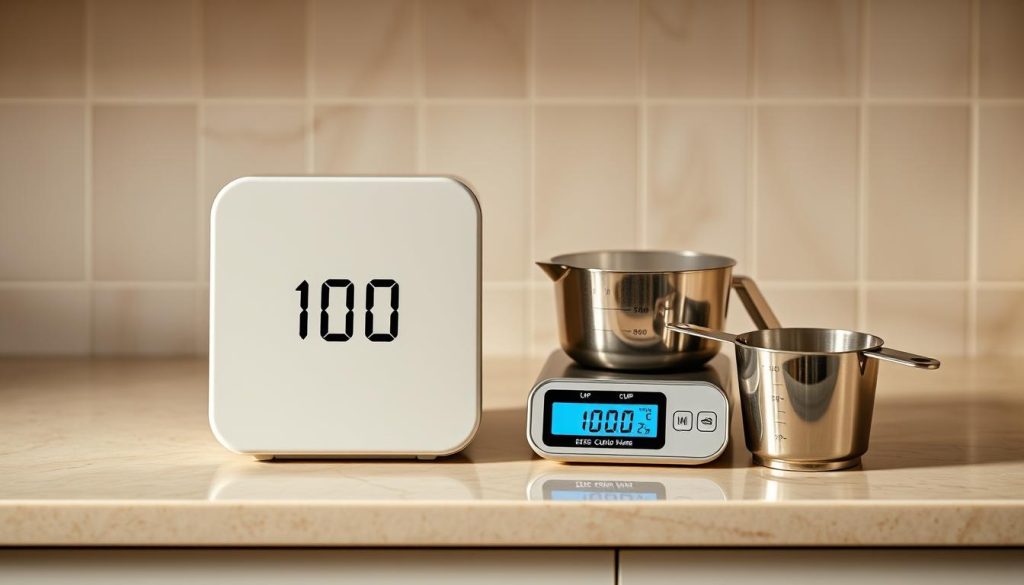
Converting grams to cups can be challenging. The result varies based on the ingredient’s density1. Each item has a unique weight-to-volume ratio2.
For water, 100 grams equals about 2/5 cup1. Other ingredients convert differently. Flour is about 0.8 cups, sugar is 0.5 cups, and butter is 0.44 cups1.
Precise measurements are vital in cooking and baking. Accurate conversions can make or break a recipe. Getting it right ensures culinary success.
Key Takeaways
- 100 grams converts differently for each ingredient
- Density determines the cup measurement
- Water has a consistent conversion rate
- Precision is crucial in recipe measurements
- Digital scales provide the most accurate measurements
Understanding Weight to Volume Conversions
Precise ingredient quantities are crucial in cooking and baking. Accurate measurements can make or break a recipe. This is especially true when converting between weight and volume3.
Different cup sizes worldwide can challenge both home cooks and professional bakers. Knowing how to convert measurements is key to success in the kitchen.
Why Density Matters in Measurements
Ingredient density is vital in cooking measurements. Not all ingredients have the same weight for a given volume. This makes recipe conversions tricky.
- 1 cup of water weighs exactly 236.59 grams3
- 1 cup of wheat flour weighs approximately 141.6 grams3
- 1 cup of salt weighs around 287 grams3
Different Types of Cups Around the World
Cup measurements vary significantly across countries. In the United States, three main cup measurements exist:
The Importance of Accurate Measurement
Precise cooking measurements ensure consistent culinary results. Professional bakers know that small variations can greatly impact a recipe’s outcome.
When converting ingredient quantities, always consider each ingredient’s specific density. This ensures accurate baking measurements4.
Accurate measurements transform good recipes into great culinary experiences.
100 Grams in Cups: Common Ingredient Conversions
Kitchen math can be tricky when converting weights to volumes. Knowing culinary calculations helps cooks achieve precise measurements5. Let’s see how 100 grams converts to cups for various ingredients.
Ingredients have unique density properties. This means 100 grams won’t always equal the same cup volume. For cooking and baking, these conversions are crucial.
Precise measurements can make or break a recipe6. Knowing how to convert between grams and cups is essential.
- All-purpose flour: 100 grams ≈ 0.8 cups5
- Granulated sugar: 100 grams ≈ 0.5 cups5
- Brown sugar (packed): 100 grams ≈ 0.4 cups5
- Butter: 100 grams ≈ 0.44 cups5
Pro tip: Use a digital scale for the most accurate kitchen math. Measuring by weight ensures consistent results in your culinary calculations6.
Some ingredients vary dramatically in cup measurements. For example, 100 grams of honey equals about 0.3 cups. Meanwhile, 100 grams of oats translates to about 1.1 cups5.
These variations show why precise measurement techniques matter. They can greatly impact your cooking and baking results.
Essential Kitchen Measurement Tips and Techniques
Precise measurements are key to successful cooking. Digital scales offer exact weights, surpassing traditional cup methods. For top-notch results, a reliable digital scale is a must-have kitchen tool.
Grasping the difference between volume and weight is vital. A digital scale can measure ingredients accurately, especially dry ones. Flour’s weight can vary based on packing, making scales crucial for consistent baking.
Pros suggest using standardized tools to avoid measurement errors. Level off dry ingredients when measuring. Remember that one tablespoon equals three teaspoons.
Hone your skills by comparing digital scale readings with measuring cup amounts. This practice will sharpen your eye for precision.
Mastering these techniques takes practice but yields impressive results. Embrace digital scales and conversion principles to elevate your cooking. Your kitchen prowess will grow with each accurate measurement you make7.
FAQ
Why isn’t converting 100 grams to cups a simple, straightforward process?
Converting 100 grams to cups is complex due to varying ingredient densities. Different items like flour, sugar, and liquids have unique weights and volumes. This means 100 grams of one ingredient might fill a different cup volume than another.
How does ingredient density affect measurement conversions?
Density is crucial in weight-to-volume conversions. 100 grams of flour will occupy a different cup volume than 100 grams of sugar or oil. That’s why chefs and bakers prefer precise weight measurements for consistent results.
Are cup measurements the same in all countries?
Cup measurements differ globally. In the US, a standard cup is 236.6 milliliters. In Australia, it’s 250 milliliters. These differences can greatly impact recipe accuracy. That’s why professional bakers prefer weight measurements like grams.
What are some common 100-gram to cup conversions for typical ingredients?
Here are some approximate conversions:
– All-purpose flour: 100 grams ≈ 0.8 cups
– Granulated sugar: 100 grams ≈ 0.5 cups
– Butter: 100 grams ≈ 0.44 cups
– Water: 100 grams = 0.42 cups (100 ml)
What’s the most accurate way to measure ingredients?
Digital scales provide the most precise measurements. They let you measure ingredients directly in grams. This eliminates the variability associated with cup measurements. Professional bakers consistently recommend using weight measurements for the best results.
What are some common measurement mistakes to avoid?
Common mistakes include:
– Using volume measurements instead of weight
– Not leveling dry ingredients in measuring cups
– Using different cup sizes
– Not accounting for ingredient density
– Assuming all ingredients convert equally
Do professional bakers use grams or cups?
Professional bakers strongly prefer gram measurements. Weight measurements are more consistent and reproducible. They eliminate variables like ingredient settling, humidity, and measuring technique that can affect volume measurements.
How can I improve my kitchen measurement skills?
Practice using a digital scale and learn about ingredient densities. Always level dry ingredients and invest in quality measuring tools. Remember, precision in baking is about consistency. It’s also about understanding how different ingredients behave.
Source Links
- What is 100 grams in cups? · Cooking Measurements & Conversion Chart – https://coda.io/@laila-robinson/cooking-measurements-conversion-chart/what-is-100-grams-in-cups-48
- How To Convert Grams To Cups For Your Next Baking Project – https://www.southernliving.com/grams-to-cups-8401955?srsltid=AfmBOopi8nb816SSaJvm9FDviFTsTpioKnXUuhB8k5kBr3b1NVbuOB7F
- Grams to Cups Converter – https://www.omnicalculator.com/food/grams-to-cups
- Ingredient Weight Chart – https://www.kingarthurbaking.com/learn/ingredient-weight-chart
- Grams to Cups Converter – https://www.thecalculatorsite.com/cooking/grams-cups.php
- Cups to Grams Conversions for Common Ingredients – https://www.asaucykitchen.com/cups-to-grams-conversions/
- Cooking 101: Measuring Ingredients – https://balancedkitchen.com/2024/06/cooking-101-measuring-ingredients/

