
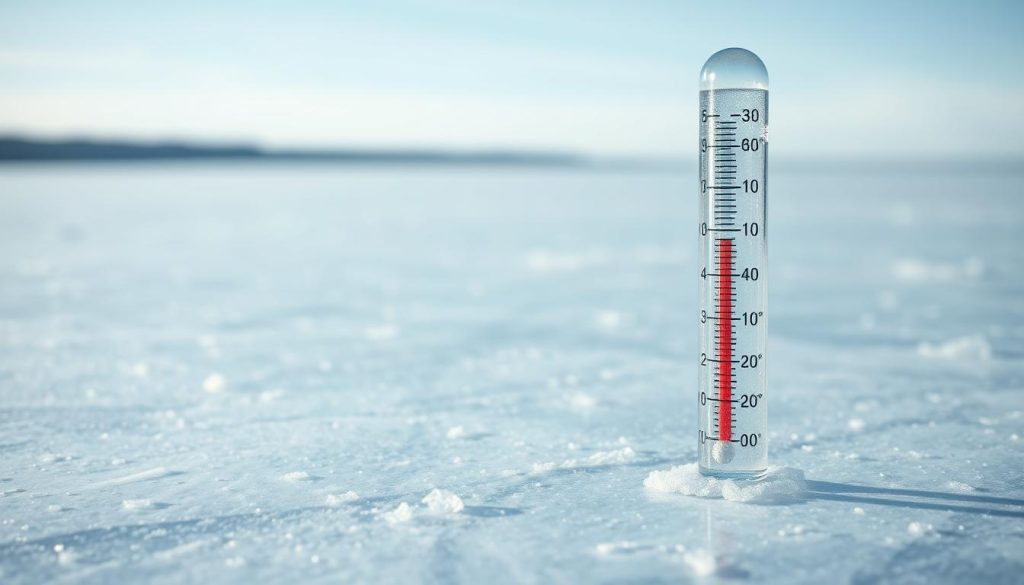
Water typically freezes at 0 degrees Celsius (32 degrees Fahrenheit) under normal conditions1. This key fact is vital for both scientists and everyday folks. It plays a big role in many scientific and practical uses2.
The freezing point of water can change based on the environment. Water can stay liquid at much lower temps through supercooling3. In labs, scientists have seen water remain liquid at -46 degrees Celsius3.
Water goes through cool changes when it turns from liquid to solid. The molecules form a special hexagon shape, making ice with unique traits1. This shift causes water to expand and take up more space when frozen1.
Key Takeaways
- Water freezes at 0°C (32°F) under standard conditions
- Freezing temperature can be influenced by various environmental factors
- Water molecules rearrange into a hexagonal pattern when freezing
- Water expands when transitioning from liquid to solid state
- Supercooling allows water to remain liquid at extremely low temperatures
Understanding Water Freezing Temperature Basics
Water’s change from liquid to solid is a fascinating process. It involves complex molecular interactions. This ice formation happens at a specific temperature point4.
As water solidifies, molecules slow down and form a rigid structure. Water freezes at exactly 32°F (0°C). This is the point where liquid becomes solid4.
The Science Behind Water’s Freezing Point
Water molecules transform during the freezing process. They align in a hexagonal pattern as temperature drops. This creates ice’s unique structure5.
- Molecular alignment begins at 32°F
- Ice expands as it freezes, occupying more space than liquid water4
- Crystal formation depends on temperature and pressure
Converting Between Celsius and Fahrenheit
Temperature conversion is key for precise water crystallization measurements. Scientists use a standard formula to track ice melting points. This helps compare results across different temperature scales.
| Celsius | Fahrenheit | Freezing Status |
|---|---|---|
| 0°C | 32°F | Water Freezes |
| -1°C | 30°F | Solid Ice |
Factors Affecting Ice Formation
Several factors influence water solidification. Surface properties, atmospheric pressure, and impurities can change freezing characteristics4.
- Surface texture impacts crystallization
- Atmospheric pressure changes freezing point
- Impurities can lower freezing temperature
Understanding these details helps predict and manage water’s behavior under various conditions.
How Surface Features Impact Water Freezing Temperature
New research challenges what we know about ice formation. Scientists found that surface features can greatly affect water freezing temperature. These changes happen through complex interactions at the molecular level.6
Surface topography plays a key role in how water molecules behave. Some surface traits can cause ice crystals to form at warmer temperatures than expected6.
- Microscopic cracks and cavities act as preferred nucleation sites
- Surface angles can guide water molecule arrangement
- Specific topographical features trigger earlier ice formation
Cracks, steps, and microscopic bumps are crucial in water freezing. These features can lower freezing points. This could lead to better snowmaking and cloud seeding processes6.
This research has far-reaching effects beyond industry. It could change fields like cryopreservation and atmospheric science. Scientists might control ice formation more precisely by changing surface features6.
We could develop materials that encourage or prevent ice formation. This could transform winter sports, agriculture, and climate research technologies6.
Conclusion
Water freezes at 0° Celsius (32° Fahrenheit). This key fact helps us grasp phase transitions in liquids78. Temperature and chemical makeup greatly affect water’s physical state.
Water’s freezing point has many real-world uses. Cars and trucks use special methods to stop ice from forming. Salt on roads and antifreeze lower water’s freezing point7. This keeps things safe in cold weather.
Scientists’ knowledge of water freezing sparks new ideas in many fields. Arctic animals have amazing ways to survive the cold. They make special substances to avoid freezing solid7.
Water’s freezing point links science and everyday life. It connects physics, chemistry, and useful tech. Studying this topic will lead to exciting new discoveries about how things change with temperature.
FAQ
At what temperature does water freeze?
Water freezes at 0 degrees Celsius (32 degrees Fahrenheit). This happens under normal air pressure. At this point, liquid water turns into solid ice crystals.
Does water always freeze at exactly 0°C?
Not always. Air pressure, added substances, and surface types can change the freezing point. Pure water usually freezes at 0°C. But other factors can slightly alter this temperature.
What happens to water molecules when they freeze?
As water freezes, its molecules slow down and form a crystal structure. They arrange in a six-sided pattern, creating ice. Ice is less dense than liquid water, which is why it floats.
Can water freeze below 0°C?
Yes, it’s called supercooling. This happens with very pure water or in special conditions. Water stays liquid even when it’s slightly colder than 0°C.
How do different surfaces affect water freezing?
Surfaces greatly impact how ice forms. Rough or water-repelling surfaces can speed up or slow down freezing. Some surfaces can lower the freezing point or create unique ice patterns.
Why is understanding water’s freezing point important?
Knowing water’s freezing point is key in many fields. It helps predict weather and design buildings. It’s also crucial for preserving biological samples and understanding environmental processes.
How do you convert between Celsius and Fahrenheit for freezing point?
To change Celsius to Fahrenheit, use: F = (C × 9/5) + 32. Water freezes at 0°C, which is 32°F. For Fahrenheit to Celsius, use: C = (F – 32) × 5/9.
Can salt change water’s freezing point?
Yes, salt lowers water’s freezing point. That’s why it’s used to melt ice on roads in winter. Salt prevents water from freezing at 0°C, making the freezing point lower.
Source Links
- Lesson 2.4: Changing State—Freezing – American Chemical Society – https://www.acs.org/middleschoolchemistry/lessonplans/chapter2/lesson4.html
- How Long for Water to Freeze? – https://van.physics.illinois.edu/ask/listing/537
- The Enduring Mystery of How Water Freezes | Quanta Magazine – https://www.quantamagazine.org/the-enduring-mystery-of-how-water-freezes-20240617/
- Basics-of-Freezing.indd – https://www.thermomegatech.com/wp-content/uploads/2014/09/Basics_Of_Freezing.pdf
- Understanding the Process of Freezing – https://extension.psu.edu/understanding-the-process-of-freezing
- Model explains why water can freeze at different temperatures – https://www.chemistryworld.com/news/model-explains-why-water-can-freeze-at-different-temperatures/4019239.article
- Freezing Point of Water – https://www.bartleby.com/subject/science/physics/concepts/freezing-point-of-water
- water freezing point: Topics by Science.gov – https://www.science.gov/topicpages/w/water freezing point

