
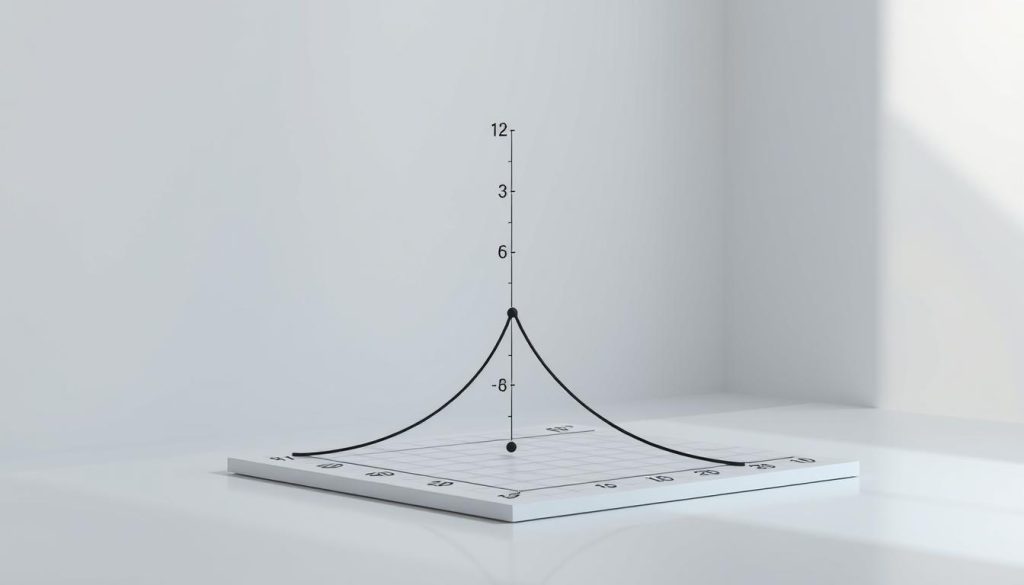
The vertex formula is key to understanding quadratic equations. It helps analyze parabolas and their math features. This method pinpoints the highest or lowest point of a quadratic graph.
Quadratic equations come in standard and vertex forms. The vertex form (y = a(x-h)² + k) makes finding vertex coordinates easy. This form improves accuracy when graphing parabolas.
The coefficient ‘a’ is crucial in vertex form. It shows if the parabola opens up or down. A positive ‘a’ means it opens up, while negative means down.
Key Takeaways
- Vertex form reveals the exact coordinates of a parabola’s turning point
- The coefficient ‘a’ determines the parabola’s orientation
- Finding the vertex is crucial for graphing quadratic equations
- Vertex form simplifies understanding parabolic functions
- Mathematical applications extend across physics, engineering, and economics
Understanding Vertex Form and Standard Form of Quadratic Equations
Quadratic equations have two main forms: standard and vertex. These forms help mathematicians understand parabola characteristics. Each form offers unique insights into a parabola’s behavior1.
The standard form is y = ax² + bx + c. Here, a, b, and c are coefficients that shape the parabola2. These coefficients define key graph features.
- Coefficient a determines whether the parabola opens upward or downward
- Coefficient b influences the axis of symmetry
- Coefficient c represents the y-intercept
Standard Form vs Vertex Form
The vertex form is y = a(x-h)² + k. It shows the parabola’s maximum or minimum point. In this form, h and k are the vertex coordinates1.
Converting Between Forms
To switch between standard and vertex forms, use the completing the square method. This technique helps transform equations easily. It also makes finding vertex points simpler2.
The Role of Coefficients
The coefficient a is crucial. A positive a means the parabola opens upward. A negative a shows it opens downward2. This helps predict parabola behavior in different equations.
Finding the Vertex in Vertex Form
Knowing how to find the vertex makes graphing quadratics easier. The vertex is the turning point of a parabola. It’s crucial for understanding the parabola’s shape and behavior3.
In vertex form, y = a(x-h)² + k helps pinpoint this key point4. Mathematicians use two formulas to find the vertex:
- x-coordinate (h): h = -b / (2a)
- y-coordinate (k): k = c – b² / (4a)
To find the vertex, start by identifying coefficients a, b, and c. These are found in the standard form equation y = ax² + bx + c3. Then, use the vertex formula to locate the parabola’s turning point4.
- a = 3, b = 12, c = -12
- x-coordinate: h = -12 / (2 * 3) = -2
- y-coordinate: k = -24
The vertex form tells us about the parabola’s direction. A positive ‘a’ means an upward-opening curve. A negative ‘a’ shows a downward-opening curve4.
Pro tip: Practice often to master vertex calculations. Always check your work. Remember, the vertex is the most important point on a quadratic graph.
Conclusion
Finding the vertex in vertex form is a key algebra skill. It reveals crucial insights into function behavior. The quadratic vertex is a pivotal point on a parabola.
The vertex point helps analyze projectile motion and solve optimization problems. It provides essential mathematical clarity for various applications5.
We’ve explored several strategies to find the vertex in vertex form. These include using the vertex formula x = -b/2a and completing the square method6.
Understanding how coefficients determine the vertex’s location boosts confidence in handling quadratic functions5. This skill has wide-ranging applications in physics and economics.
The quadratic vertex form helps solve real-world problems. It’s useful for optimization, trajectory analysis, and system modeling.
Mastering these techniques builds a powerful mathematical toolset. It applies across many disciplines5. This skill opens doors to understanding complex systems through math.
Practice and curiosity turn abstract concepts into problem-solving skills. Keep exploring to unlock the full potential of this mathematical knowledge6.
FAQ
What is the vertex form of a quadratic equation?
The vertex form is y = a(x-h)² + k. Here, (h, k) shows the vertex coordinates of the parabola. This form reveals the parabola’s lowest or highest point.
How do I find the vertex using the vertex formula?
Use the formula h = -b / (2a). Here, a and b are coefficients from the standard form equation. Identify these coefficients from your equation first.
Then, plug them into the formula. This will give you the x-coordinate of the vertex.
What’s the difference between standard form and vertex form?
Standard form (y = ax² + bx + c) shows the parabola’s general shape. Vertex form (y = a(x-h)² + k) reveals the vertex point directly.
Vertex form makes it easier to spot the parabola’s axis of symmetry. It also shows its highest or lowest point clearly.
How do I convert from standard form to vertex form?
Use the completing the square method. Rearrange the equation by grouping terms. Factor out the coefficient of x².
Add and subtract terms to create a perfect square trinomial. This will give you the vertex form.
What determines whether a parabola opens up or down?
The sign of coefficient ‘a’ determines the parabola’s orientation. A positive ‘a’ makes the parabola open upward, like a smile.
A negative ‘a’ makes the parabola open downward, resembling a frown.
Why is finding the vertex important?
The vertex is the parabola’s maximum or minimum point. It’s crucial in many real-world applications.
These include physics (trajectory analysis), economics (optimization problems), and engineering (designing curves and arches).
Can I find the vertex without converting to vertex form?
Yes, use the formula h = -b / (2a) for the x-coordinate. Then, plug this value into the original equation for the y-coordinate.
This method lets you find the vertex point without changing the equation’s form.
What are some common mistakes when finding the vertex?
People often apply the vertex formula incorrectly. They might mix up x and y coordinates.
Another mistake is forgetting to consider the sign of ‘a’. This affects the parabola’s orientation.
Source Links
- Vertex Form: What Is It? How Do You Calculate It? · PrepScholar – https://blog.prepscholar.com/vertex-form-parabola
- Vertex form – https://www.math.net/vertex-form
- Vertex Formula with Solved Examples | Vertex Form – https://byjus.com/vertex-formula/
- Vertex Form Calculator – https://www.omnicalculator.com/math/vertex-form
- How to Find Vertex of a Quadratic Function? – GeeksforGeeks – https://www.geeksforgeeks.org/how-to-find-vertex-of-a-quadratic-function/
- How to Find the Vertex of a Parabola in 3 Easy Steps — Mashup Math – https://www.mashupmath.com/how-to-find-the-vertex-of-a-parabola

