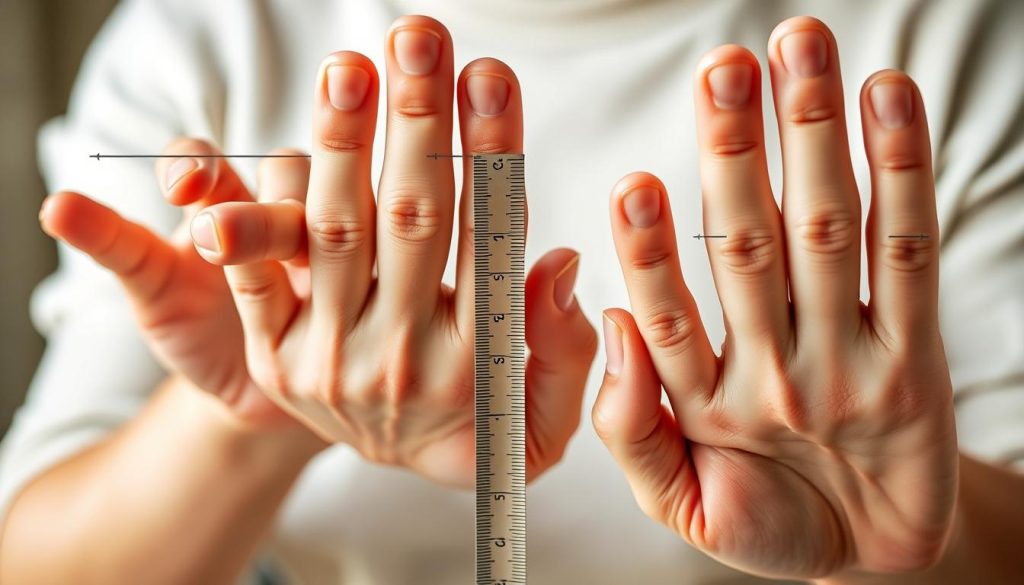
Hand measurement techniques offer quick dimension estimates. The finger span method is great for measuring 5 inches without tools1. People have used body proportions as handy measuring alternatives for ages1.
To measure 5 inches, you need to know your hand’s size. Your hand can become a useful measuring tool with practice. Learn how different parts of your hand relate to standard measurements2.
Many professionals use hand measurements for quick estimates. Mapping your hand’s dimensions creates a reliable on-the-go measuring method1. This skill is helpful when precise tools aren’t available.
Key Takeaways
- Hand measurements provide quick dimension estimation
- Finger span method works for approximating 5-inch lengths
- Body proportions can replace traditional measuring tools
- Personal hand mapping increases measurement accuracy
- Practice improves hand measurement skills
Understanding Basic Hand Measurements and Body Proportions
Hand measurements offer insights into body proportions. Our hands can help estimate distances quickly and accurately. They’re unique tools for rough measurements without a ruler3.
Adult male hands average 7.6 inches long and 3.5 inches wide. Female hands are slightly smaller at 6.8 inches long and 3.1 inches wide3.
These differences in palm size highlight the intricacies of hand dimensions. Understanding these can be useful in various situations.
Finger Length References
Your fingers can be precise measurement tools. Here are some key references for no ruler technique:
- The first joint of an index finger is approximately 1 inch long
- A fully spread hand spans about 9 inches from thumb to pinkie tip4
- The distance from thumb to index finger tip is roughly 6 inches
Hand Span Guidelines
Hand span measurements vary across different demographics:
| Gender | Hand Span Range |
|---|---|
| Adult Males | 7-11 inches4 |
| Adult Females | 6.5-9.5 inches4 |
Pro tip: Your hand measurements can be a reliable tool for quick estimations. Use them in daily life for easy and handy measurements.
Measuring 5 Inches with Fingers: Practical Techniques
Your hands can become reliable measuring tools with practice. Learn to estimate 5 inches using simple techniques. These hands-on methods require keen observation and regular practice.
The human hand offers multiple ways to measure 5 inches. You can use finger width and thumb measurements strategically. An adult thumb is about one inch wide.
Placing your thumb side by side five times can help estimate 5 inches.
- Use thumb width as a basic measuring unit
- Spread fingers to create reference points
- Compare hand spans with known objects
Try these finger measurement techniques for DIY projects:
- Place five quarters in a line to confirm 5-inch length5
- Extend your hand and measure from thumb tip to index finger tip
- Compare with everyday objects like pens or letter openers5
| Measurement Method | Approximate Length |
|---|---|
| Thumb width repeated | 5 inches |
| Hand span tip to tip | Approximately 6 inches6 |
| Quarters lined up | 5 inches5 |
Pro tip: Practice these hands-on measuring techniques to improve accuracy over time. Hand sizes vary, so cross-check with a ruler when precision matters.
Alternative Measurement Methods Without Tools
No ruler? No problem! Everyday items can help you estimate sizes. These creative techniques turn common objects into makeshift measuring tools. Let’s explore some practical ways to measure without traditional instruments.
Everyday Items as Measurement References
Household objects can be reliable measuring standards. Here are some handy reference points:
- A standard credit card measures approximately 3.37 inches long7
- A dollar bill spans 6.14 inches in length8
- A US quarter has a diameter of 0.955 inches7
Combining Measurement Methods
Mix different techniques to boost accuracy. Try using hand spans, body proportions, and item comparisons together. An adult hand span usually measures 7 to 9 inches, offering another useful reference.
By combining methods, you can create more precise rough measurements9. This approach helps when you need a quick estimate.
Pro tip: Always cross-reference your estimates using multiple methods for better precision.
These smart tricks turn regular objects into powerful measuring tools. You can now estimate dimensions quickly without special equipment. Give these methods a try next time you need a quick measurement!
Conclusion
Mastering finger measurements turns your hands into handy tools. This skill lets you quickly estimate sizes without traditional devices10. Using hands for estimating dimensions is more than just fun—it’s useful daily11.
To measure 5 inches, practice and know your hand size. Your hand becomes a natural tool for sizing objects. This method sharpens your spatial awareness and enables quick visual estimates10.
Success comes from regular practice and building muscle memory. As you improve, you’ll get more accurate at guessing lengths. For crucial measurements, always use precise tools12.
Use your hands as natural rulers and explore size estimation. With time, your fingers will become reliable measuring instruments.
FAQ
Can I really measure 5 inches accurately using just my fingers?
You can get a close estimate using your hand’s natural proportions. Most people can measure within a quarter-inch accuracy with practice. Understanding your hand’s unique measurements and using multiple reference points is crucial.
How do different hand sizes affect finger measurement techniques?
Hand sizes vary, so it’s important to calibrate your own measurements. People with larger hands might cover more distance. Those with smaller hands may need to adjust their techniques.
What are the most reliable body-based methods for measuring 5 inches?
Reliable techniques include using your full hand span and combining finger widths. Measuring from specific knuckle points is also effective. For most adults, spreading four fingers plus thumb width approximates 5 inches closely.
Are there any alternative objects I can use to cross-reference my finger measurements?
Common items can help verify your hand measurement estimates. Credit cards (3.37 inches), standard paper clips (about 1 inch), and dollar bills work well. These objects can help you calibrate your measurements.
How can I improve my hand measurement accuracy?
Practice is essential for improving accuracy. Start by measuring known objects with your fingers. Then check with a ruler. Over time, you’ll develop a better sense of your hand’s proportions.
When should I not rely on finger measurements?
Avoid using hand measurements for precision tasks like scientific experiments or professional construction. Medical applications also require more accurate tools. Use rulers, calipers, or laser measuring devices for these situations.
Can children use these hand measurement techniques?
Children’s hands are still growing, so their measurements will be less consistent. Adults should demonstrate the techniques and supervise children. It’s important to explain that hand sizes change significantly during growth.
Do different cultures have traditional hand measurement techniques?
Many cultures used hand and body measurements before standardized tools existed. The ancient Egyptian cubit, based on forearm length, is one example. This shows that body-based measurements have been used for thousands of years.
Source Links
- The Hand as Measuring Device – https://seweverythingblog.com/2020/05/12/the-hand-as-measuring-device/
- Tips for Estimating Measurements When You Don’t Have a Ruler – https://www.thesprucecrafts.com/ways-to-measure-without-ruler-2366642
- Average Hand Size: For Adults, Children, Athletes, and More – https://www.healthline.com/health/average-hand-size
- 3 Ways to Measure Hand Size – wikiHow – https://www.wikihow.com/Measure-Hand-Size
- 11 Common Things That Are 5 Inches Long – https://dimensionsscript.com/5-inches-long/
- 4 Ways to Measure Without a Ruler – https://brightside.me/articles/4-ways-to-measure-without-a-ruler-811641/
- How to Measure Length Without A Ruler: Simple DIY Techniques – https://frontierwaste.com/resources/measure-length-no-ruler/
- How to Measure Without a Tape Measure | Budget Dumpster – https://www.budgetdumpster.com/blog/measure-without-tape-measure
- How to Measure Without a Ruler: 8 Steps (with Pictures) – wikiHow – https://www.wikihow.com/Measure-Without-a-Ruler
- 11 Common things that are 5 Inches long – Measure Crafted – https://measurecrafted.com/5-inches-long/
- How to Measure Your Height Accurately at Home – https://www.healthline.com/health/how-to-measure-height
- 5 Easy Methods To Measure Ring Size – Omarsons Jewellers – https://omarsonsjewellers.com/tips-and-tricks/how-to-measure-ring-size/