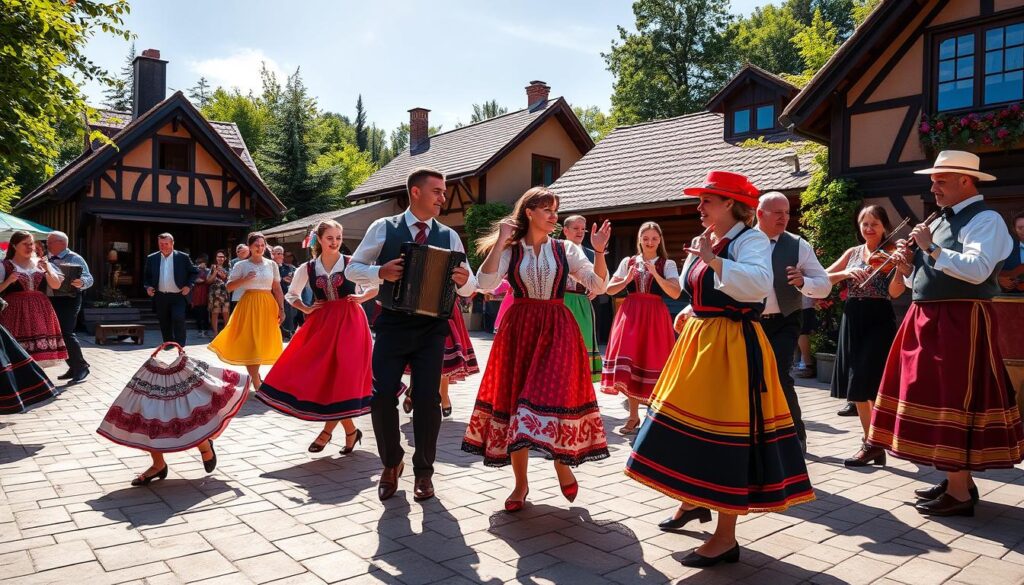
Eastern European folk dances showcase a vibrant tapestry of cultural heritage. They capture the spirit of traditional music and ethnic rhythms. These dances are living stories passed down through generations12.
Polish national dances feature intricate steps. Russian folk traditions boast energetic movements. Each motion tells a story of cultural identity1.
Eastern European dance traditions have spread globally. They’ve influenced music and performance styles worldwide. Polish dance culture has reached North America, blending ballroom elegance with folkloric passion1.
Folk dances are more than entertainment. They serve as powerful national identifiers. These dances awaken pride and connect communities to their historical roots2.
Each region boasts unique dance styles. They reflect specific cultural landscapes. Polish national dances are theatrical, while Hungarian performances are improvisational1.
Key Takeaways
- Folk dances are living expressions of cultural heritage
- Eastern European dance traditions have global influence
- Each dance tells a unique cultural story
- Dances serve as important national symbols
- Complex choreography reflects deep cultural traditions
The Rich Heritage of Eastern European Folk Dances
Eastern European folk dances are living artifacts of cultural expression. They’re deeply rooted in oral tradition and regional identity. These captivating performances represent powerful narratives of community, history, and indigenous art3.
Eastern European dance traditions reveal fascinating characteristics. They feature unique elements that bring communities together. These include circle formations, complex rhythms, storytelling through movement, and traditional costume symbolism3.
- Circle and line dance formations3
- Complex rhythmic patterns
- Storytelling through movement
- Traditional costume symbolism3
Understanding the Roots and History
Folk dances in this region evolved from ancient rituals and social gatherings. Many dances use compound musical meters, creating distinctive rhythmic experiences3. These performances often reflect historical events, agricultural cycles, and community milestones.
Key Characteristics of Folk Dances
Eastern European folk dances burst with vibrant energy and intricate movements. Dancers often use traditional instruments like the Hungarian fiddle and Ukrainian bandura3. These instruments add authenticity and richness to their performances.
| Dance Type | Key Features |
|---|---|
| Couple Dances | Lively tempos with varying pace3 |
| Solo Dances | High-energy, acrobatic movements3 |
| Ritual Dances | Performed during harvest and life transitions3 |
Importance of Folk Dances in Culture
These dances are living representations of cultural identity. Professional folk dance ensembles work hard to preserve these traditions. They showcase Eastern European heritage locally and internationally3.
Folk dances are the heartbeat of Eastern European cultural heritage, connecting generations through movement and music.
Experience the rich tapestry of Eastern European cultural expression. Watch these performances and witness stories of community and tradition. Every step tells a tale of resilience and cultural pride.
Popular Eastern European Folk Dances You Should Know
Folk dances are lively expressions of cultural heritage in Eastern Europe. They tell stories of community and celebration through intricate movements. These dances capture the spirit of regional identity with rhythmic patterns4.
Folk dances create a fascinating tapestry of cultural expression. They connect generations through movement and music. Each dance reflects local traditions and folk instruments of its origin.
Discover more by exploring the diverse folk dance traditions.
The Energetic Polka
The polka began in Bohemia during the 1830s. It quickly spread across European dance halls with its lively tempo. This infectious dance became popular, capturing dancers’ hearts everywhere5.
The Graceful Mazurka
The mazurka, from Poland, is a sophisticated dance with a unique triple meter. It features unexpected rhythmic accents that make it captivating. Dancers move elegantly, showcasing intricate footwork.
The Joyous Hopak
Ukraine’s national dance, the hopak, shows strength and agility. Male dancers perform spectacular jumps, squats, and kicks. These moves demonstrate incredible physical prowess4.
The Evocative Kolo
The kolo is a beloved circle dance from the Balkan region. It brings communities together in a shared experience. Dancers join hands or hold waists, moving in a synchronized circular formation.
| Dance | Origin | Key Characteristics |
|---|---|---|
| Polka | Bohemia | Lively hopping steps |
| Mazurka | Poland | Triple meter, unexpected accents |
| Hopak | Ukraine | Powerful jumps and kicks |
| Kolo | Balkans | Circular group formation |
These folk dances showcase Eastern Europe’s rich musical and movement heritage. Each step preserves a piece of cultural memory. Dive into these traditions to explore the heart of Eastern European culture5.
Learning and Participating in Folk Dance
Eastern European folk dance offers a thrilling dive into cultural heritage. Find classes at community centers, cultural organizations, and dance studios nationwide6. Many universities with Slavic studies also offer courses on ethnic music and traditional movement7.
Starting your folk dance journey can be fun and easy. Most dances have only 3-4 basic moves, making them simple to learn6. Experts suggest breaking down steps and using “movement games” to stay motivated6.
Folk dance activities boost physical and mental health. They help fight against a sedentary lifestyle8. Comfortable clothing and finger movement practice can improve your choreography skills6.
Folk festivals offer authentic cultural experiences. The Balkan Folk Festival in Bulgaria and International Folklore Festival in Poland are great examples. These events feature workshops, performances, and chances to meet passionate dancers7.
Folk dance is more than just steps. It’s about embracing a living tradition. Join community dance groups to connect with this rich cultural heritage. Every move links you to Eastern Europe’s vibrant historical and social narrative.
FAQ
What are Eastern European folk dances?
Eastern European folk dances come from countries like Poland, Russia, and Ukraine. They reflect cultural heritage through energetic movements and intricate footwork. These dances often involve circle formations, partner dances, and group performances in colorful costumes.
How old are Eastern European folk dances?
Many Eastern European folk dances have roots dating back to the Middle Ages. They evolved from religious ceremonies and social gatherings. These dances preserve cultural identity and pass down traditions through generations.
What are some famous Eastern European folk dances?
Notable Eastern European folk dances include the Polka, Mazurka, and Hopak. The Kolo, Russian Troika, and Bulgarian Pravo horo are also popular. Each dance has unique traits that reflect its cultural origin.
What should I wear to a folk dance class?
Wear comfortable, flexible clothing that allows free movement for folk dance classes. Choose footwear that supports quick steps and turns. Lightweight, breathable clothing is ideal for ease of movement.
Where can I learn Eastern European folk dances?
You can learn these dances at community centers and cultural organizations. Dance studios and universities with Slavic studies programs also offer classes. Many cities host folk dance workshops for beginners.
What instruments are typically used in Eastern European folk music?
Eastern European folk music often features the accordion, balalaika, and tambourine. Violins, cimbaloms, and various wind instruments are also common. These provide the rhythmic and melodic background for folk dances.
Are there folk dance festivals I can attend?
Yes! The Balkan Folk Festival in Bulgaria celebrates Eastern European traditions. Poland hosts the International Folklore Festival. The Guča Trumpet Festival in Serbia is also popular.
These events offer live music, dance performances, and workshops. You’ll find plenty of chances to join in and dance.
How difficult are Eastern European folk dances for beginners?
Folk dances vary in complexity, but most start with basic steps and rhythms. Beginners should focus on understanding fundamental patterns and maintaining proper posture. Enjoying the cultural experience is key to learning these dances.
Source Links
- European dances – https://en.wikipedia.org/wiki/European_dances
- Folk dance – Categorizing, Types, Styles | Britannica – https://www.britannica.com/art/folk-dance/Categorizing-dances
- The Eastern European Folk Dances: A Guide to Traditional Steps – ConnollyCove – https://www.connollycove.com/the-eastern-european-folk-dance/
- 7 Traditional Greek Dances You Should Know About – https://theculturetrip.com/europe/greece/articles/7-traditional-greek-dances-you-should-know-about
- Folk Dances of Bulgaria – https://socalfolkdance.org/articles/folk_dances_of_bulgaria_moreau.htm
- 6 Simple Tricks for Teaching Folk Dance – Michigan Kodaly Educators – https://mikodaly.org/teaching-folk-dance/
- Folk Dance: An Occupation For Building Community – https://encompass.eku.edu/cgi/viewcontent.cgi?article=1640&context=etd
- Frontiers | The effects of folk-dance in schools on physical and mental health for at-risk adolescents: a pilot intervention study – https://www.frontiersin.org/journals/sports-and-active-living/articles/10.3389/fspor.2024.1434661/full