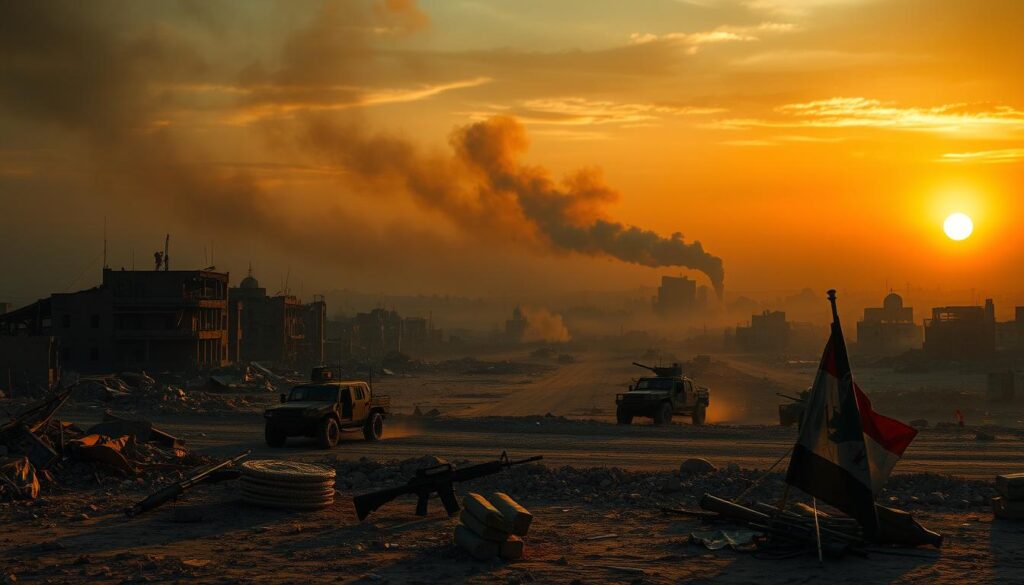
The 2003 invasion of Iraq was a major event led by the United States and its allies. It changed the Middle East and global politics. The invasion was supported by 72% of Americans1.
This event was caused by concerns over Saddam Hussein’s regime. The invasion started on March 20, 2003, and lasted a month. It had big effects on international relations and the war on terror, with 309,000–584,799 troops involved2.
The invasion involved the United States and Iraq’s Saddam Hussein regime. U.S. forces launched a missile attack on March 19, 20033. It’s important to understand the historical context and reasons behind this event.
Key Takeaways
- The 2003 invasion of Iraq was led by a United States-led combined force of troops from the United States, the United Kingdom, Australia, and Poland.
- The invasion marked a significant turning point in modern geopolitics, reshaping the landscape of the Middle East and global politics.
- The United States invasion of Iraq in 2003 was supported by 72% of Americans1.
- The Strength of Coalition forces in 2003 was between 309,000–584,799 personnel2.
- U.S. planes and warships based in the Persian Gulf hit targets within Iraq with a barrage of Tomahawk missiles on March 19, 20033.
- The invasion had far-reaching implications for international relations, regional stability, and the global war on terror.
Background and Justifications for the Invasion
The early 2000s saw a rise in global tensions. The September 11 attacks made everyone focus more on security and the War on Terror. This changed how the United States made foreign policy decisions4.
Political Context Leading Up to 2003
The United Nations played a big role before the invasion. On November 8, 2002, the UN Security Council passed Resolution 1441. It asked Iraq to disarm and follow its rules4.
But, many people opposed the war without a clear UN mandate. They saw the United States as a danger to world peace4.
Key Players in the Decision-Making Process
President George W. Bush and UK Prime Minister Tony Blair were key players. They said the invasion was needed to disarm Iraq, stop Saddam Hussein’s support for terrorism, and free the Iraqi people. They saw it as a necessary step for global security.
Claims of Weapons of Mass Destruction
The main reason for the invasion was believed to be Iraq’s Weapons of Mass Destruction. But, later, it was found that these claims were based on bad intelligence. This led to a lot of debate among scholars about the real reasons for Operation Iraqi Freedom56.
The Course of the Invasion
Operation Iraqi Freedom was a key moment in the Middle East conflict. It started a series of military actions to remove Saddam Hussein’s regime.
Major Military Operations in March 2003
The invasion began with airstrikes on key targets. Then, ground troops moved in from all sides. They used new technology and tactics to break through Iraqi defenses7.
The Role of Coalition Forces
At the start, 160,000 troops were involved8. The forces were made up of:
- American soldiers: 130,000
- British soldiers: 45,000
- Australian soldiers: 2,000
- Polish commandos: Approximately 200
This mix of forces worked together. They used each country’s strengths to reach their goals8.
Initial Reactions and Global Responses
The quick win in Baghdad got mixed reactions. Some supported the mission to stop threats. Others questioned the evidence of weapons of mass destruction8.
Aftermath and Consequences
The 2003 invasion of Iraq changed the nation and the Middle East. Saddam Hussein’s removal led to big changes in society and politics. These changes are felt today.
Impact on Iraqi Society and Infrastructure
The Iraq War damaged the country’s infrastructure. It disrupted services and made recovery hard. Over 210,090 civilians died in violence from 2003 to now, with 2006 being the worst year9.
Many people were forced to leave their homes. In 2015, 4.4 million were displaced due to ISIL’s rise9.
Long-term Political Ramifications
The invasion made Iraq’s politics unstable. It led to more violence and new political groups. Corruption is a big problem, making Iraq one of the most corrupt countries10.
The government set up after the invasion is weak. This has caused ongoing political problems.
Regional Stability and Security Issues
The Iraq War’s effects are seen across the Middle East. Changes in power and new security threats have made things worse. The rise of groups like ISIS has destabilized Iraq and affected other countries910.
Evaluations and Controversies
The 2003 U.S. invasion of Iraq has caused a lot of debate. The main reason for the war, the presence of Weapons of Mass Destruction, was never proven. This has led to a lot of criticism.
Critiques of the Justification for War
No Weapons of Mass Destruction were found, which made the war’s reason weak1112. It was shown that some intelligence was wrong or used to justify the war11. This has made people question the honesty of the intelligence and the pressure on those making decisions.
Perspectives from Different Stakeholders
People have different opinions about the invasion. Those in charge say it was needed for peace, but others say there was no proof of WMDs11. The people of Iraq suffered a lot, with their economy and society in trouble13. The Kurdish government’s problems also added to the chaos13.
Legacy of the 2003 Iraq Invasion
The invasion has changed U.S. foreign policy and international law13. It has made the Middle East more unstable and led to the rise of groups like ISIS. The war also cost over $765 billion, affecting both the U.S. and Iraq greatly13.
FAQ
What were the main reasons behind the 2003 invasion of Iraq?
The main reason for the 2003 invasion was the belief that Saddam Hussein had weapons of mass destruction. The invasion was also part of the War on Terror, after the September 11 attacks. The goal was to remove Hussein’s regime and protect global security.
Who were the key players involved in the decision to invade Iraq in 2003?
Key figures included President George W. Bush of the United States and Prime Minister Tony Blair of the United Kingdom. They, along with other allies, shaped the reasons for the invasion.
What was Operation Iraqi Freedom?
Operation Iraqi Freedom was the 2003 invasion of Iraq. Led by the United States, it included troops from the UK, Australia, and Poland. The goal was to remove Saddam Hussein, find WMDs, and set up a new government.
Did Iraq possess weapons of mass destruction?
After the invasion, no evidence of WMDs in Iraq was found. The intelligence used to justify the invasion was criticized, sparking debate over the Iraq War’s legitimacy.
How did the international community respond to the 2003 invasion of Iraq?
The invasion got mixed reactions worldwide. The US and its allies supported it, but many countries and the UN opposed it. This showed the conflict’s contentious nature and its impact on diplomacy.
What were the major military operations during the invasion?
The invasion started with airstrikes to weaken Iraq’s command. Then, coalition forces quickly moved, taking Baghdad. Their use of technology and tactics helped them succeed early on.
What were the immediate consequences of the invasion for Iraq?
Saddam Hussein’s regime fell after the invasion. But, Iraq faced big challenges like setting up a new government and rebuilding. The lack of a strong government led to more violence and instability.
How has the 2003 invasion of Iraq impacted regional stability in the Middle East?
The invasion changed the Middle East’s power dynamics and security threats. It increased sectarian tensions, led to extremist groups, and destabilized countries. This changed the conflict’s landscape in the region.
What controversies have surrounded the 2003 Iraq invasion?
The invasion is surrounded by many controversies, mainly about the WMD claims. Critics say the intelligence was wrong and the invasion was for other reasons. These debates affect how people view U.S. foreign policy and military actions.
What is the legacy of the 2003 invasion of Iraq?
The invasion’s legacy is complex, affecting U.S. foreign policy, international law, and views on military actions. It has sparked discussions on the ethics and success of such invasions, the need for accurate intelligence, and the consequences of regime changes in the Middle East.
Source Links
- The March to Baghdad: A Timeline of the 2003 Invasion of Iraq — Team Red, White & Blue – https://teamrwb.org/blog/the-march-to-baghdad-a-timeline-of-the-2003-invasion-of-iraq
- Iraq War – https://en.wikipedia.org/wiki/Iraq_War
- 20 Years Later: Recalling the US Invasion of Iraq – https://www.vfw.org/media-and-events/latest-releases/archives/2023/3/20-years-later-recalling-the-us-invasion-of-iraq
- Rationale for the Iraq War – https://en.wikipedia.org/wiki/Rationale_for_the_Iraq_War
- The Iraq War | George W. Bush Library – https://www.georgewbushlibrary.gov/research/topic-guides/the-iraq-war
- Why Did the United States Invade Iraq? The Debate at 20 Years – Texas National Security Review – https://tnsr.org/2023/06/why-did-the-united-states-invade-iraq-the-debate-at-20-years/
- Iraq War | Summary, Causes, Dates, Combatants, Casualties, & Facts | Britannica – https://www.britannica.com/event/Iraq-War
- 2003 invasion of Iraq – https://en.wikipedia.org/wiki/2003_invasion_of_Iraq
- Iraq war, 20 years on: Visualising the impact of the invasion – https://www.aljazeera.com/news/longform/2023/4/5/iraq-war-20-years-on-visualising-the-impact-of-the-invasion
- A bloody delusion: how Iraq war led to catastrophic aftermath in Middle East – https://www.theguardian.com/world/2023/mar/17/iraq-war-invasion-2003-aftermath-middle-east-islamic-state
- Iraq and Weapons of Mass Destruction – https://nsarchive2.gwu.edu/NSAEBB/NSAEBB80/
- Unproven: The Controversy over Justifying War in Iraq – https://ciaotest.cc.columbia.edu/special_section/iraq_review/ciao/pi_jrw_04.pdf
- America’s Failed Strategy in the Middle East: Losing Iraq and the Gulf – https://www.csis.org/analysis/americas-failed-strategy-middle-east-losing-iraq-and-gulf