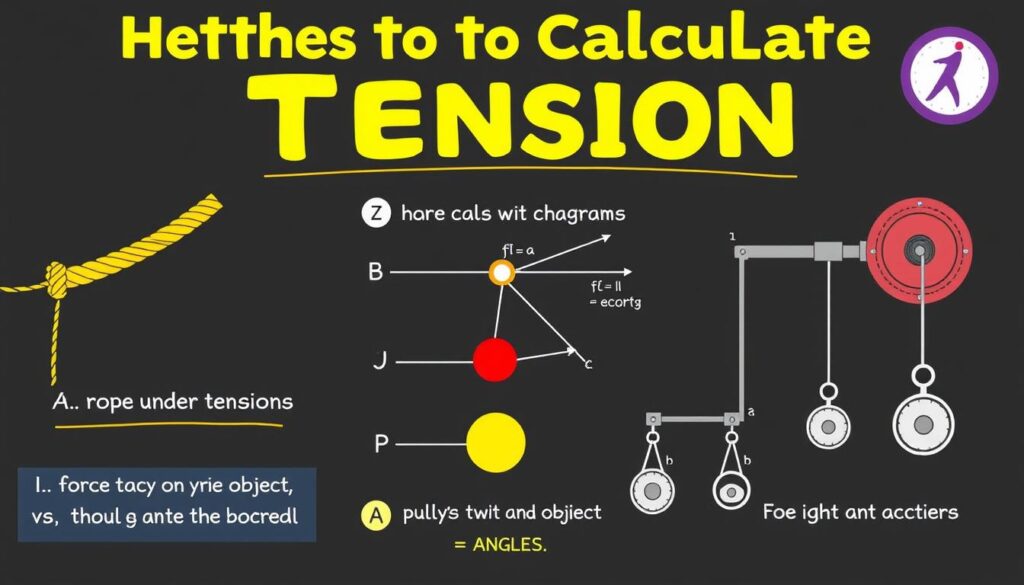
Understanding tension is key in physics for solving mechanical problems. It’s a vital force in scientific and engineering applications12. You’ll find tension in ropes, cables, and other flexible objects that transmit pulling forces.
The tension formula offers a way to measure this unique force. A tension calculator helps determine the exact pulling force in various situations1. Calculations consider factors like mass, gravity, and acceleration1.
Tension in physics is measured in newtons (N). Its value depends on environmental and structural conditions2. You’ll discover three main methods to accurately determine tension in different scenarios.
Key Takeaways
- Tension is a pulling force transmitted through flexible mediums
- Calculations involve mass, gravity, and potential acceleration
- Tension is measured in newtons (N)
- Different methods exist for calculating tension
- Understanding tension is crucial in physics and engineering
Understanding Tension in Physics
Physics reveals fascinating insights into tension, a fundamental force in mechanical systems. This invisible pull impacts objects in motion and at rest. Tension in string equations helps us understand these effects3.
Tension is a pulling force along flexible mediums like ropes or cables3. It pulls equally on both ends of a rope connecting two objects. This creates a dynamic interaction of forces4.
Defining Tension in Physical Systems
Tension force calculation involves understanding force interactions in mechanical systems. Here are key characteristics of tension:
- Tension acts as a contact force transmitted through flexible connectors4
- It pulls outward along the ends of a rope or cable3
- Measured in newtons in the International System of Units5
Importance of Understanding Tension
Mastering tension in rope formulas is crucial for analyzing complex physical scenarios. Scientists and engineers use tension calculations for various purposes.
These include predicting object movement, designing structural systems, and understanding force interactions.
- Predict object movement
- Design structural systems
- Understand force interactions
“Tension reveals the invisible forces that connect and move our physical world.”
Common Scenarios Involving Tension
You’ll encounter tension in various real-world situations. These include hanging objects from ropes, pulley systems, and objects moving on inclined surfaces4.
- Hanging objects from ropes
- Pulley systems
- Objects moving on inclined surfaces4
These principles help you grasp how forces interact in complex mechanical systems. Understanding tension is key to analyzing object movement3.
Method 1: Using Newton’s Second Law
Newton’s Second Law of Motion is key to finding tension in physics. It helps solve complex problems by breaking down forces acting on objects6.
Step-by-Step Approach to Calculating Tension
To calculate tension, follow this method:
- Identify all forces acting on the object
- Draw a free body diagram
- Apply Newton’s Second Law equation: F = ma6
Free Body Diagrams Explained
A free body diagram visually shows all external forces on an object. These forces include:
- Gravitational force
- Tension force
- Normal force
- Applied forces
Practical Tension Calculation Example
Picture a 10 kg mass hanging from a rope. The tension calculation depends on the object’s acceleration1.
- At zero acceleration, tension equals the object’s weight
- With upward acceleration, tension increases
- With downward acceleration, tension decreases
“In physics, tension is not just a force, but a dynamic interaction between objects connected by a medium.” – Physics Dynamics Researcher
The formula T = mg + ma helps calculate tension in various scenarios1. Tension always acts along the rope or string1.
Method 2: Using the Rope and Pulley System
Pulley systems are mechanical setups that show how motion and force work together. They help us explore the way forces move through connected objects. These systems offer a great way to study physics principles.
Key Components of the Pulley System
A typical rope and pulley system has several important parts:
- Frictionless pulley
- Inextensible rope
- Connected masses
- Gravitational forces
Calculating Tension in Different Scenarios
To figure out tension in a pulley system, you need to look at several things. Mass, acceleration, and gravity all play a role. The tension usually stays the same throughout the rope.
Small changes can happen based on how the system moves. A tension calculator can help you work out the numbers.
“The beauty of a pulley system lies in its ability to distribute and transfer forces across connected masses.”
Practical Example Problems
Let’s look at a system with two masses linked by a rope. In one case, a 0.500kg mass moving down has a string tension of 4.3 N.
Another example uses two 0.500kg masses on a smooth surface. This setup shows how to find the system’s acceleration.
When studying tension, we make some assumptions. We ignore the rope’s weight and assume the pulley has no friction. We also think the rope stays tight78.
Method 3: Application in Real-Life Situations
Tension force is everywhere in our daily lives. It’s crucial in industrial machinery and fun activities. Engineers use tension knowledge to create safer, more efficient systems.
Tension in Hanging Objects
Tension keeps chandeliers and suspension bridges stable. In stationary hanging objects, tension equals the object’s weight. Industries use tension calculations for cranes, well pulleys, and towing vehicles9.
Tension in Accelerating Systems
Elevators and ski lifts have more complex tension forces. Tension changes based on acceleration direction and strength. Ziplining and bungee jumping show how tension varies with movement9.
Case Studies: Everyday Applications
Tension force affects guitar strings and massive bridge structures. Learning tension calculation helps analyze various mechanical setups. The Newton (N) measures these important forces in physics and engineering9.
FAQ
What is tension in physics?
Tension is a pulling force along a flexible medium like a rope or cable. It acts on every section of the rope, pulling at both ends. Tension only pulls, never pushes, as ropes can’t effectively push.
How do you calculate tension in a physics problem?
Use the formula T = mg + ma to calculate tension. T is tension, m is mass, g is gravitational acceleration, and a is acceleration. Draw a free body diagram showing all forces on the object. Apply Newton’s Second Law (F = ma) to find the tension force.
What are common scenarios involving tension?
Tension is crucial in objects suspended by ropes or cables. It’s also important in pulley systems, elevators, and ski lifts. Bridges and hanging signs rely on tension to support weight and manage forces.
How does tension change in different situations?
Tension varies based on an object’s motion. For stationary objects, tension equals the object’s weight. In accelerating systems, tension changes with acceleration direction and magnitude. An upward-accelerating elevator has higher tension than its resting weight.
How do you calculate tension in a pulley system?
For a simple pulley system with two masses, use T = (2M1M2g) / (M1 + M2). M1 and M2 are masses, and g is gravitational acceleration. Consider forces on each component and use Newton’s laws to determine rope tension.
What’s the difference between tension in a stationary and moving object?
Stationary object tension equals its weight. Moving object tension depends on weight and acceleration. Upward acceleration increases tension above weight. Downward acceleration decreases tension below weight.
Why is understanding tension important?
Tension knowledge is vital for engineers and physicists designing safe mechanical systems. It helps analyze structural integrity and ensure object stability under various forces. This understanding is crucial in construction, transportation, and mechanical engineering.
Source Links
- Tension – Definition, Explanation, Solved Problems, FAQs – https://byjus.com/physics/tension/
- Tension Formula | Problems with Solved Examples – https://www.vedantu.com/formula/tension-formula
- 2.6: Normal Force and Tension – https://phys.libretexts.org/Bookshelves/Conceptual_Physics/Introduction_to_Physics_(Park)/02:_Mechanics_I_-_Motion_and_Forces/02:_Dynamics/2.06:_Normal_Force_and_Tension
- Tension: Meaning, Examples, Forces & Physics – https://www.vaia.com/en-us/explanations/physics/dynamics/tension/
- Tension (physics) – https://en.wikipedia.org/wiki/Tension_(physics)
- Newton’s Second Law of Motion – https://www.physicsclassroom.com/class/newtlaws/lesson-3/newton-s-second-law
- Finding the tension in rope of pulley with 2 blocks.(lots of my work shown) – https://www.physicsforums.com/threads/finding-the-tension-in-rope-of-pulley-with-2-blocks-lots-of-my-work-shown.521442/
- Section13 – https://physics.csuchico.edu/kagan/204A/lecturenotes/Section13.pdf
- Tension Force: Formula, Definition, Solved Examples, and FAQs – GeeksforGeeks – https://www.geeksforgeeks.org/tension-formula/