
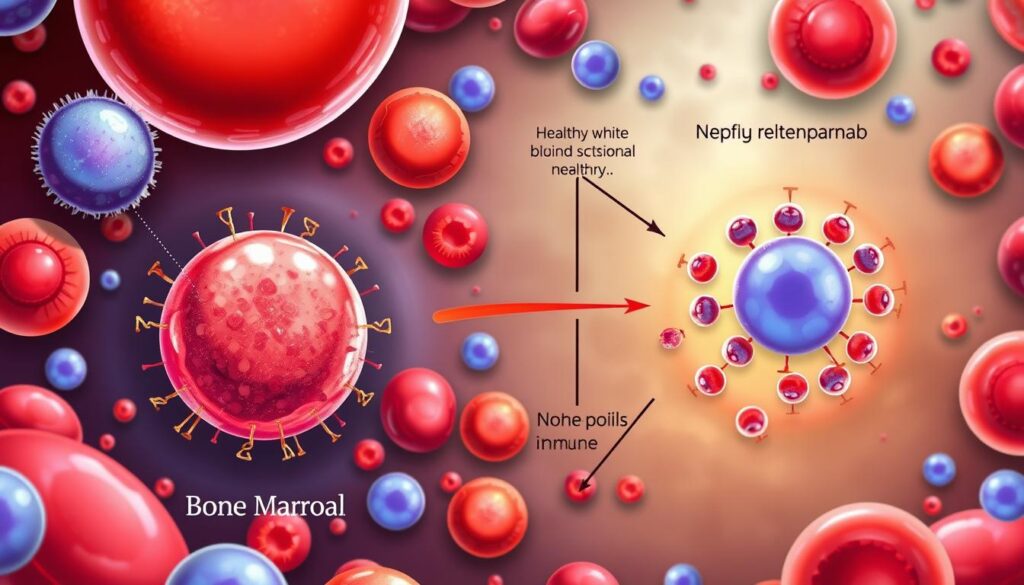
Neutropenia weakens your body’s defense against infections. It happens when your neutrophil count drops, making you more susceptible to health risks1. Cancer patients often face this issue during chemotherapy, which severely impacts their immune system1.
Your body relies on neutrophils to fight bacteria and fungi. Without enough neutrophils, you’re at a higher risk of getting sick1. Various factors can cause neutropenia, including certain medicines, autoimmune diseases, and infections.
Neutropenia can result from bone marrow problems or vitamin shortages. Some people have chronic idiopathic neutropenia, where the cause is unknown1. Interestingly, benign neutropenia exists too, where low neutrophil counts don’t always increase infection risks1.
Key Takeaways
- Neutropenia significantly reduces your body’s infection-fighting capabilities
- Cancer treatments often trigger low white blood cell counts
- Multiple medical conditions can cause neutropenia
- Understanding your neutrophil levels is crucial for managing health risks
- Consultation with healthcare professionals is essential for proper diagnosis
What is Neutropenia and How Does It Affect Your Body
Neutropenia is a serious blood disorder that weakens your body’s defense against infections. It occurs when you have too few neutrophils, white blood cells vital for your immune system.
Neutrophils are crucial for fighting harmful bacteria and protecting you from infections. When these white blood cells drop below normal levels, your body becomes more susceptible to health risks.
Understanding Normal Neutrophil Levels
Healthy neutrophil counts usually exceed 1,500 per microliter of blood. Levels below this may indicate neutropenia, which can be temporary or chronic.
Neutropenia can last more than three months in chronic cases. It affects both children and adults.
- Temporary (acute) condition
- Chronic lasting more than three months2
- Affecting both children and adults3
Signs and Symptoms of Neutropenia
Symptoms of neutropenia can vary among individuals. Common signs include sore throat, swollen lymph nodes, and mouth ulcers.
Other symptoms may include fatigue, fever, and slow wound healing.
- Sore throat
- Swollen lymph nodes
- Mouth ulcers
- Fatigue
- Fever
- Difficulty healing wounds2
Early detection and monitoring are crucial for managing neutropenia effectively.
Types of Neutropenia
There are four main types of neutropenia. Each type has its own unique characteristics.
| Type | Description |
|---|---|
| Congenital | Present at birth, most severe form3 |
| Idiopathic | Unknown cause |
| Cyclic | Occurs every three weeks, lasting 3-6 days3 |
| Autoimmune | Immune system destroys neutrophils |
Febrile neutropenia is a serious condition, especially for cancer patients on chemotherapy. It’s marked by fever and higher infection risk.
Common Causes of Neutropenia
Neutropenia can stem from various factors affecting white blood cell production. Understanding these causes is vital for managing the condition effectively. Let’s explore the main factors impacting neutrophil levels.
- Cancer treatments: Chemotherapy side effects dramatically reduce neutrophil counts
- Bone marrow disorders that disrupt white blood cell production
- Autoimmune diseases attacking neutrophils
- Certain medications that suppress neutrophil generation
Cancer treatments pose significant challenges. Chemotherapy targets cancer cells but also destroys white blood cells. This leaves patients highly susceptible to infections.
Febrile neutropenia can become life-threatening during treatment. The risk of infection rises sharply as neutrophil counts drop4.
| Cause Category | Specific Triggers | Potential Impact |
|---|---|---|
| Medical Treatments | Chemotherapy | High infection risk |
| Genetic Conditions | Chronic neutropenia | Persistent low neutrophil count5 |
| Infections | Viral diseases | Neutrophil destruction |
Neutropenia experiences can vary among individuals. For some people of African and Middle Eastern descent, mild neutropenia may be normal4. Genetic variations in over 20 genes might contribute to chronic neutropenia5.
Understanding your specific leukopenia risk is key to proactive healthcare management.
Stay healthy by maintaining excellent hygiene and avoiding sick individuals. Seek prompt medical attention if you experience unusual symptoms4. These strategies can help prevent complications.
Conclusion
Neutropenia treatment involves preventing infections and providing comprehensive patient care. Identifying underlying causes and implementing targeted strategies is crucial. Granulocyte colony-stimulating factor (G-CSF) is vital for managing this condition, especially during chemotherapy6.
Treatment approaches vary based on severity and individual needs. Some patients need monitoring, while others require aggressive interventions. G-CSF dosages range from 1.2 to 7.3 mcg/kg/day, depending on neutropenia type6.
Infection prevention is critical, particularly for those with weakened immune systems7. Early detection and personalized treatment plans are essential. Your healthcare team will assess risk factors and potential complications6.
Proper management helps patients navigate neutropenia challenges effectively. It’s possible to maintain a good quality of life with the right approach8.
Successful neutropenia management requires teamwork between patients and healthcare providers. Stay informed and follow medical advice. Prioritize your health through proactive strategies and recommended treatments.
FAQ
What is neutropenia?
Neutropenia is a condition with low neutrophil counts. Neutrophils are white blood cells that fight infections. Normal levels are above 1,500 per microliter of blood. The severity can be mild, moderate, or severe.
What causes neutropenia?
Neutropenia can stem from various factors. These include cancer treatments, certain medications, and infections. Autoimmune diseases, bone marrow disorders, and vitamin deficiencies can also cause it.
Some people have benign neutropenia without increased infection risk. This includes those with Benign Ethnic Neutropenia (BEN).
What are the symptoms of neutropenia?
Mild cases may show no symptoms. Moderate to severe neutropenia increases infection risk. Symptoms can include sore throat and swollen lymph nodes.
Other signs are mouth ulcers, urinary issues, and diarrhea. Abscesses and fatigue may also occur. Fever often indicates infection in neutropenic patients.
How is neutropenia treated?
Treatment varies based on cause and severity. Mild cases may not need intervention. Severe cases might require antibiotics or medication to boost white blood cell production.
Other treatments include medication adjustments and granulocyte transfusions. Corticosteroids or stem cell transplants may be used in extreme cases.
How can I prevent infections with neutropenia?
Prevention is key. Practice good hygiene and avoid contact with sick people. Proper wound care and dietary precautions are also important.
Cancer patients on chemotherapy need regular neutrophil level checks. This helps manage infection risks effectively.
Are there different types of neutropenia?
Yes, there are four main types of neutropenia. These are congenital, idiopathic, cyclic, and autoimmune. Congenital neutropenia is present at birth.
Febrile neutropenia is a serious condition often seen in cancer patients. It’s marked by fever and increased infection risk.
Who is most at risk for neutropenia?
Cancer patients on chemotherapy have a high risk. About 50% develop the condition. People with certain genetic conditions are also susceptible.
Those with autoimmune diseases and bone marrow disorders face increased risk. Some ethnic groups are more prone to Benign Ethnic Neutropenia.
Source Links
- Neutropenia (low neutrophil count) Causes – https://www.mayoclinic.org/symptoms/neutropenia/basics/causes/sym-20050854
- Neutropenia: Causes, Symptoms, and Treatment – https://www.webmd.com/a-to-z-guides/neutropenia-causes-symptoms-treatment
- Neutropenia – https://www.chop.edu/conditions-diseases/neutropenia
- Neutropenia – https://www.healthdirect.gov.au/neutropenia
- Chronic neutropenia | Immune Deficiency Foundation – https://primaryimmune.org/understanding-primary-immunodeficiency/types-of-pi/chronic-neutropenia
- How I diagnose and treat neutropenia – https://pmc.ncbi.nlm.nih.gov/articles/PMC4668211/
- Overcoming Resistance: Antibiotic Guidance for Multidrug-Resistant Febrile Neutropenia in Patients with Cancer – https://www.jhoponline.com/breast-cancer-articles?view=article&artid=18876:overcoming-resistance-antibiotic-guidance-for-multidrug-resistant-febrile-neutropenia-in-patients-with-cancer
- Challenges in diagnosis and management of neutropenia upon exposure to immune-checkpoint inhibitors: meta-analysis of a rare immune-related adverse side effect – BMC Cancer – https://bmccancer.biomedcentral.com/articles/10.1186/s12885-020-06763-y

