
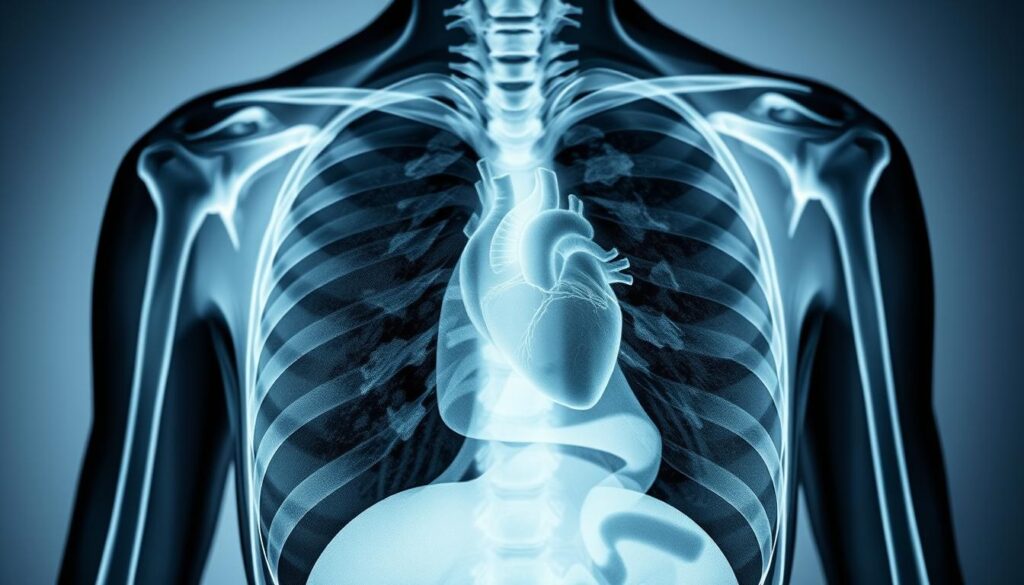
Chest X-rays are a vital tool in radiology. They offer detailed insights into your internal health1. These images help doctors examine your heart, lungs, and chest structure with precision2.
Doctors may suggest a chest X-ray for chest pain or breathing issues. It’s often the first step to check for heart or lung problems3. The process is quick, painless, and gives valuable information about your body2.
X-rays can show many medical conditions. These include pneumonia, heart failure, and emphysema2. They help doctors spot fluid in lungs and assess heart size3.
Key Takeaways
- Chest X-rays are a critical diagnostic tool in medical imaging
- The procedure is quick and typically completed within 15 minutes
- X-rays can detect multiple health conditions affecting the chest
- Radiation exposure is minimal and considered safe
- Radiologists provide detailed interpretations of X-ray results
What Are Chest X-Rays and Their Medical Importance
Chest X-rays are vital diagnostic tools. They help doctors examine internal body structures with precision. These tests provide insights into respiratory and cardiac conditions4.
A chest X-ray is quick and non-invasive. It helps doctors investigate chest health issues. This technology is key for diagnosing pneumonia and screening for tuberculosis5.
Chest X-rays also aid in cardiac evaluation. They’re essential for detecting respiratory illnesses too.
Basic Principles of Chest X-Ray Imaging
Chest X-rays use low-dose radiation. It passes through your body to create detailed images. The procedure is simple and fast4.
- Positioning you against an X-ray plate
- Taking multiple views (front and side)
- Capturing images in less than one-half second4
Common Reasons for Getting a Chest X-Ray
Doctors recommend chest X-rays for various conditions. These include lung infections, heart issues, and bone fractures.
- Lung infections like pneumonia
- Heart-related complications
- Bone fractures
- Potential lung cancer
These tests can reveal critical health issues. They spot problems not visible through external exams6.
Safety and Radiation Exposure Concerns
“Modern X-ray technology prioritizes patient safety while providing essential diagnostic information.”
Chest X-rays involve minimal radiation exposure. Doctors carefully manage radiation levels for safety. In the U.S., medical X-rays account for 15% of annual radiation exposure4.
| X-Ray Type | Primary Purpose | Radiation Level |
|---|---|---|
| Chest X-Ray | Respiratory Illness Screening | Low |
| Cardiac X-Ray | Heart Evaluation | Minimal |
Talk to your doctor about chest X-rays. They can explain the benefits and potential risks for your situation.
How to Prepare for Your Chest X-Rays and What to Expect
Chest X-rays can seem daunting, but knowing the process helps ease worry. The Radiographic Analysis involves steps to capture your Thoracic Anatomy7. This quick exam usually takes about 15 minutes7.
- Remove jewelry from the upper body
- Change into a medical exam gown
- Remove any metal objects that might interfere with imaging
During the X-ray, you’ll be positioned for clear images. Trained technicians will guide you through different poses8. This helps get the best view of your chest.
Your cooperation is key to obtaining the most accurate diagnostic images.
Chest X-rays expose you to about 10 days of background radiation8. Medical staff take steps to lower any risks.
| Procedure Step | Duration | Key Considerations |
|---|---|---|
| Preparation | 5 minutes | Changing, removing jewelry |
| X-ray Positioning | 10 minutes | Multiple views of chest |
Some patients need special care. Pregnant people should talk to their doctor about risks8. Radiation can affect unborn babies.
Conclusion
Medical imaging, especially Chest X-Rays, is vital in modern healthcare diagnostics. These tools offer quick, detailed views of your body’s internal structures. Doctors use them to diagnose and manage various medical conditions9.
Chest X-Rays capture images of your heart, lungs, and chest wall. This helps doctors spot critical health issues fast and accurately. These medical imaging techniques can greatly improve patient care10.
Knowing about Radiology is key for patients seeking thorough medical care. Studies show that 24% of chest X-rays reveal important abnormalities. In 60% of cases, this changes how patients are treated11.
Chest X-Rays keep improving as medical tech advances. New methods aim to cut radiologists’ workload through automated reports. At the same time, they maintain high diagnostic accuracy10.
These imaging techniques offer a quick, safe way to diagnose issues. They’re useful for chest pain, lung conditions, and heart health checks. In some cases, they can even save lives9.
FAQ
What exactly is a chest X-ray?
A chest X-ray is a quick medical imaging test. It uses radiation to create pictures of your chest. This test helps doctors examine internal structures and diagnose various conditions.
Doctors can spot issues like pneumonia, heart problems, and lung diseases. They can also see potential fractures in chest bones.
How long does a chest X-ray procedure typically take?
The chest X-ray procedure is very fast. It usually takes just a few minutes. You’ll stand against an image plate for different views.
You’ll need to hold your breath for a few seconds. This helps make the images clearer. The process is painless and simple.
What should I wear or bring for my chest X-ray?
You’ll need to undress from the waist up. The clinic will give you a gown to wear. Remove any jewelry from your upper body.
Metal objects can block the X-ray images. Wear comfy, loose clothes that are easy to take off.
Are chest X-rays safe? How much radiation am I exposed to?
Chest X-rays use low radiation exposure. Doctors believe the benefits outweigh any potential risks. Special care is taken for sensitive patients, like pregnant women.
The radiation dose is very small. It’s similar to the background radiation you get in daily life.
What conditions can a chest X-ray detect?
Chest X-rays can show many health issues. These include lung diseases, heart problems, and blood vessel changes. They can also reveal fractures, cancer, and infections.
Doctors often use X-rays first when checking for heart or lung problems. They can also see if medical devices are in the right spot.
How quickly will I receive my chest X-ray results?
You’ll usually get chest X-ray results in one to two days. A radiologist will study the images carefully. They may compare them with your old scans.
Your doctor will then talk to you about the findings. They’ll also discuss any next steps you might need to take.
Can a chest X-ray be performed if I have difficulty standing?
Yes, chest X-rays can be done even if you can’t stand easily. The staff can help you get into a comfortable position.
You might be able to sit or lie down instead. The main goal is to get clear images safely.
How often should I get a chest X-ray?
The frequency of chest X-rays depends on your health. Your doctor will suggest a schedule based on your needs. They’ll consider your age, medical history, and current health.
Healthy people don’t usually need regular chest X-rays. You might need one if you have symptoms or health risks.
Source Links
- The Radiology Assistant : Chest X-Ray – https://radiologyassistant.nl/chest/chest-x-ray/basic-interpretation
- chestrad – https://www.radiologyinfo.org/en/info/chestrad
- Chest X-rays – Mayo Clinic – https://www.mayoclinic.org/tests-procedures/chest-x-rays/about/pac-20393494
- Chest X-Ray in Children | Medical Examination – https://www.cincinnatichildrens.org/health/c/chest-x-ray
- X-ray: Imaging test quickly helps find diagnosis – https://www.mayoclinic.org/tests-procedures/x-ray/about/pac-20395303
- Chest X-Ray: Purpose, Procedure, and Risks – https://www.healthline.com/health/chest-x-ray
- Chest X-ray | Diagnostic X-Ray | North Oaks Health System – https://www.northoaks.org/medical-services/diagnostics-imaging/x-ray/chest-x-ray/
- What Are X-Rays? – https://my.clevelandclinic.org/health/diagnostics/21818-x-ray
- What Do My Chest X-Ray Results Show? – Baptist Health – https://www.baptisthealth.com/blog/heart-care/what-do-my-chest-x-ray-results-show
- Show, Describe and Conclude: On Exploiting the Structure Information of Chest X-ray Reports – https://aclanthology.org/P19-1657
- Chest radiography in general practice: indications, diagnostic yield and consequences for patient management – https://pmc.ncbi.nlm.nih.gov/articles/PMC1874520/

