
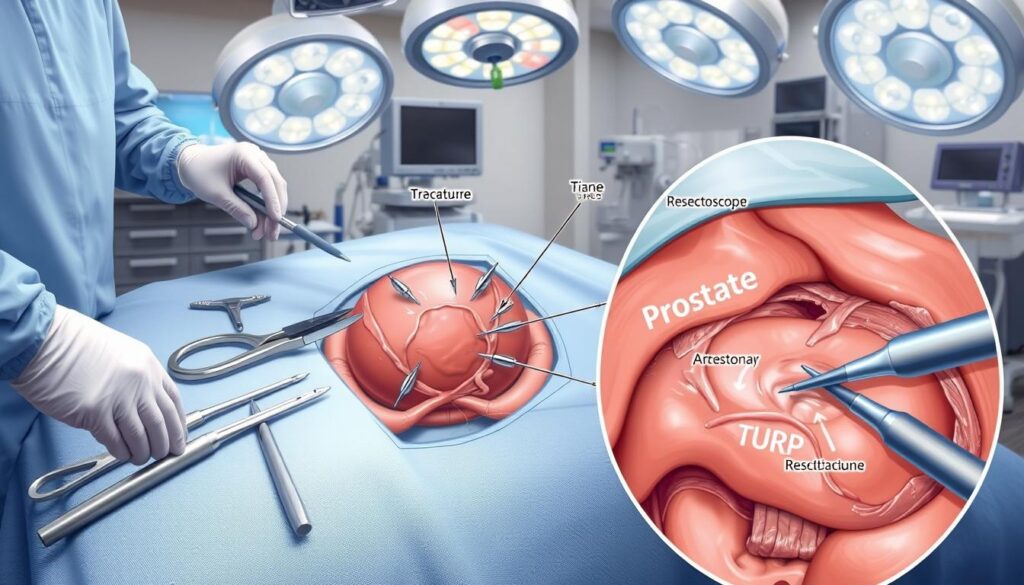
Urinary obstruction from benign prostatic hyperplasia (BPH) can be tough. TURP offers a surgical fix for men with moderate to severe prostate-related urinary issues1. It’s a beacon of hope for those seeking relief from stubborn symptoms1.
TURP might be your solution if you have ongoing urinary problems. The procedure removes excess prostate tissue to improve urine flow1. It usually takes 60 to 90 minutes and may require a brief hospital stay23.
Surgeons use a special tool called a resectoscope during TURP. This instrument helps remove problematic prostate tissue, easing urinary blockages3. The aim is to provide lasting relief and boost your quality of life1.
Key Takeaways
- TURP is an effective surgical treatment for enlarged prostate
- The procedure typically takes 60-90 minutes
- Patients usually stay in the hospital for 1-2 days
- Recovery can take 1-3 weeks
- Long-term symptom relief is possible
- Multiple treatment options are available for prostate issues
- Consultation with a healthcare professional is crucial
Understanding Transurethral Resection of the Prostate (TURP)
Prostate health is crucial for aging men. TURP is a minimally invasive treatment for prostate issues. It effectively addresses prostate-related problems without major surgery4.
What is TURP?
TURP is a surgery that removes problematic prostate tissue. Doctors use a resectoscope to access the prostate through the urethra.
This method allows precise tissue removal without external cuts5. It’s an efficient way to treat prostate issues.
Why is TURP Performed?
TURP treats urinary symptoms caused by an enlarged prostate. These symptoms can greatly affect daily life.
- Weak urine flow
- Frequent urination
- Difficulty starting urination
- Waking up multiple times at night to urinate
70-80% of men in their 60s and 70s experience benign prostatic hyperplasia (BPH). TURP offers relief for many6.
Who is a Good Candidate for TURP?
Good candidates for TURP are men with specific conditions. These include moderate to severe urinary symptoms and lack of response to medication.
- Have moderate to severe urinary symptoms
- Have not responded well to medication
- Experience recurring urinary tract infections
- Have prostate sizes between 30-100 grams6
“TURP can significantly improve quality of life for men struggling with prostate-related urinary issues.”
TURP typically takes 1-2 hours to complete. Patients usually stay in the hospital for 1-3 days4.
Your doctor can help decide if TURP is right for you. They’ll consider your symptoms and overall health.
The TURP Procedure: What to Expect
Understanding the TURP process can ease your worries. This guide will walk you through the key steps of your surgical journey. You’ll learn about preparation, the procedure, and recovery.
Pre-Operative Preparation
Your TURP prep starts weeks before surgery. You’ll have a pre-admission appointment to check your fitness for the procedure3. Your medical team will provide specific instructions.
These may include:
- Stop eating and drinking 6 hours before surgery3
- Potentially receive compression stockings to prevent blood clots3
- Discuss medication adjustments with your doctor
The Surgery Explained
https://www.youtube.com/watch?v=aBelQBJNDNM
During TURP, your surgeon uses a resectoscope to remove prostate tissue. This helps improve urine flow. The surgery usually takes up to one hour3.
You’ll be under anesthesia, so you won’t feel any discomfort. Your surgeon will focus on removing the tissue that’s blocking urine flow.
Post-Operative Care and Recovery
After surgery, expect a hospital stay of 1-3 days7. Catheterization is normal. It helps your body heal and manage urinary function.
Your recovery will involve several key steps:
- Rest and limited physical activity for 2 weeks7
- Drink 8-10 glasses of fluids daily7
- Avoid heavy lifting and strenuous activities8
- Follow your doctor’s guidance on sexual activity8
“Patient recovery is a gradual process that requires patience and careful adherence to medical advice.”
Most patients return to work within 1-3 weeks8. Remember, each recovery is unique. Keep open communication with your healthcare provider throughout the process8.
[Source 1: Patient Recovery Statistics]3[Source 2: Surgical Preparation Guidelines]7[Source 3: Post-Operative Care Recommendations]
Benefits and Risks of TURP
Transurethral Resection of the Prostate (TURP) offers significant urinary symptom relief for men with persistent prostate issues. Understanding its benefits and risks is vital for making an informed decision9.
TURP provides long-lasting results for urinary function, improving quality of life. Most men lose the ability to ejaculate semen after TURP, resulting in retrograde ejaculation10.
This condition doesn’t affect your ability to have an erection or experience orgasm. Your sexual health remains intact11.
TURP is generally safe, but potential complications exist. Erectile dysfunction is rare, and temporary urinary incontinence usually resolves within weeks10.
Other risks include bladder injury, bleeding, and infection. These depend on individual health conditions9.
Long-term outcomes are typically positive, with many patients reporting improved urinary symptoms. Your doctor can suggest alternatives like laser ablation or UroLift if TURP isn’t suitable11.
Regular follow-up care ensures continued prostate health and addresses any ongoing concerns.
FAQ
What is a Transurethral Resection of the Prostate (TURP)?
TURP is a minimally invasive surgery for urinary problems caused by an enlarged prostate. Doctors use a resectoscope to remove excess prostate tissue through the urethra. This improves urine flow and eases symptoms of benign prostatic hyperplasia (BPH).
How long does the TURP procedure typically take?
TURP surgery usually lasts 60 to 90 minutes. You’ll be under anesthesia during the procedure. Most patients stay in the hospital for 1 to 2 days for monitoring.
Who is a good candidate for TURP?
TURP may be right for you if medications haven’t helped your moderate to severe urinary symptoms. It’s also an option if you have urinary retention or frequent infections.
Common symptoms include frequent urination, trouble starting to pee, and a weak urine stream. Incomplete bladder emptying is another sign that TURP might help.
What are the potential risks of TURP?
TURP is generally safe, but it does have some risks. These include bleeding, urinary tract infections, and retrograde ejaculation. Rarely, erectile dysfunction or urinary incontinence may occur.
Your urologist can explain how these risks might apply to your specific health situation.
How long do the benefits of TURP last?
TURP benefits can last 15 years or more for many patients. Most men see big improvements in urinary function and quality of life. However, the prostate may continue to grow, so some men might need more treatment later.
What is the recovery process like after TURP?
After TURP, you’ll usually have a catheter for 1-3 days. Recovery involves drinking lots of fluids and avoiding hard activities for 4-6 weeks. You should also avoid sex during this time.
You may have temporary symptoms like frequent or urgent urination. These usually get better over time.
How should I prepare for TURP surgery?
To prepare for TURP, stop taking blood-thinning medications and fast before surgery. You might also need to take antibiotics. Your doctor will give you specific instructions based on your health.
What alternative treatments are available if TURP isn’t right for me?
Other treatments for BPH include medications and minimally invasive procedures like UroLift or Rezum. Laser therapy and open prostate surgery are also options. Your urologist can help choose the best treatment for you.
Source Links
- Transurethral resection of the prostate (TURP) – https://www.mayoclinic.org/tests-procedures/turp/about/pac-20384880
- Learning About Transurethral Resection of the Prostate (TURP) – https://myhealth.alberta.ca/Health/aftercareinformation/pages/conditions.aspx?hwid=zc2623
- Transurethral resection of the prostate (TURP) – How it’s performed – https://www.nhs.uk/conditions/transurethral-resection-of-the-prostate-turp/what-happens/
- Transurethral resection of the prostate Information | Mount Sinai – https://www.mountsinai.org/health-library/surgery/transurethral-resection-of-the-prostate
- Transurethral resection of the prostate (TURP) – https://www.nhsinform.scot/tests-and-treatments/surgical-procedures/transurethral-resection-of-the-prostate-turp/
- Transurethral Resection of the Prostate – StatPearls – https://www.ncbi.nlm.nih.gov/books/NBK560884/
- TURP Surgery (Transurethral Resection of the Prostate) for BPH – https://www.urologysanantonio.com/bph-enlarged-prostate/turp-surgery/
- What to Expect at Home – https://myhealth.alberta.ca/Health/aftercareinformation/pages/conditions.aspx?hwid=zc2627
- Transurethral Resection of the Prostate (TURP) – https://www.urmc.rochester.edu/encyclopedia/content.aspx?contenttypeid=92&contentid=P09349
- Transurethral resection of the prostate (TURP) – https://www.nhs.uk/conditions/transurethral-resection-of-the-prostate-turp/
- Transurethral Resection of the Prostate (TURP) | Veterans Affairs – https://www.veteranshealthlibrary.va.gov/3,83040

