
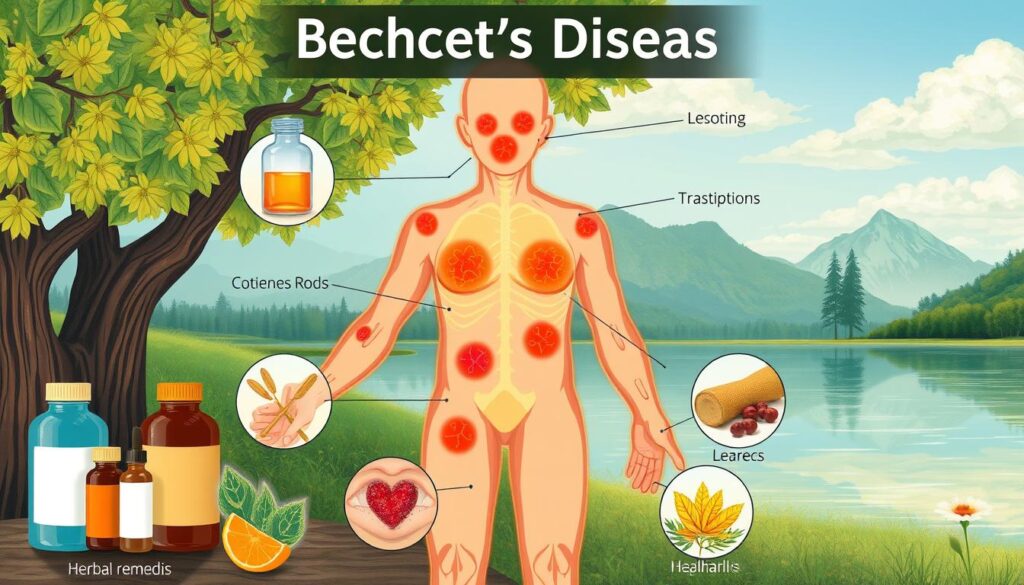
Behcet’s disease is a rare autoimmune disorder that affects blood vessels throughout your body. It creates a range of symptoms impacting multiple organ systems1. Understanding this complex condition is crucial for effective management.
The disease usually appears in young adults between their 20s and 30s1. People from Turkey, Iran, Japan, and China are more likely to develop it1. Men often face more severe symptoms1.
Behcet’s disease can cause recurring mouth sores, eye inflammation, and skin lesions1. Almost every patient experiences mouth sores, which are a key diagnostic sign2. Early recognition and proper medical care are vital due to unpredictable symptoms.
Key Takeaways
- Behcet’s disease is a rare autoimmune disorder affecting blood vessels
- Symptoms typically emerge in young adults aged 20-30
- Multiple body systems can be impacted by this condition
- Geographic origin can influence disease prevalence
- Comprehensive medical management is crucial for symptom control
Understanding Behcet’s Disease: Causes and Risk Factors
Behcet’s disease is a complex autoimmune disorder that baffles medical researchers worldwide. Scientists have uncovered important insights into this rare vasculitis condition. Yet, its exact origins remain a mystery.
The disease develops through a mix of genetic and environmental triggers. These factors impact your body’s immune system. Your genes can greatly influence your chances of developing this condition3.
Genetic Factors in Behcet’s Disease
Genetic predisposition plays a key role in Behcet’s disease. Researchers have found specific genetic markers that increase susceptibility.
- HLA-B51 genetic marker is found in approximately 60% of patients4
- Some individuals have a familial tendency to develop the disease4
- Genetic variations can make you more vulnerable to immune system dysfunction
Environmental Triggers
Environmental factors can activate the disease in genetically susceptible individuals. These triggers might include:
- Viral infections
- Bacterial exposures
- Geographical location and climate
Global Distribution and Demographics
| Region | Prevalence | Key Characteristics |
|---|---|---|
| Turkey | 80-370 cases per 100,000 | Highest worldwide prevalence4 |
| Japan | High prevalence | Significant regional concentration5 |
| Middle East | Higher incidence | More severe symptoms in males3 |
| United Kingdom | 0.64 cases per 100,000 | Relatively rare occurrence4 |
Your risk of Behcet’s disease rises if you’re between 20-40 years old. In certain regions, males often experience more severe symptoms53.
Understanding your genetic background and potential environmental exposures can help you and your healthcare provider manage this complex autoimmune disorder effectively.
Key Symptoms and Warning Signs
Behçet’s disease shows various symptoms that differ among people. Spotting these signs early is key for managing the condition6. The disease usually starts in young adults, often in their 20s and 30s6.
Mouth sores are the main sign of Behçet’s disease, affecting nearly all patients7. These painful ulcers often come back and can make daily life tough. For a clear diagnosis, patients need at least three mouth ulcer episodes in a year6.
- Mouth sores: Frequent and painful
- Eye inflammation: Affects approximately 70% of patients7
- Genital sores: Painful and common in both men and women7
- Skin lesions: Including erythema nodosum and pseudofolliculitis7
Joint problems are common in Behçet’s disease. Arthritis often hits the knees, ankles, wrists, and small hand joints. It affects about half of all patients, causing pain and making movement hard7.
“Understanding your symptoms is the first step toward effective management of Behçet’s disease.”
Other issues can include eye swelling, blood vessel problems, and brain-related symptoms. Some patients may feel very tired, which can disrupt their daily life7.
| Symptom Category | Prevalence | Impact |
|---|---|---|
| Mouth Ulcers | Almost Universal | High Pain, Recurrent |
| Eye Inflammation | 70% | Potential Vision Disruption |
| Joint Inflammation | 50% | Mobility Challenges |
Note: If you experience persistent or recurring symptoms, consult a healthcare professional for proper evaluation and diagnosis.
Treatment Strategies and Medical Interventions
Behçet’s disease management requires a tailored approach to your symptoms and disease progression. The goal is to control inflammation and prevent complications. Your treatment plan aims to improve your quality of life8.
Your healthcare team will create a personalized plan to address your condition. This plan may include various interventions to tackle the complex nature of Behçet’s disease8.
Corticosteroid Treatments
Corticosteroids are key in managing Behçet’s disease symptoms. These medications come in creams, pills, and injections. They reduce inflammation and provide quick relief8.
- Potential side effects include weight gain
- Risk of ulcers
- Possible mood changes
- Increased infection susceptibility
Immunosuppressive Medications
Immunosuppressants control your overactive immune system. Drugs like azathioprine, ciclosporin, and tacrolimus help stop inflammation. These medications are crucial in managing Behçet’s disease8.
| Medication | Primary Purpose | Potential Side Effects |
|---|---|---|
| Azathioprine | Reduce inflammation | Blood cell alterations |
| Ciclosporin | Suppress immune response | Liver function changes |
| Tacrolimus | Control immune activity | Increased infection risk |
Biological Therapies
Biological therapies offer targeted treatment for severe cases. TNF inhibitors like infliximab and adalimumab focus on specific inflammatory processes. These drugs help when traditional treatments don’t work8.
Topical Treatments
Topical treatments provide relief for specific symptoms. Corticosteroid creams, gels, and mouthwashes help with mouth and genital ulcers. These treatments offer localized relief for Behçet’s disease symptoms9.
Effective management requires a multidisciplinary approach, with specialists collaborating to create the most appropriate treatment strategy10.
Remember that your treatment plan will be unique to your specific symptoms and disease progression.
Conclusion
Behçet’s disease management requires a comprehensive approach. Ongoing research reveals new insights into genetic factors influencing the condition11. The HLA-B*51 gene is crucial, with a 60% association across ethnic groups11.
Quality of life is vital in Behçet’s disease treatment. Recent studies show promising developments in therapeutic approaches12. Apremilast has improved quality of life measures, offering hope for effective management12.
Collaborating with healthcare professionals is key for personalized treatment plans. Advanced medical understanding and targeted therapies can help manage symptoms effectively. A proactive approach is essential for Behçet’s disease management.
Future medical research promises more advanced treatment options. Genetic studies have uncovered insights into the MEFV gene and potential environmental triggers11. Stay informed and engaged with your healthcare team to navigate Behçet’s disease confidently.
FAQ
What is Behcet’s Disease?
Behcet’s Disease is a rare autoimmune disorder. It causes inflammation of blood vessels throughout the body. This condition affects multiple systems, including skin, eyes, joints, and more.
Symptoms include recurrent mouth sores, eye inflammation, and skin lesions. Genital sores, digestive issues, and brain inflammation may also occur.
Who is most likely to develop Behcet’s Disease?
Behcet’s Disease typically affects people in their 20s and 30s. It’s more common in Middle Eastern and East Asian countries. Men often experience more severe symptoms.
Genetic and environmental factors contribute to its development. However, the exact cause remains unknown.
What are the most common symptoms of Behcet’s Disease?
Common symptoms include painful mouth sores similar to canker sores. Eye inflammation causing redness and blurred vision is also frequent. Skin lesions and genital sores are other typical signs.
Patients may experience joint swelling and pain. This often affects knees, ankles, elbows, or wrists.
How is Behcet’s Disease diagnosed?
There’s no specific test for Behcet’s Disease. Diagnosis relies on clinical signs and symptoms. Doctors evaluate recurring symptoms like mouth sores and eye inflammation.
Various tests may be conducted to rule out other conditions.
What treatments are available for Behcet’s Disease?
Treatment focuses on managing symptoms and preventing complications. Options include corticosteroids to control inflammation. Immunosuppressants like azathioprine and ciclosporin are also used.
Biological therapies such as TNF inhibitors may be prescribed. Topical treatments for mouth and genital ulcers are available. Treatment plans are personalized based on individual symptoms.
Can Behcet’s Disease be cured?
Currently, there’s no cure for Behcet’s Disease. However, proper management can significantly improve patients’ quality of life. Treatment strategies focus on controlling symptoms and reducing inflammation.
A comprehensive, multidisciplinary approach helps prevent serious complications.
What complications can Behcet’s Disease cause?
Potential complications include vision loss and blood vessel inflammation. This can lead to aneurysms or blockages. Digestive system issues like abdominal pain and bleeding may occur.
Brain inflammation can cause headaches, fever, or stroke-like symptoms. Regular monitoring and early treatment are crucial to prevent serious complications.
How does Behcet’s Disease affect daily life?
Behcet’s Disease can significantly impact daily life. Patients may experience periods of active disease followed by remission. Managing the condition requires close cooperation with healthcare professionals.
Adjusting medications and developing coping strategies are essential. These help patients navigate the challenges of recurring symptoms.
Source Links
- Behcet’s disease – Symptoms and causes – https://www.mayoclinic.org/diseases-conditions/behcets-disease/symptoms-causes/syc-20351326
- Behcet’s disease – Diagnosis and treatment – https://www.mayoclinic.org/diseases-conditions/behcets-disease/diagnosis-treatment/drc-20351331
- Behcet’s Syndrome: What to Know – https://www.webmd.com/skin-problems-and-treatments/behcet-syndrome
- Behcet’s disease – PMC – https://pmc.ncbi.nlm.nih.gov/articles/PMC6297594/
- Behcet Disease | Northwestern Medicine – https://www.nm.org/conditions-and-care-areas/rheumatology/vasculitis-center/Behcets-disease
- Behçet’s disease – https://www.nhs.uk/conditions/behcets-disease/
- Behçet’s disease – Symptoms – https://www.nhs.uk/conditions/behcets-disease/symptoms/
- Behçet’s disease – Treatment – https://www.nhs.uk/conditions/behcets-disease/treatment/
- Behçet’s Disease, Pathogenesis, Clinical Features, and Treatment Approaches: A Comprehensive Review – https://pmc.ncbi.nlm.nih.gov/articles/PMC11051811/
- Treatment of Behçet’s Disease: An Algorithmic Multidisciplinary Approach – https://pmc.ncbi.nlm.nih.gov/articles/PMC8115406/
- Behçet’s disease – Arthritis Research & Therapy – https://arthritis-research.biomedcentral.com/articles/10.1186/ar757
- Impact of apremilast on quality of life in Behçet’s syndrome: analysis of the phase 3 RELIEF study – https://rmdopen.bmj.com/content/8/2/e002235

